

CXC Home | Search | Help | Image Use Policy | Latest Images | Privacy | Accessibility | Glossary | Q&A
1. Chandra's Archives Come to Life
QuicktimeMPEG Audio Only
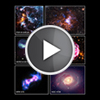
Every year, NASA's Chandra X-ray Observatory looks at hundreds of objects throughout space to help expand our understanding of the Universe. Ultimately, these data are stored in the Chandra Data Archive, an electronic repository that provides access to these unique X-ray findings for anyone who would like to explore them. With the passing of Chandra's 15th anniversary, in operation since August 26, 1999, the archive continues to grow as each successive year adds to the enormous and invaluable dataset.
To celebrate Chandra's decade and a half in space, and to honor October as American Archive Month, a variety of objects have been selected from Chandra's archive. Each of the new images we have produced combines Chandra data with those from other telescopes. This technique of creating "multiwavelength" images allows scientists and the public to see how X-rays fit with data of other types of light, such as optical, radio, and infrared. As scientists continue to make new discoveries with the telescope, the burgeoning archive will allow us to see the high-energy Universe as only Chandra can.
[Runtime: 01:27]
(NASA/CXC/A. Hobart)
Related Chandra Images:
QuicktimeMPEG Audio Only
- Audio (1.2 MB)
Every year, NASA's Chandra X-ray Observatory looks at hundreds of objects throughout space to help expand our understanding of the Universe. Ultimately, these data are stored in the Chandra Data Archive, an electronic repository that provides access to these unique X-ray findings for anyone who would like to explore them. With the passing of Chandra's 15th anniversary, in operation since August 26, 1999, the archive continues to grow as each successive year adds to the enormous and invaluable dataset.
To celebrate Chandra's decade and a half in space, and to honor October as American Archive Month, a variety of objects have been selected from Chandra's archive. Each of the new images we have produced combines Chandra data with those from other telescopes. This technique of creating "multiwavelength" images allows scientists and the public to see how X-rays fit with data of other types of light, such as optical, radio, and infrared. As scientists continue to make new discoveries with the telescope, the burgeoning archive will allow us to see the high-energy Universe as only Chandra can.
[Runtime: 01:27]
(NASA/CXC/A. Hobart)
Related Chandra Images:
- Photo Album: Chandra Archive Collection

2. New Look at an Old Friend
QuicktimeMPEG Audio Only
Just weeks after NASA's Chandra X-ray Observatory began operations in 1999, the telescope pointed at Centaurus A (Cen A, for short). This galaxy, at a distance of about 12 million light years from Earth, contains a gargantuan jet blasting away from a central supermassive black hole.
Since then, Chandra has returned its attention to this galaxy, each time gathering more data. And, like an old family photo that has been digitally restored, new processing techniques are providing astronomers with a new look at this old galactic friend.
This new image of Cen A contains data from observations, equivalent to over nine and a half days worth of observing time, taken between 1999 and 2012. In this image, the lowest-energy X-rays Chandra detects are in red, while the medium-energy X-rays are green, and the highest-energy ones are blue.
As in all of Chandra's images of Cen A, this one shows the spectacular jet of outflowing material that is generated by the giant black hole at the galaxy's center. The new image also highlights a dust lane that wraps around the waist of the galaxy. Astronomers think this feature is a remnant of a collision that Cen A experienced with a smaller galaxy millions of years ago.
In addition to allowing for the creation of new images, the data housed in Chandra's extensive archive on Cen A provide a rich resource for a wide range of scientific investigations. For example, just last year researchers published new findings on the point-like X-ray sources in Cen A. They found that these sources had masses that fell into two categories. These separate groups correspond to systems where either a neutron star or a black hole is pulling material from a companion star. Information like this may tell us important details about the way the massive stars explode, and gives us even more reason to appreciate this new view of a familiar object.
[Runtime: 02:22]
(NASA/CXC/A. Hobart)
Related Chandra Images:
QuicktimeMPEG Audio Only
- Audio (2.1 MB)
Just weeks after NASA's Chandra X-ray Observatory began operations in 1999, the telescope pointed at Centaurus A (Cen A, for short). This galaxy, at a distance of about 12 million light years from Earth, contains a gargantuan jet blasting away from a central supermassive black hole.
Since then, Chandra has returned its attention to this galaxy, each time gathering more data. And, like an old family photo that has been digitally restored, new processing techniques are providing astronomers with a new look at this old galactic friend.
This new image of Cen A contains data from observations, equivalent to over nine and a half days worth of observing time, taken between 1999 and 2012. In this image, the lowest-energy X-rays Chandra detects are in red, while the medium-energy X-rays are green, and the highest-energy ones are blue.
As in all of Chandra's images of Cen A, this one shows the spectacular jet of outflowing material that is generated by the giant black hole at the galaxy's center. The new image also highlights a dust lane that wraps around the waist of the galaxy. Astronomers think this feature is a remnant of a collision that Cen A experienced with a smaller galaxy millions of years ago.
In addition to allowing for the creation of new images, the data housed in Chandra's extensive archive on Cen A provide a rich resource for a wide range of scientific investigations. For example, just last year researchers published new findings on the point-like X-ray sources in Cen A. They found that these sources had masses that fell into two categories. These separate groups correspond to systems where either a neutron star or a black hole is pulling material from a companion star. Information like this may tell us important details about the way the massive stars explode, and gives us even more reason to appreciate this new view of a familiar object.
[Runtime: 02:22]
(NASA/CXC/A. Hobart)
Related Chandra Images:
- Photo Album: Centaurus A
3. Simulation of Black Hole Ejection
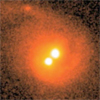
QuicktimeMPEG This simulation shows a collision between a pair of spiral galaxies leading to a merger between their supermassive black holes and an ejection of the new black hole that forms. This represents a model for the formation and evolution of the exotic X-ray source CID-42.
The galaxy collision causes long tails of stars to be thrown out of each galaxy. After the collision the two black holes (labelled by circles) initially located at the center of each galaxy orbit around each other until they eventually merge. The newly formed black hole recoils from the directional emission of gravitational waves produced by the collision, giving the newly merged black hole a sufficiently large kick for it to eventually escape from the galaxy. The simulation freezes briefly to make a comparison with the HST optical image, at a time about 6 million years after the merger. The speed of the black hole at this time is over three million miles per hour, compared to the escape velocity of the galaxy of only about 1.7 million miles per hour.
The masses of the two galaxies are about 450 billion and 230 billion times the mass of the sun, with stars forming throughout the simulation. The masses of the two black holes just before they merge are about 5.4 and 4.3 million times the mass of the sun, giving a total of about 10 million solar masses for the new black hole. Both black holes grow considerably during the galaxy collision. The total duration of the movie is 2 billion years, with the merger and ejection of the black hole occurring after 1.9 billion years. The movie runs at half speed after the merger so the eye can track the black hole flying out of the galaxy. The recoiling black hole could be detectable, by radiation from material in a surrounding disk, for several million years after the time of the observation. By the end of the simulation, the BH has virtually exhausted its gas supply and is moving, invisible, through intergalactic space.
[Runtime: 00.29]
(Laura Blecha)
Related Chandra Images:
QuicktimeMPEG This simulation shows a collision between a pair of spiral galaxies leading to a merger between their supermassive black holes and an ejection of the new black hole that forms. This represents a model for the formation and evolution of the exotic X-ray source CID-42.
The galaxy collision causes long tails of stars to be thrown out of each galaxy. After the collision the two black holes (labelled by circles) initially located at the center of each galaxy orbit around each other until they eventually merge. The newly formed black hole recoils from the directional emission of gravitational waves produced by the collision, giving the newly merged black hole a sufficiently large kick for it to eventually escape from the galaxy. The simulation freezes briefly to make a comparison with the HST optical image, at a time about 6 million years after the merger. The speed of the black hole at this time is over three million miles per hour, compared to the escape velocity of the galaxy of only about 1.7 million miles per hour.
The masses of the two galaxies are about 450 billion and 230 billion times the mass of the sun, with stars forming throughout the simulation. The masses of the two black holes just before they merge are about 5.4 and 4.3 million times the mass of the sun, giving a total of about 10 million solar masses for the new black hole. Both black holes grow considerably during the galaxy collision. The total duration of the movie is 2 billion years, with the merger and ejection of the black hole occurring after 1.9 billion years. The movie runs at half speed after the merger so the eye can track the black hole flying out of the galaxy. The recoiling black hole could be detectable, by radiation from material in a surrounding disk, for several million years after the time of the observation. By the end of the simulation, the BH has virtually exhausted its gas supply and is moving, invisible, through intergalactic space.
[Runtime: 00.29]
(Laura Blecha)
Related Chandra Images:
- Photo Album: CID-42
4. X-ray and Optical Images of NGC 3393
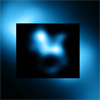
QuicktimeMPEG This sequence shows images of NGC 3393, a spiral galaxy with a pair of supermassive black holes likely left behind after a merger with another galaxy. The first image is a composite of X-rays from Chandra (blue) and optical data from the Hubble Space Telescope (orange and yellow). Zooming into the galaxy’s central region, the view transitions to observations from only Chandra. Two separate peaks of X- ray emission (roughly at 11 o'clock and 4 o'clock) can clearly be seen. These two sources are actively growing black holes a mere 490 light years apart. Because X-rays are generated as gas falls towards the black holes and becomes hotter, astronomers were able to detect the black holes in the Chandra data.
[Runtime: 00:20]
(NASA/CXC/A. Hobart)
Related Chandra Images:
QuicktimeMPEG This sequence shows images of NGC 3393, a spiral galaxy with a pair of supermassive black holes likely left behind after a merger with another galaxy. The first image is a composite of X-rays from Chandra (blue) and optical data from the Hubble Space Telescope (orange and yellow). Zooming into the galaxy’s central region, the view transitions to observations from only Chandra. Two separate peaks of X- ray emission (roughly at 11 o'clock and 4 o'clock) can clearly be seen. These two sources are actively growing black holes a mere 490 light years apart. Because X-rays are generated as gas falls towards the black holes and becomes hotter, astronomers were able to detect the black holes in the Chandra data.
[Runtime: 00:20]
(NASA/CXC/A. Hobart)
Related Chandra Images:
- Photo Album: NGC 3393
5. Multiwavelength Views of NGC 4151
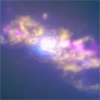
QuicktimeMPEG These images feature the central region of the spiral galaxy NGC 4151. In the pupil of the "eye," X-rays (blue) from Chandra are combined with optical data (yellow) showing positively charged hydrogen. The red around the pupil reveals neutral hydrogen detected by radio observations. Next, we zoom in to a close-up of the central region of the galaxy. The dimensions of the close-up are only 2,000 light years across. Here, the Chandra X-ray data from the larger image are shown in blue, and we add in radio data from the VLA (purple) and HST data (yellow) showing oxygen emission. The linear structures show clear evidence for an earlier outburst from a supermassive black hole at the center of the galaxy.
[Runtime: 0.30]
(X-ray: NASA/CXC/CfA/J.Wang et al.; Optical: Isaac Newton Group of Telescopes, La Palma/Jacobus Kapteyn Telescope, Radio: NSF/NRAO/VLA)
Related Chandra Images:
QuicktimeMPEG These images feature the central region of the spiral galaxy NGC 4151. In the pupil of the "eye," X-rays (blue) from Chandra are combined with optical data (yellow) showing positively charged hydrogen. The red around the pupil reveals neutral hydrogen detected by radio observations. Next, we zoom in to a close-up of the central region of the galaxy. The dimensions of the close-up are only 2,000 light years across. Here, the Chandra X-ray data from the larger image are shown in blue, and we add in radio data from the VLA (purple) and HST data (yellow) showing oxygen emission. The linear structures show clear evidence for an earlier outburst from a supermassive black hole at the center of the galaxy.
[Runtime: 0.30]
(X-ray: NASA/CXC/CfA/J.Wang et al.; Optical: Isaac Newton Group of Telescopes, La Palma/Jacobus Kapteyn Telescope, Radio: NSF/NRAO/VLA)
Related Chandra Images:
- Photo Album: NGC 4151
6. Animation of Changes in the X-ray Spectrum
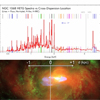
QuicktimeMPEG This animation shows some of the detailed observations used to study the powerful winds in NGC 1068. It begins with a view of the composite image then rotates the view so that the radio jet runs from left to right. The changes in the X-ray spectrum about 3000 light years on either side of the central black hole are then shown. Detailed models applied to these data have allowed the speed and energy of the winds to be estimated.
[Runtime: 0:13]
(X-ray (NASA/CXC/MIT/C.Canizares, D.Evans et al), Optical (NASA/STScI), Radio (NSF/NRAO/VLA))
Related Chandra Images:
QuicktimeMPEG This animation shows some of the detailed observations used to study the powerful winds in NGC 1068. It begins with a view of the composite image then rotates the view so that the radio jet runs from left to right. The changes in the X-ray spectrum about 3000 light years on either side of the central black hole are then shown. Detailed models applied to these data have allowed the speed and energy of the winds to be estimated.
[Runtime: 0:13]
(X-ray (NASA/CXC/MIT/C.Canizares, D.Evans et al), Optical (NASA/STScI), Radio (NSF/NRAO/VLA))
Related Chandra Images:
- Photo Album: NGC 1068
7. Composite Image of NGC 1068
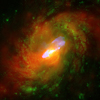
QuicktimeMPEG This is a composite image of NGC 1068, one of the nearest and brightest galaxies containing a rapidly growing supermassive black hole. X-ray data from the Chandra X-ray Observatory are shown in red, optical data from the Hubble Space Telescope in green and radio data from the Very Large Array in blue. The spiral structure of NGC 1068 is shown by the X-ray and optical data, and a jet powered by the central supermassive black hole is shown by the radio data. The Chandra data shows evidence for powerful winds blown from the vicinity of the black hole. These winds contain enough energy to suppress new star formation in NGC 1068.
[Runtime: 0:13]
(X-ray (NASA/CXC/MIT/C.Canizares, D.Evans et al), Optical (NASA/STScI), Radio (NSF/NRAO/VLA))
Related Chandra Images:
QuicktimeMPEG This is a composite image of NGC 1068, one of the nearest and brightest galaxies containing a rapidly growing supermassive black hole. X-ray data from the Chandra X-ray Observatory are shown in red, optical data from the Hubble Space Telescope in green and radio data from the Very Large Array in blue. The spiral structure of NGC 1068 is shown by the X-ray and optical data, and a jet powered by the central supermassive black hole is shown by the radio data. The Chandra data shows evidence for powerful winds blown from the vicinity of the black hole. These winds contain enough energy to suppress new star formation in NGC 1068.
[Runtime: 0:13]
(X-ray (NASA/CXC/MIT/C.Canizares, D.Evans et al), Optical (NASA/STScI), Radio (NSF/NRAO/VLA))
Related Chandra Images:
- Photo Album: NGC 1068
8. Important features of Centaurus A
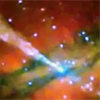
QuicktimeMPEG This short movie highlights some of the important features of the Chandra X-ray Observatory image of Centaurus A. The entire Chandra image is shown, followed by a zoom into the center of the galaxy where the active nucleus and the launching point for a jet are featured. Particles in the jet and radiation from the active nucleus are both powered by a supermassive black hole. The movie then pans to the upper left to show more of the jet, followed by a view of the shorter "counterjet" pointed in the opposite direction.
[Runtime: 0:30]
(NASA/CXC/CfA/R.Kraft et al)
Related Chandra Images:
QuicktimeMPEG This short movie highlights some of the important features of the Chandra X-ray Observatory image of Centaurus A. The entire Chandra image is shown, followed by a zoom into the center of the galaxy where the active nucleus and the launching point for a jet are featured. Particles in the jet and radiation from the active nucleus are both powered by a supermassive black hole. The movie then pans to the upper left to show more of the jet, followed by a view of the shorter "counterjet" pointed in the opposite direction.
[Runtime: 0:30]
(NASA/CXC/CfA/R.Kraft et al)
Related Chandra Images:
- Photo Album: Centaurus A
9. Multiwavelength views of Centaurus A
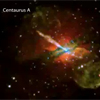
QuicktimeMPEG This sequence of images of the galaxy Centaurus A begins with the deep Chandra X-ray Observatory image, then shows the radio image from the Very Large Array, then the optical image from the ESO's Wide-Field Imager (WFI) camera at the ESO/MPG 2.2-m telescope on La Silla. Finally, a composite image with all three wavelengths is shown.
[Runtime: 0:14]
(X-ray X-ray: NASA/CXC/CfA/R.Kraft et al; Radio: NSF/VLA/Univ.Hertfordshire/M.Hardcastle; Optical: ESO/VLT/ISAAC/M.Rejkuba et al.)
Related Chandra Images:
QuicktimeMPEG This sequence of images of the galaxy Centaurus A begins with the deep Chandra X-ray Observatory image, then shows the radio image from the Very Large Array, then the optical image from the ESO's Wide-Field Imager (WFI) camera at the ESO/MPG 2.2-m telescope on La Silla. Finally, a composite image with all three wavelengths is shown.
[Runtime: 0:14]
(X-ray X-ray: NASA/CXC/CfA/R.Kraft et al; Radio: NSF/VLA/Univ.Hertfordshire/M.Hardcastle; Optical: ESO/VLT/ISAAC/M.Rejkuba et al.)
Related Chandra Images:
- Photo Album: Centaurus A
10. Comparison of 3C321 Composite to Artist's Illustration
QuicktimeMPEG Broadcast:
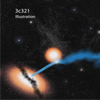
This sequence compares the composite image of 3C321 to an artist's illustration of the system, showing the main galaxy and the companion galaxy. A jet of particles generated by a supermassive black hole at the center of the main galaxy is striking the companion galaxy. The jet is disrupted and deflected by this impact. The key features of this system are labeled in the final view.
[Runtime: 0:14]
(Image: X-ray: NASA/CXC/CfA/D.Evans et al.; Optical/UV: NASA/STScI; Radio: NSF/VLA/CfA/D.Evans et al., STFC/JBO/MERLIN; Illustration: NASA/CXC/M. Weiss)
Related Chandra Images:
QuicktimeMPEG Broadcast:
- QuickTime movie (uncompressed)
- D1 (0.9 pixel aspect ratio)
- 720x486
- 29.97 fps
- file size = (450.5 MB)
This sequence compares the composite image of 3C321 to an artist's illustration of the system, showing the main galaxy and the companion galaxy. A jet of particles generated by a supermassive black hole at the center of the main galaxy is striking the companion galaxy. The jet is disrupted and deflected by this impact. The key features of this system are labeled in the final view.
[Runtime: 0:14]
(Image: X-ray: NASA/CXC/CfA/D.Evans et al.; Optical/UV: NASA/STScI; Radio: NSF/VLA/CfA/D.Evans et al., STFC/JBO/MERLIN; Illustration: NASA/CXC/M. Weiss)
Related Chandra Images:
- Photo Album: 3C321


Revised: December 28, 2022