

CXC Home | Search | Help | Image Use Policy | Latest Images | Privacy | Accessibility | Glossary | Q&A
Exploring The Invisible universe: The Chandra X-ray Observatory
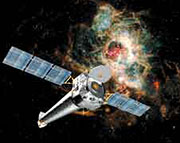
To the human eye, space appears serene and void. It is neither.
To the "eye" of an X-ray telescope, the universe is totally different , a violent, vibrant, and ever-changing place. Temperatures can reach millions of degrees. Objects are accelerated by gravity to nearly the speed of light and magnetic fields more than a trillion times stronger than the Earth's cause some stars to crack and tremble.
NASA's newest space telescope, called the Chandra X-ray Observatory, will allow scientists from around the world to obtain unprecedented X-ray images of these and other exotic environments to help understand the structure and evolution of the universe. The observatory will not only help to probe these mysteries, but also will serve as a unique tool to study detailed physics in a laboratory that cannot be replicated here on Earth , the universe itself. NASA's Chandra X-ray Observatory has every prospect of rewriting textbooks and helping technology advance in the coming decade.
The Chandra X-ray Observatory will provide unique and crucial information on the nature of objects ranging from comets in our solar system to quasars at the edge of the observable universe. The observatory should provide long-sought answers to some major scientific questions, such as:
-
What and where is the "Dark Matter" in our universe? The largest and most massive objects in the universe are galaxy clusters - enormous collections of galaxies, some like our own. These galaxies are bound together into a cluster by gravity. Much of their mass is in the form of an incredibly hot, X-ray emitting gas that fills the entire space between the galaxies. Yet, neither the mass of the galaxies, nor the mass of the hot X-ray gas is enough to provide the gravity that we know holds the cluster together. X-ray observations with the Chandra X-ray Observatory will map the location of the dark matter and help us to identify it.
-
What is the powerhouse driving the explosive activity in many distant galaxies? The centers of many distant galaxies are incredible sources of energy and radiation , especially X-rays. Scientists theorize that massive black holes are at the center of these active galaxies, gobbling up any material , even a whole star , that passes too close. Detailed studies with the Chandra X-ray Observatory can probe the faintest of these active galaxies, and study not only how their energy output changes with time, but also how these objects produce their intense energy emissions in the first place.
Since X-rays are absorbed by the Earth's atmosphere, space-based observatories are necessary to study these phenomena. To meet this scientific challenge, the Chandra X-ray Observatory, NASA's most powerful X-ray telescope, was launched in July 1999. Complementing two other space observatories now orbiting Earth , the Hubble Space Telescope and the Compton Gamma Ray Observatory , this observatory studies X-rays rather than visible light or gamma rays. By capturing images created by these invisible rays, the observatory will allow scientists to analyze some of the greatest mysteries of the universe.
Named in honor of the late Indian-American Nobel Laureate Subrahmanyan Chandrasekhar, the observatory was formerly known as the Advance X-ray Astrophysics Facility. The Chandra X-ray Observatory was carried into low Earth orbit by the Space Shuttle Columbia. The observatory was deployed from the shuttle's cargo bay at 155 miles above the Earth. Two firings of an attached Inertial Upper Stage rocket and several firings of its own on-board rocket motors after separating from the Inertial Upper Stage placed the observatory into its working orbit.
Unlike the Hubble Space Telescope's circular orbit that is relatively close to the Earth, the Chandra X-ray Observatory was placed in a highly elliptical (oval-shaped) orbit. At its closest approach to Earth, the observatory will be at an altitude of about 6,000 miles. At its farthest, 86,400 miles, it travels almost one-third of the way to the Moon. Due to this elliptical orbit, the observatory circles the Earth every 64 hours, carrying it far outside the belts of radiation that surround our planet. This radiation, while harmless to life on Earth, can overwhelm the observatory's sensitive instruments. The X-ray observatory is outside this radiation long enough to take 55 hours of uninterrupted observations during each orbit. During periods of interference from Earth's radiation belts, scientific observations are not taken.
The Chandra X-ray Observatory has three major elements. They are the spacecraft system, the telescope system and the science instruments.
The Spacecraft System
The spacecraft module contains computers, communication
antennas and data recorders to transmit and receive information
between the observatory and ground stations. The onboard
computers and sensors, with ground-based control center
assistance, command and control the vehicle and monitor its
health during its expected five-year lifetime.
The spacecraft module also provides rocket propulsion to move and aim the entire observatory, an aspect camera that tells the observatory its position relative to the stars, and a Sun sensor that protects it from excessive light. Electrical power is provided by solar arrays that also charge three nickel-hydrogen batteries that provide backup power.
The Telescope System
At the heart of the telescope system is the High-Resolution
Mirror Assembly. Since high-energy X-rays would penetrate a
normal mirror, special cylindrical mirrors were created. The
two sets of four nested mirrors resemble tubes within tubes.
Incoming X-rays graze off the highly polished mirror surfaces
and are funneled to the instrument section for detection and
study.
The mirrors of the X-ray observatory are the largest of their kind and the smoothest ever created. If the surface of the state of Colorado were as relatively smooth, Pike's Peak would be less than one inch tall. The largest of the eight mirrors is almost 4 feet in diameter and 3 feet long. Assembled, the mirror group weighs more than 1 ton.
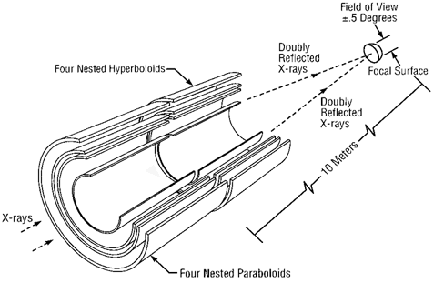
The High-Resolution Mirror Assembly is contained in the cylindrical "telescope" portion of the observatory. The entire length of the telescope is covered with reflective multi-layer insulation that assists heating elements inside the unit in keeping a constant internal temperature. By maintaining a precise temperature, the mirrors within the telescope are not subjected to expansion and contraction , thus ensuring greater accuracy in observations.
The assembled mirrors were tested at NASA's Marshall Space Flight Center in Huntsville, Ala. Marshall's world-class X-ray Calibration Facility verified the mirrors' exceptional accuracy , comparable to the accuracy required to hit a hole-in-one from Los Angeles to San Diego. This achievement allows the observatory to detect objects separated by one-half arc second. This is comparable to reading the letters of a stop sign 12 miles away.
The Chandra X-ray Observatory represents a scientific leap in ability over previous X-ray observatories like NASA's Einstein, which orbited the Earth from 1978 to 1981. With its combination of large mirror area, accurate alignment and efficient X-ray detectors, the Chandra X-ray Observatory has eight times greater resolution and is 20-to-50 times more sensitive than any previous X-ray telescope.
Science Instruments
Within the instrument section of the observatory, two
instruments at the narrow end of the telescope cylinder will
collect X-rays and study them in various ways. Each of the
instruments can serve as an imager or spectrometer.
A High-Resolution Camera will record X-ray images, giving scientists an unequaled look at violent, high-temperature occurrences like the death of stars or colliding galaxies. The High-Resolution Camera is composed of two clusters of 69 million tiny lead-oxide glass tubes. The tubes are only one-twentieth of an inch long and just one-eighth the thickness of a human hair. When X-rays strike the tubes, particles called electrons are released. As the electrons are accelerated down the tubes by high voltage, they cause an avalanche of about 30 million more electrons. A grid of electrically charged wires at the end of the tube detects this flood of particles and allows the position of the original X-ray to be precisely determined. The High-Resolution Camera also complements the Charge-Coupled Device Imaging Spectrometer, described below.
The Chandra X-ray Observatory's Imaging Spectrometer is also located at the narrow end of the observatory. This detector is capable of recording not only the position, but also the color (energy) of the X-rays. The imaging spectrometer is made up of 10 charge-coupled device arrays. These detectors are similar to those used in home video recorders and digital cameras but are designed to detect X-rays. Commands from the ground allow astronomers to select which of the various detectors to use. The imaging spectrometer can distinguish up to 50 different energies within the range the observatory operates. In order to gain even more energy information, two screen-like instruments, called diffraction gratings, can be inserted into the path of the X-rays between the telescope and the detectors. The gratings change the path of the X-ray depending on its color (energy) and the X-ray cameras record the color and position. One grating concentrates on the higher and medium energies and uses the imaging spectrometer as a detector , the other grating disperses low energies and is used in conjunction with the High Resolution Camera.
By studying these X-ray rainbows, or spectra, and recognizing signatures of known elements, scientists can determine the composition of the X-ray producing objects, and learn how the X-rays are produced.
Observatory Operations
The Smithsonian Astrophysical Observatory controls science and
flight operations of the Chandra X-ray Observatory for NASA
from Cambridge, Mass. The Smithsonian manages two
electronically linked facilities , the Operations Control
Center and the Science Center.
The Operations Control Center is responsible for directing the observatory's mission as it orbits Earth. A control center team interacts with the observatory three times a day , receiving science and housekeeping information from its recorders. The control center team also sends new instructions to the observatory as needed, as well as transmit scientific information from the X-ray observatory to the Science Center.
The Science Center is an important resource for scientists who wish to study X-ray emitting celestial objects like quasars and colliding galaxies. The Science Center will provide user support to researchers, including science data processing and a science data archive. The Science Center will work with NASA and the scientific community to allow public access to the scientific results.
NASA and Partners
The Chandra X-ray Observatory program is managed by the
Marshall Center for the Office of Space Science, NASA
Headquarters, Washington, D.C. TRW Space and Electronics Group (now NGST)
of Redondo Beach, Calif., is the prime contractor and has
assembled and tested the observatory for NASA. Using glass
purchased from Schott Glaswerke, Mainz, Germany, the
telescope's mirrors were built by Raytheon Optical Systems
Inc., Danbury, Conn. The mirrors were coated by Optical Coating
Laboratory, Inc., Santa Rosa, Calif., and assembled by Eastman
Kodak Co., Rochester, N.Y.
The Chandra X-ray Observatory Charge-Coupled Device Imaging Spectrometer was developed by Pennsylvania State University, University Park, Pa., and the Massachusetts Institute of Technology (MIT), Cambridge. One diffraction grating was developed by MIT, the other by the Space Research Organization Netherlands, Utrecht, Netherlands, in collaboration with the Max Planck Institute, Garching, Germany. The High Resolution Camera was built by the Smithsonian Astrophysical Observatory. Ball Aerospace & Technologies Corporation of Boulder, Colo., developed the aspect camera and the Science Instrument Module.
Chandra X-ray Observatory Technical Details |
|
| Size | 45.3 feet long x 64.0 feet wide (solar arrays deployed) |
| Weight | 10,560 pounds |
| Life | Minimum 5 years |
| Orbit | 6,000 x 86,400 miles, 64-hour period per orbit |
| Power | Two 3-panel, silicon solar arrays (2,350 watts). Three 40-amp-hour nickel-hydrogen batteries for power in eclipse |
| Data recording | Solid-state recorder; 1.8 gigabits (16.8 hours) of recording capability |
| High-Resolution Mirror Assembly |
4 sets of nested, grazing incidence
paraboloid/hyperboloid mirror pairs, constructed of
Zerodur material - Weight of assembly: 2,104 pounds - Focal length: 10 meters (about 33 feet) - Outer diameter: 1.2 meters (about 4 feet) |
| Charge-coupled Imaging Spectrometer | Ten charge-coupled device arrays provide simultaneous imaging and spectroscopy |
| High-Resolution Camera | Micro-channel plates detect X-ray photons |
| Transmission Gratings | One high/medium- and one low-energy, gold grating |
Top


Revised: May 12, 2008