



CXC Home | Search | Help | Image Use Policy | Latest Images | Privacy | Accessibility | Glossary | Q&A
For Release: August 8, 2006
CXC RELEASE 06-04
A critically important number that specifies the expansion rate of the Universe, the so-called Hubble constant, has been independently determined using NASA's Chandra X-ray Observatory. This new value matches recent measurements using other methods and extends their validity to greater distances, thus allowing astronomers to probe earlier epochs in the evolution of the Universe.
"The reason this result is so significant is that we need the Hubble constant to tell us the size of the Universe, its age, and how much matter it contains," said Max Bonamente from the University of Alabama in Huntsville and NASA's Marshall Space Flight Center (MSFC) in Huntsville, Ala., lead author on the paper describing the results. "Astronomers absolutely need to trust this number because we use it for countless calculations."
The Hubble constant is calculated by measuring the speed at which objects are moving away from us and dividing by their distance. Most of the previous attempts to determine the Hubble constant have involved using a multi-step, or distance ladder, approach in which the distance to nearby galaxies is used as the basis for determining greater distances.
The most common approach has been to use a well-studied type of pulsating star known as a Cepheid variable, in conjunction with more distant supernovae to trace distances across the Universe. Scientists using this method and observations from the Hubble Space Telescope were able to measure the Hubble constant to within 10%. However, only independent checks would give them the confidence they desired, considering that much of our understanding of the Universe hangs in the balance.
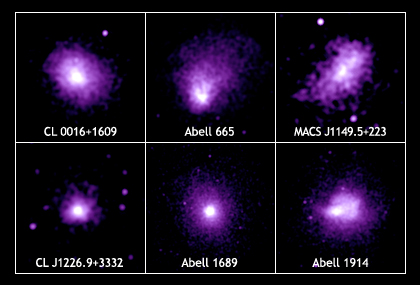
By combining X-ray data from Chandra with radio observations of galaxy clusters, the team determined the distances to 38 galaxy clusters ranging from 1.4 billion to 9.3 billion light years from Earth. These results do not rely on the traditional distance ladder. Bonamente and his colleagues find the Hubble constant to be 77 kilometers per second per megaparsec (a megaparsec is equal to 3.26 million light years), with an uncertainty of about 15%.
This result agrees with the values determined using other techniques. The Hubble constant had previously been found to be 72, give or take 8, kilometers per second per megaparsec based on Hubble Space Telescope observations. The new Chandra result is important because it offers the independent confirmation that scientists have been seeking and fixes the age of the Universe between 12 and 14 billion years.
"These new results are entirely independent of all previous methods of measuring the Hubble constant," said team member Marshall Joy also of MSFC.
The astronomers used a phenomenon known as the Sunyaev-Zeldovich effect, where photons in the cosmic microwave background (CMB) interact with electrons in the hot gas that pervades the enormous galaxy clusters. The photons acquire energy from this interaction, which distorts the signal from the microwave background in the direction of the clusters. The magnitude of this distortion depends on the density and temperature of the hot electrons and the physical size of the cluster.
Using radio telescopes to measure the distortion of the microwave background and Chandra to measure the properties of the hot gas, the physical size of the cluster can be determined. From this physical size and a simple measurement of the angle subtended by the cluster, the rules of geometry can be used to derive its distance. The Hubble constant is determined by dividing previously measured cluster speeds by these newly derived distances.
This project was championed by Chandra's telescope mirror designer, Leon Van Speybroeck, who passed away in 2002. The foundation was laid when team members John Carlstrom (University of Chicago) and Marshall Joy obtained careful radio measurements of the distortions in the CMB radiation using radio telescopes at the Berkeley-Illinois-Maryland Array and the Caltech Owens Valley Radio Observatory. In order to measure the precise X-ray properties of the gas in these distant clusters, a space-based X-ray telescope with the resolution and sensitivity of Chandra was required.
"It was one of Leon's goals to see this project happen, and it makes me very proud to see this come to fruition," said Chandra Project Scientist Martin Weisskopf of MSFC.
The results are described in a paper appearing in the August 10th issue of The Astrophysical Journal. MSFC manages the Chandra program for the agency's Science Mission Directorate. The Smithsonian Astrophysical Observatory controls science and flight operations from the Chandra X-ray Center, Cambridge, Mass.
Additional information and images can be found at:
MEDIA CONTACTS
Steve Roy
Marshall Space Flight Center, Huntsville, Ala.
(Phone: 256/544-6535)
Megan Watzke
Chandra X-ray Center, Cambridge, Mass.
(Phone: 617/496-7998)


Revised: March 27, 2008