



CXC Home | Search | Help | Image Use Policy | Latest Images | Privacy | Accessibility | Glossary | Q&A
April 6, 2006
ASTRONOMY & ASTROPHYSICS JOURNAL RELEASE
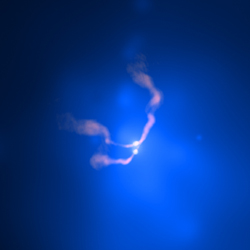
An international team of astrophysicists, led by D. Hudson from the University of Bonn and including the U.S. Naval Research Laboratory and the University of Virginia, presents their X-ray detection of a proto supermassive binary black hole. Their results will be published in an upcoming issue of Astronomy & Astrophysics. The image of this proto binary black hole was obtained with NASA's Chandra X-ray Observatory. The two black holes have already been seen in radio images. The new X-ray images provide unique evidence that these two black holes are in the process of forming a binary system; that is, they are gravitationally bound and orbit each other.
The two black holes are located in the nearby galaxy cluster Abell 400. With high-resolution Chandra data, the team was able to spatially resolve the two supermassive black holes (separated by 15") at the centre of the cluster. Each black hole is located at the centre of its respective host galaxy and the host galaxies appear to be merging. It is not, however, just the two host galaxies that are colliding - the whole cluster in which they live is merging into another neighbouring galaxy cluster.
Using these new data, the team show that the two black holes are moving through the intracluster medium at the supersonic speed of about 1200 km/s. The wind from such a motion would cause the radio plasma emitted from these two black holes to bend backwards. Although this bending had been observed previously, the cause of it was still being debated. Since the bending of the jets due to this motion is in the same direction, it suggests that the two black holes are travelling along the same path within the cluster and are therefore gravitationally bound.
These two black holes became gravitationally bound when their host galaxies collided. In several million years, the two black holes will probably coalesce causing a burst of gravitational waves, as predicted by Einstein's theory of relativity. This event will produce one of the brightest sources of gravitational radiation in the Universe. Although we will not be around to see this particular one, the observations provide additional evidence that such bound systems exist and are currently merging. The gravitational waves produced by these mergers are believed to be the biggest source of gravitational waves to be detected by the future Laser Interferometer Space Antenna (LISA).
Notes to the Editors
The team includes D.S. Hudson (AIfA,Germany), T.H. Reiprich (AIfA,Germany), T.E. Clarke (NRL & Interferometrics Inc.,USA), and C.L. Sarazin (UVa,USA).
X-ray detection of the proto supermassive binary black hole at the centre of Abell 400 by D.S Hudson, T.H. Reiprich, T.E. Clarke, and C.L. Sarazin.
To be published in Astronomy & Astrophysics (DOI number: 10.1051/0004-6361:20064955) Full article available in PDF format.
Electronic edition of the press release available at http://www.edpsciences.org/aa.
© Astronomy & Astrophysics 2006
MEDIA CONTACTS
Dr. Jennifer Martin
Astronomy & Astrophysics
61 avenue de l'Observatoire 75014
Paris, France
Email: aanda.paris (at) obspm.fr
Phone: +33 1 43 29 05 41


Revised: March 25, 2008