


CXC Home | Search | Help | Image Use Policy | Latest Images | Privacy | Accessibility | Glossary | Q&A
April 28, 2005
CXC RELEASE 05-06
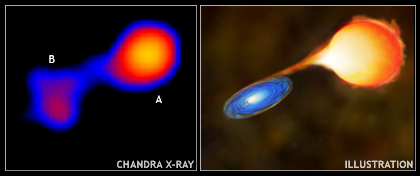
For the first time an X-ray image of a pair of interacting stars has been made by NASA's Chandra X-ray Observatory. The ability to distinguish between the interacting stars - one a highly evolved giant star and the other likely a white dwarf - allowed a team of scientists to observe an X-ray outburst from the giant star and find evidence that a bridge of hot matter is streaming between the two stars.
"Before this observation it was assumed that all the X-rays came from a hot disk surrounding a white dwarf, so the detection of an X-ray outburst from the giant star came as a surprise," said Margarita Karovska of the Harvard-Smithsonian Center for Astrophysics in Cambridge, Mass., and lead author article in the latest Astrophysical Journal Letters describing this work. An ultraviolet image made by the Hubble Space Telescope was a key to identifying the location of the X-ray outburst with the giant star.
X-ray studies of this system, called Mira AB, may also provide better understanding of interactions between other binary systems consisting of a "normal" star and a collapsed star such as a white dwarf, black hole or a neutron star, where the stellar objects and gas flow cannot be distinguished in an image.
The separation of the X-rays from the giant star and the white dwarf was made possible by the superb angular resolution of Chandra, and the relative proximity of the star system at about 420 light years from Earth. The stars in Mira AB are about 6.5 billion miles apart, or almost twice the distance of Pluto from the Sun.
Mira A (Mira) was named "The Wonderful" star in the 17th century because its brightness was observed to wax and wane over a period of about 330 days. Because it is in the advanced, red giant phase of a star's life, it has swollen to about 600 times that of the Sun and it is pulsating. Mira A is now approaching the stage where its nuclear fuel supply will be exhausted, and it will collapse to become a white dwarf.
The internal turmoil in Mira A could create magnetic disturbances in the upper atmosphere of the star and lead to the observed X-ray outbursts, as well as the rapid loss of material from the star in a blustery, strong, stellar wind. Some of the gas and dust escaping from Mira A is captured by its companion Mira B.
In stark contrast to Mira A, Mira B is thought to be a white dwarf star about the size of the Earth. Some of the material in the wind from Mira A is captured in an accretion disk around Mira B, where collisions between rapidly moving particles produce X-rays.
One of the more intriguing aspects of the observations of Mira AB at both X-ray and ultraviolet wavelengths is the evidence for a faint bridge of material joining the two stars. The existence of a bridge would indicate that, in addition to capturing material from the stellar wind, Mira B is also pulling material directly off Mira A into the accretion disk.
Chandra observed Mira with its Advanced CCD Imaging Spectrometer on December 6, 2003 for about 19 hours. NASA's Marshall Space Flight Center, Huntsville, Ala., manages the Chandra program for NASA's Science Mission Directorate, Washington. Northrop Grumman of Redondo Beach, Calif., was the prime development contractor for the observatory. The Smithsonian Astrophysical Observatory controls science and flight operations from the Chandra X-ray Center in Cambridge, Mass.
Additional information and images are available at:
MEDIA CONTACTS
Steve Roy
Marshall Space Flight Center, Huntsville, AL
Phone: 256-544-6535
Megan Watzke
Chandra X-ray Center, CfA, Cambridge, MA
Phone: 617-496-7998


Revised: March 25, 2008