



CXC Home | Search | Help | Image Use Policy | Latest Images | Privacy | Accessibility | Glossary | Q&A
April 6, 2005
NASA RELEASE: 05-093
Distant galaxies undergoing intense bursts of star formation have been shown by NASA's Chandra X-ray Observatory to be fertile growing grounds for the largest black holes in the Universe. Collisions between galaxies in the early Universe may be the ultimate cause for both the accelerated star formation and black hole growth.
By combining the deepest X-ray image ever obtained with submillimeter and optical observations, an international team of scientists has found evidence that some extremely luminous adolescent galaxies and their central black holes underwent a phenomenal spurt of growth more than 10 billion years ago. This concurrent black hole and galaxy growth spurt is only seen in these galaxies and may have set the stage for the birth of quasars - distant galaxies that contain the largest and most active black holes in the Universe.
"The extreme distances of these galaxies allow us to look back in time, and take a snapshot of how today's largest galaxies looked when they were producing most of their stars and growing black holes," said David Alexander of the University of Cambridge, UK, and lead author of a paper in the April 7, 2005 issue of Nature that describes this work.
The galaxies studied by Alexander and his colleagues are known as submillimeter galaxies, so-called because they were originally identified by the James Clerk Maxwell submillimeter telescope (JCMT) on Mauna Kea in Hawaii. The submillimeter observations along with optical data from Keck indicate these galaxies had an unusually large amount of gas. The gas in each galaxy was forming into stars at a rate of about one per day, or 100 times the present rate in the Milky Way galaxy. The Chandra X-ray data show that the supermassive black holes in the galaxies were also growing at the same time.
These galaxies are very faint and it is only with the deepest observations of the Universe that they can be detected at all. "The deeper we look into the Universe with Chandra, the more fascinating things we find" says Niel Brandt of Penn State University in University Park. "Who knows what nature has in store for us as we push the boundaries yet further."
The X-ray observations also showed that the black holes are surrounded by a dense shroud of gas and dust. This is probably the material that will be consumed by the growing black holes.
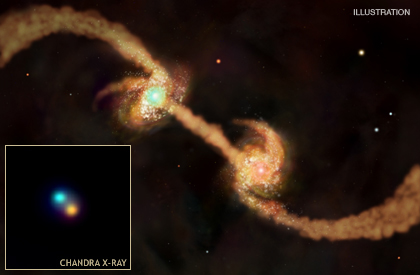
Hubble Space Telescope observations indicate that most of the submillimeter galaxies are actually two galaxies that are colliding and merging. Recent sophisticated computer simulations performed by Tiziana Di Matteo of Carnegie Mellon University in Pittsburgh, Penn., and her collaborators have shown that such mergers drive gas toward the central regions of galaxies, triggering a burst of star formation and providing fuel for the growth of a central black hole.
"It is exciting that these recent observations are in good agreement with our simulation," says Di Matteo, "We seem to be converging on a consistent picture of galaxy formation with both observations and theory." In particular, this work will help scientists to understand the observed link in the present epoch between the total mass of stars in the central bulges of large galaxies and the size of their central, supermassive black holes.
The James Clerk Maxwell Telescope (JCMT) is operated on behalf of the United Kingdom, Canada & Netherlands by the Joint Astronomy Centre. With its 15-meter (50-foot) diameter dish the JCMT detects light with "submillimeter" wavelengths, between infrared light and radio waves on the wavelength scale. The W. M. Keck Observatory is operated by the California Association for Research in Astronomy.
NASA's Marshall Space Flight Center, Huntsville, Ala., manages the Chandra program for NASA's Science Mission Directorate, Washington. Northrop Grumman of Redondo Beach, Calif., was the prime development contractor for the observatory. The Smithsonian Astrophysical Observatory controls science and flight operations from the Chandra X-ray Center in Cambridge, Mass.
Additional information and images are available at:
MEDIA CONTACTS
Dolores Beasley
NASA Headquarters, Washington, DC
(Phone: 202-358-1753)
Steve Roy
Marshall Space Flight Center, Huntsville, AL
Phone: 256-544-6535
Megan Watzke
Chandra X-ray Observatory Center, CFA, Cambridge, MA
Phone: 617-496-7998
cxcpress@cfa.harvard.edu


Revised: March 31, 2008