



CXC Home | Search | Help | Image Use Policy | Latest Images | Privacy | Accessibility | Glossary | Q&A
December 14, 2004
RELEASE: 04-13
A long look at a young pulsar with NASA's Chandra X-ray Observatory revealed unexpectedly rapid cooling, which suggests that it contains much denser matter than previously expected. The pulsar's cool temperature and the vast magnetic web of high-energy particles that surrounds it have implications for the theory of nuclear matter and the origin of magnetic fields in cosmic objects.
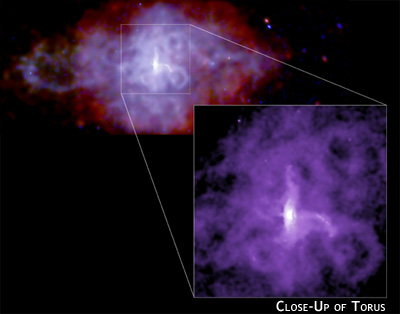
An international team of scientists used the Chandra data to measure the temperature of the pulsar at the center of 3C58, the remains of a star observed to explode in the year 1181. Chandra's image of 3C58 also shows spectacular jets, rings and magnetized loops of high-energy particles generated by the pulsar.
"We now have strong evidence that, in slightly more than 800 years, the surface of the 3C58 pulsar has cooled to a temperature of slightly less than a million degrees Celsius," said Patrick Slane of the Harvard-Smithsonian Center for Astrophysics in Cambridge, Mass., and lead author on a paper describing these results in the November 20, 2004 issue of The Astrophysical Journal. "A million degrees may sound pretty hot, but for a young neutron star that's like the frozen tundra in Green Bay, Wisconsin."
Pulsars are formed when the central core of a massive star collapses to create a dense object about 15 miles across that is composed almost entirely of neutrons. Collisions between neutrons and other subatomic particles in the interior of the star produce neutrinos that carry away energy as they escape from the star. This cooling process depends critically on the density and type of particles in the interior, so measurements of the surface temperature of pulsars provide a way to probe extreme conditions where densities are so high that our current understanding of how particles interact with one another is limited. They represent the maximum densities that can be attained before the star collapses to form a black hole.
The relatively cool temperature of the 3C58 pulsar, combined with evidence from the Vela pulsar and other young neutron stars, points to rapid cooling due to unexpected conditions in the neutron stars. One possibility is that more protons than expected survived the crush to neutron star densities, or perhaps an exotic form of sub-nuclear particles is responsible for more rapid cooling.
Surrounding the pulsar is a bright doughnut-shaped, or toroidal, structure, with jet-like features extending in a perpendicular direction away from the torus. These features, which are due to radiation from extremely high energy particles produced by the pulsar, show a strong resemblance to the rings and jets around the Crab pulsar.
Chandra images of the 3C58, Crab, and a growing list of other pulsars provide dramatic proof that strong electromagnetic fields around rapidly rotating neutron stars are powerful generators of high-energy particles. One of the more intriguing implications of these results is that pulsars can spin magnetic fields as well as high-energy particles far out into space.
The intricate structure of X-ray loops visible in the Chandra image and radio images of 3C58 in the nebula that extends a dozen light years from the pulsar likely represents the complex magnetic field structure there. Detailed analysis and comparison of these structures with those seen in the Crab Nebula and other pulsars should help astrophysicists to better understand how magnetic fields are produced by pulsars, and on a much larger scale by disks of matter swirling into supermassive black holes in galaxies.
Chandra observed 3C58, which is about 10,000 light years from Earth, for almost 100 hours between April 22-26, 2003, with its Advanced CCD Imaging Spectrometer instrument. Other members of the research team were David Helfand (Columbia University), Eric van der Swaluw (FOM Institute of Plasma Physics, the Netherlands), and Stephen Murray (Harvard-Smithsonian Center for Astrophysics).
NASA's Marshall Space Flight Center, Huntsville, Ala., manages the Chandra program for NASA's Office of Space Science, Washington. Northrop Grumman of Redondo Beach, Calif., formerly TRW, Inc., was the prime development contractor for the observatory. The Smithsonian Astrophysical Observatory controls science and flight operations from the Chandra X-ray Center in Cambridge, Mass.
Additional information and images are available at:
MEDIA CONTACTS
Steve Roy
Marshall Space Flight Center, Huntsville, AL
Phone: 256-544-6535
Megan Watzke
Chandra X-ray Observatory Center, CFA, Cambridge, MA
Phone: 617-496-7998
cxcpress@cfa.harvard.edu


Revised: March 27, 2008