






CXC Home | Search | Help | Image Use Policy | Latest Images | Privacy | Accessibility | Glossary | Q&A
1
Chandra 3-color X-ray Image of 3C58
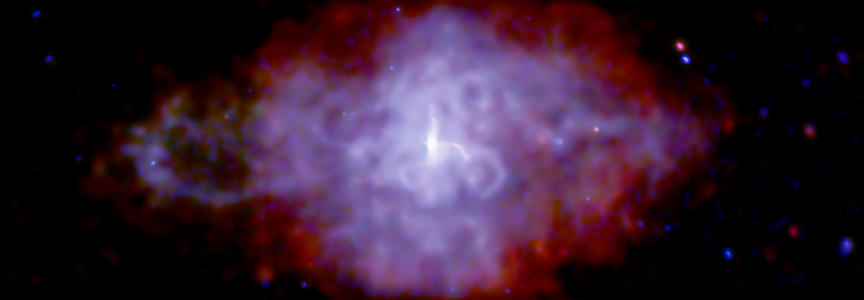
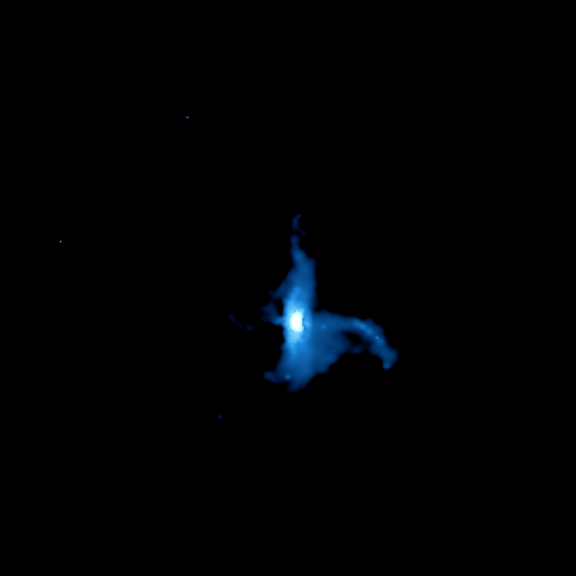
3C58 is the remnant of a supernova observed in the year 1181 by Chinese and Japanese astronomers. A long look by Chandra shows that the central pulsar - a rapidly rotating neutron star formed in the supernova event - is surrounded by a bright torus of X-ray emission. An X-ray jet erupts in both directions from the center of the torus, and extends over a distance of a few light years. Further out, an intricate web of X-ray loops can be seen. In this image, the colors represent different ranges of X-rays with red, green, and blue representing low, medium, and higher X-ray energies.
Scale: Image is 12.1 by 4.2 arcmin
(Credit: NASA/CXC/SAO/P.Slane et al.)
3C58 is the remnant of a supernova observed in the year 1181 by Chinese and Japanese astronomers. A long look by Chandra shows that the central pulsar - a rapidly rotating neutron star formed in the supernova event - is surrounded by a bright torus of X-ray emission. An X-ray jet erupts in both directions from the center of the torus, and extends over a distance of a few light years. Further out, an intricate web of X-ray loops can be seen. In this image, the colors represent different ranges of X-rays with red, green, and blue representing low, medium, and higher X-ray energies.
Scale: Image is 12.1 by 4.2 arcmin
(Credit: NASA/CXC/SAO/P.Slane et al.)
2
Chandra Broadband Image of 3C58
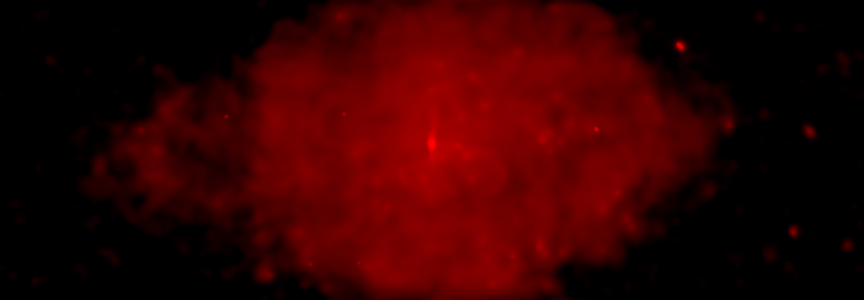
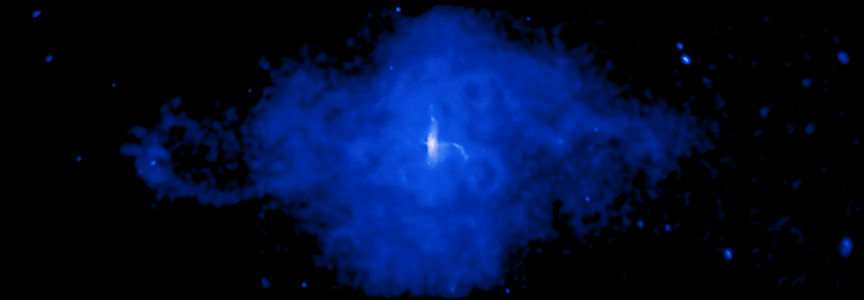
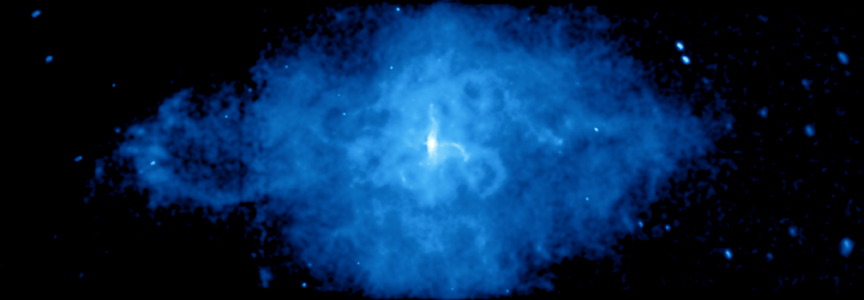
A long look at the young pulsar 3C58 with the Chandra X-ray Observatory revealed unexpectedly rapid cooling, which suggests that it contains much denser matter than previously expected. The pulsar's cool temperature and the vast magnetic web of high-energy particles that surrounds it have implications for the theory of nuclear matter and the origin of magnetic fields in cosmic objects.
Scale: Full-field image is 12.1 by 4.2 arcmin; Close-up images are 3 arcmin across
(Credit: NASA/CXC/SAO/P.Slane et al.)
A long look at the young pulsar 3C58 with the Chandra X-ray Observatory revealed unexpectedly rapid cooling, which suggests that it contains much denser matter than previously expected. The pulsar's cool temperature and the vast magnetic web of high-energy particles that surrounds it have implications for the theory of nuclear matter and the origin of magnetic fields in cosmic objects.
Scale: Full-field image is 12.1 by 4.2 arcmin; Close-up images are 3 arcmin across
(Credit: NASA/CXC/SAO/P.Slane et al.)
3
VLA Radio & Chandra X-ray Composite of 3C58
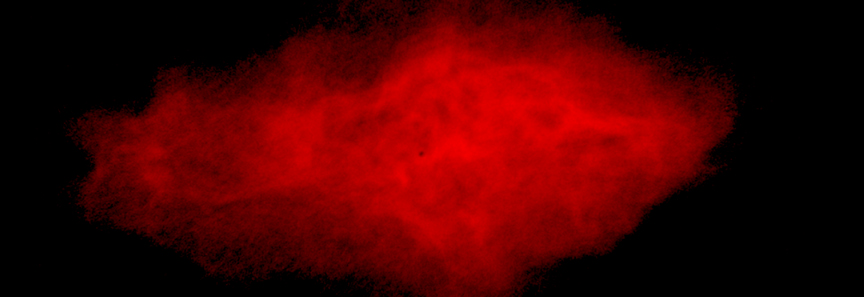
This image compares Chandra's X-ray image of 3C58 with the radio image taken by NRAO's Very Large Array (VLA). The intricate X-ray loops in the Chandra image and the features in the radio image of 3C58 extend a dozen light years from the pulsar, likely representing the complex magnetic field structure there. The radio data was taken on April 30, 1984.
Scale: Image is 12.1 by 4.2 arcmin
(Credit: X-ray: NASA/CXC/SAO/P.Slane et al.; Radio: NCSU/S.Reynolds)
This image compares Chandra's X-ray image of 3C58 with the radio image taken by NRAO's Very Large Array (VLA). The intricate X-ray loops in the Chandra image and the features in the radio image of 3C58 extend a dozen light years from the pulsar, likely representing the complex magnetic field structure there. The radio data was taken on April 30, 1984.
Scale: Image is 12.1 by 4.2 arcmin
(Credit: X-ray: NASA/CXC/SAO/P.Slane et al.; Radio: NCSU/S.Reynolds)
4
Optical & Chandra X-ray Composite of 3C58
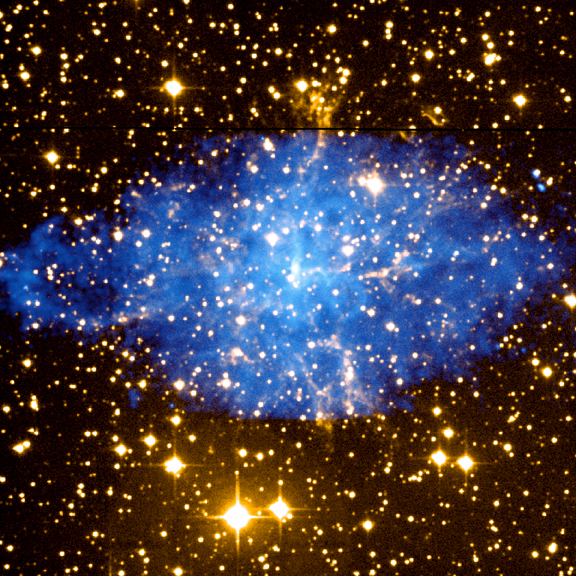
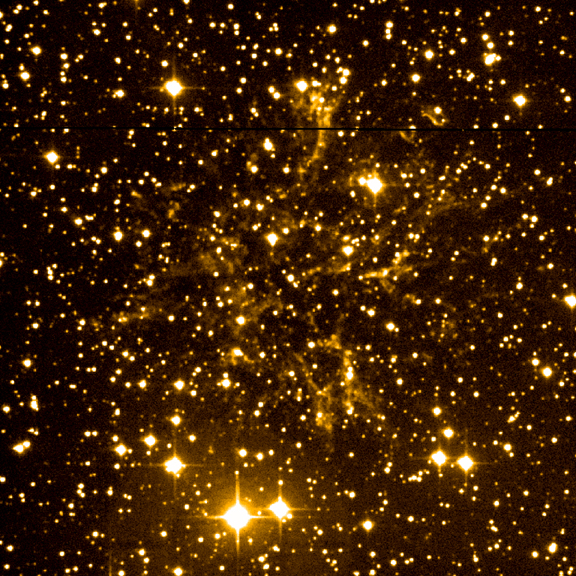
This image from the 1.3m McGraw-Hill shows 3C58 in visible light compared with Chandra's X-ray data of the same field of view. The optical image was taken on January 13, 2004.
Scale: Image is 8.4 arcmin per side
(Credit: X-ray: NASA/CXC/SAO/P.Slane et al.; Optical: xxxx)
This image from the 1.3m McGraw-Hill shows 3C58 in visible light compared with Chandra's X-ray data of the same field of view. The optical image was taken on January 13, 2004.
Scale: Image is 8.4 arcmin per side
(Credit: X-ray: NASA/CXC/SAO/P.Slane et al.; Optical: xxxx)
5
Wide-Field DSS Optical Images of Region Around 3C58
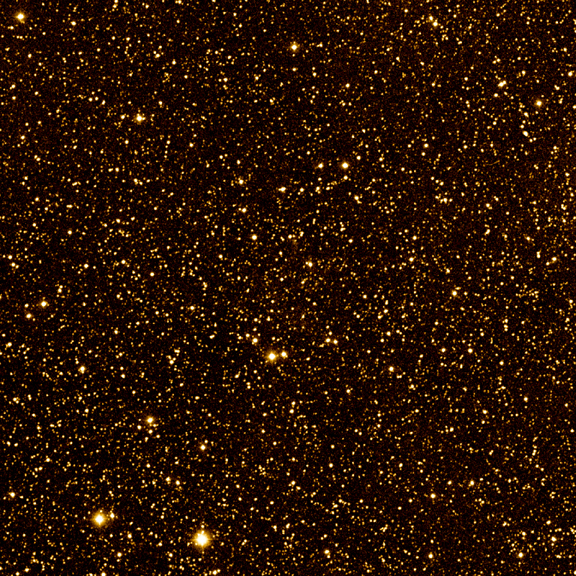
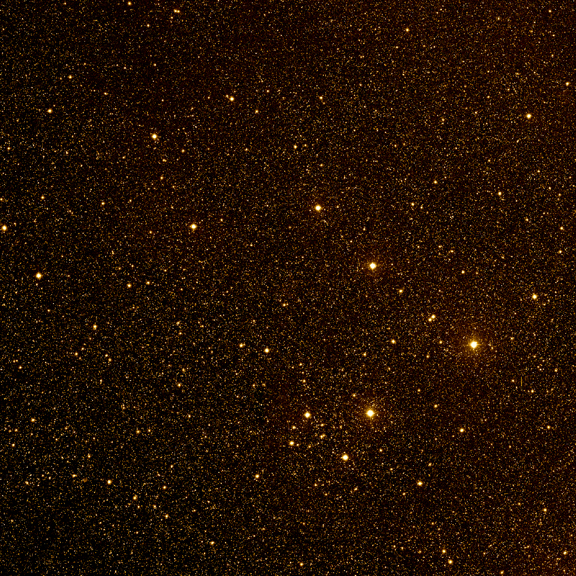
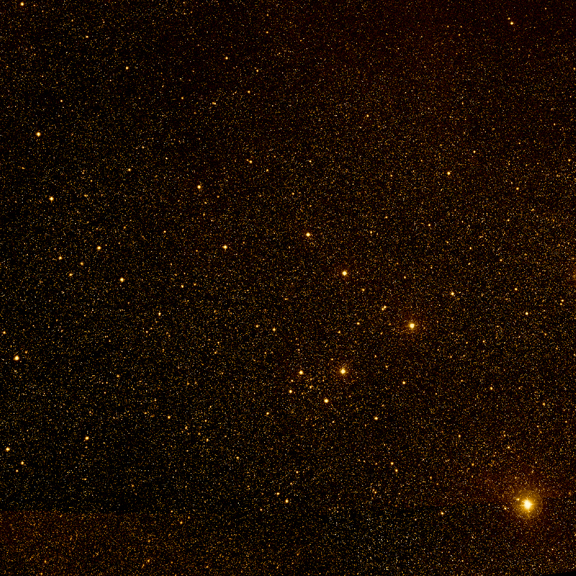
These images from the Digitized Sky Survey (DSS) show 4 different optical fields (sizes of 0.5, 1, 2, & 3 degrees respectively) of the region surrounding the young pulsar 3C58.
(Credit: Digital Sky Survey)
These images from the Digitized Sky Survey (DSS) show 4 different optical fields (sizes of 0.5, 1, 2, & 3 degrees respectively) of the region surrounding the young pulsar 3C58.
(Credit: Digital Sky Survey)
6
3C58 Comparison with the Crab Nebula
This image shows the strong similarities between the center of 3C58 and the Crab Nebula pulsar -- one of the most famous objects in astronomy. The 3C58 pulsar, the Crab Nebula pulsar, and a growing list of other pulsars offer dramatic proof that strong electromagnetic fields around rapidly rotating neutron stars are powerful generators of both high-energy particles and magnetic fields. This side-by-side view of 3C58 and Crab compares the physical size of the two objects. The image of the Crab Nebula (scale = 3 arcmin per side) has been sized to show it at the same distance of 3C58.
Scale: Each image is 3 arcmin across
(Credit: 3C58: NASA/CXC/SAO/P.Slane et al.; Crab Nebula: NASA/CXC/ASU/J.Hester et al.)
This image shows the strong similarities between the center of 3C58 and the Crab Nebula pulsar -- one of the most famous objects in astronomy. The 3C58 pulsar, the Crab Nebula pulsar, and a growing list of other pulsars offer dramatic proof that strong electromagnetic fields around rapidly rotating neutron stars are powerful generators of both high-energy particles and magnetic fields. This side-by-side view of 3C58 and Crab compares the physical size of the two objects. The image of the Crab Nebula (scale = 3 arcmin per side) has been sized to show it at the same distance of 3C58.
Scale: Each image is 3 arcmin across
(Credit: 3C58: NASA/CXC/SAO/P.Slane et al.; Crab Nebula: NASA/CXC/ASU/J.Hester et al.)
7
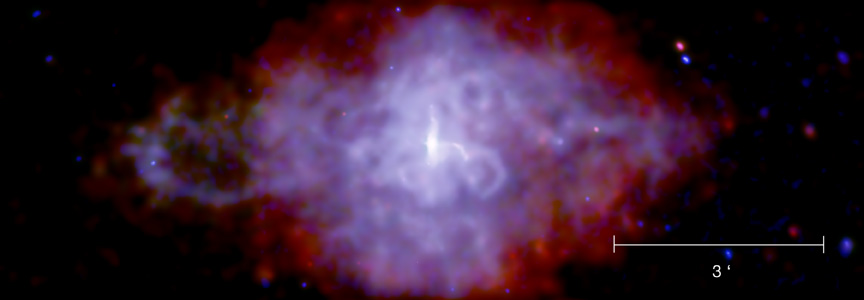
Chandra X-ray Image with Scale Bar
Scalebar = 3 arcmin
(Credit: NASA/CXC/SAO/P.Slane et al.)
Scalebar = 3 arcmin
(Credit: NASA/CXC/SAO/P.Slane et al.)
Return to 3C58 (14 Dec 04)


Revised: May 17, 2022