


CXC Home | Search | Help | Image Use Policy | Latest Images | Privacy | Accessibility | Glossary | Q&A
February 27, 2003
RELEASE: 03-81
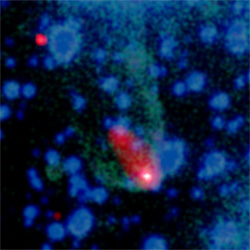
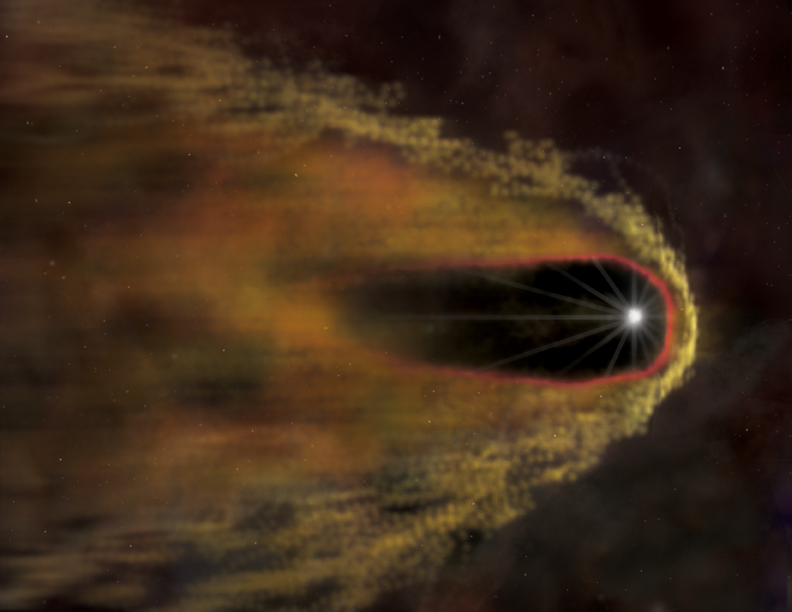
NASA's Chandra X-ray Observatory image of the mysterious "Black Widow" pulsar reveals the first direct evidence of an elongated cocoon of high-energy particles. This discovery shows that this billion-year-old rejuvenated pulsar is an extremely efficient generator of a high-speed flow of matter and antimatter particles.
Known officially as pulsar B1957+20, the Black Widow received its nickname because it is emitting intense high-energy radiation that is destroying its companion through evaporation. B1957+20, which completes one rotation every 1.6-thousandths of a second, belongs to a class of extremely rapidly rotating neutron stars called millisecond pulsars.
The motion of B1957+20 through the galaxy -- at a high speed of almost a million kilometers per hour -- creates a bow shock wave visible to optical telescopes. The Chandra observation shows what cannot be seen in visible light: a second shock wave. This secondary shock wave is created from pressure that sweeps the wind back from the pulsar to form the cocoon of high-energy particles, visible for the first time in the Chandra data.
"This is the first detection of a double-shock structure around a pulsar," said Benjamin Stappers, of the Dutch Organization for Research in Astronomy (ASTRON), lead author on a paper describing the research that will appear in the Feb. 28, 2003, issue of Science magazine. "It should enable astronomers to test theories of the dynamics of pulsar winds and their interaction with their environment."
Scientists believe millisecond pulsars are very old neutron stars that have been spun up by accreting material from their companions. The steady push of the infalling matter on the neutron star spins it up in much the same way as pushing on a merry-go-round makes it rotate faster.
The result is an object about 1.5 times as massive as the Sun and ten miles in diameter that rotates hundreds of times per second. The advanced age, very rapid rotation rate and relatively low magnetic field of millisecond pulsars put them in a totally separate class from young pulsars observed in the remnants of supernova explosions.
"This star has had an incredible journey. It was born in a supernova explosion as a young and energetic pulsar, but after a few million years grew old and slow and faded from view," said Bryan Gaensler of the Harvard-Smithsonian Center for Astrophysics in Cambridge, Mass., a coauthor of the paper. "Over the next few hundred million years, this dead pulsar had material dumped on it by its companion, and the pulsar's magnetic field has been dramatically reduced.
"This pulsar has been through hell, yet somehow it's still able to generate high-energy particles just like its younger brethren," continued Gaensler. The key is the rapid rotation of B1957+20. The Chandra result confirms the theory that even a relatively weakly magnetized neutron star can generate intense electromagnetic forces and accelerate particles to high energies to create a pulsar wind, if it is rotating rapidly enough.
Chandra's Advanced CCD Imaging Spectrometer observed B1957+20 for over 40,000 seconds on June 21, 2001. Other members of the research team include Victoria Kaspi (McGill University, Montreal), Michiel van der Klis (University of Amsterdam) and Walter Lewin (Massachusetts Institute of Technology, Cambridge).
NASA's Marshall Space Flight Center in Huntsville, Ala., manages the Chandra program, and TRW, Inc., Redondo Beach, Calif., is the prime contractor for the spacecraft. The Smithsonian's Chandra X-ray Center controls science and flight operations from Cambridge, Mass., for the Office of Space Science at NASA Headquarters, Washington.
MEDIA CONTACTS
Don Savage, Public Affairs Office
NASA Headquarters, Washington D.C.
Phone: 202-358-1727
Steve Roy
Marshall Space Flight Center, Huntsville, AL
Phone: 256-544-6535
Megan Watzke
Chandra X-ray Observatory Center, CfA, Cambridge, MA
Phone: 617-496-7998
cxcpress@cfa.harvard.edu


Revised: March 27, 2008