

Location: Zodiac constellation, visible in both Hemispheres
Coordinates:
Right Ascension: 04h
Declination: +15º
Source: Bull legends from various ancient civilizations, also Greek mythology, Egyptian, Arab, other
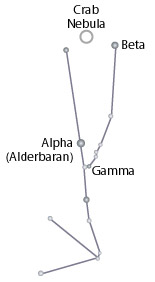
The story behind the name: The constellations that are included in the Zodiac - the 12 constellations recognized by Babylonian astronomers through which our Sun, moon, and planets appeared to travel during the course of a year - are considered to be among the oldest sky patterns recognized by human civilizations. They were thought to have more significance because they were touched by the Sun. Taurus is among the very oldest. At the time that the ancient Mediterranean and Middle East civilizations were at their heights, the Sun would have entered Taurus in the spring. For many of these herding and agricultural civilizations, the spring season - planting and births of animals - signaled the start of a new year.
The bull figured as a symbol of strength and fertility in many of these ancient cultures, and is prominent in the mythology of almost all early civilizations. Not only is Taurus associated with myths from Egypt (Apis), Greece (the Minotaur, and several involving Zeus in disguise), and the Druids, but many of the celestial objects in Taurus that are visible to the naked eye were also given significance. Among them are the star clusters Hyades and Pleiades.

The rising of the Hyades was associated with rain from ancient Greece to ancient China. The Pleiades were said to be visible in good weather, a sign that the ancient seamen could undertake a sea voyage. The Pleiades are also associated with a myth about Orion, and a Polynesian myth. Some Arab names for the stars in Taurus refer to the bull's horns and the bull's eye.
Introduction to Constellations | Constellation Sources | Constellations Index
Objects observed by Chandra in Taurus: