

Location: Northern Hemisphere
Coordinates:
Right Ascension: 16h
Declination: +30º
Source: Greek mythology, also Arab, Native American, Aborigine
 The story behind the name: The open circlet of stars known as the constellation Corona Borealis was noticed by many civilizations, but only the Greeks saw it as a crown or wreath. Middle East civilizations saw it as a broken or cracked dish. Australian aboriginals saw a boomerang. A myth of the Shawnee tribe of Native Americans saw the pattern as a group of dancing star maidens. The circle is incomplete because one of the maidens fell in love with a mortal warrior and returned to Earth to live with him.
The original constellation associated with Ariadne's crown is probably the Corona Australis (southern crown). This fairly dim constellation was one of the original 48 identified by Ptolemy in the 2nd century A.D. In modern usage, the story of Ariadne is associated with Corona Borealis. Ariadne's crown is known to be a specific type of woman's hair ornament fashioned from gold in the shape of a wreath with jeweled roses. It is described in Plutarch's story about Theseus, and a crown of this type was found in an ancient Greek treasure cache.
Ariadne was the daughter of King Minos of Crete, who, according to one legend, kept the ferocious Minotaur (half human, half bull) in a labyrinth under his palace. Every ninth year, seven young men and seven young women from Athens were sacrificed to the Minotaur to appease the death of Minos' son. Theseus, a son of the sea god Poseidon and a human mother, displayed heroic traits from an early age. Some stories say he volunteered, some stories say he was chosen: but seeing the grief of the young Athenian sacrifices, Theseus decided to join them and defeat the Minotaur.
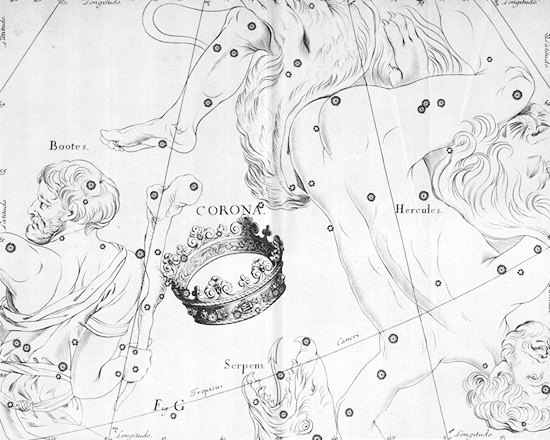
In one version he agrees on the understanding that the custom will be abandoned if he can defeat the Minotaur with his bare hands. On his arrival at Crete he was challenged to prove that his father was Poseidon by retrieving a gold ring that Minos threw into the ocean. The Nereids helped him find the ring, and one of the sea goddesses - Thetis or Amphitrite - gave him a jeweled crown made by the god Hephaestus, possibly her wedding crown. Ariadne fell in love with Theseus. She offered to help him defeat the Minotaur if he promised to take her to Athens and marry her. She gave him a magic ball of thread that would lead him safely into and out of the labyrinth. Theseus defeated the Minotaur and escaped Crete with Ariadne and the Athenians. After some days at sea the ship stopped at the island of Dia (Naxos). There are a number of strange stories that explain why or how Ariadne was deserted on the island. However, there was a happy ending. Dionysus appeared and married her, putting Theseus' crown on her head. They had many children. Later he is supposed to have placed the crown in the stars in her honor.
Other versions of these myths tell totally different stories, including versions with no Minotaur, or in which Ariadne dies or does not marry Dionysus. These other versions make no mention of the supposed origin of the constellation Corona Borealis.
Introduction to Constellations | Constellation Sources | Constellations Index
Objects observed by Chandra in Corona Borealis: