

CXC Home | Search | Help | Image Use Policy | Latest Images | Privacy | Accessibility | Glossary | Q&A

Tour of Vela Pulsar
Quicktime MPEG With closed-captions (at YouTube)
Unlike with some Hollywood films, a sequel of a movie from NASA's Chandra X-ray Observatory is better than the first. The star of this Chandra movie is the Vela pulsar, a neutron star that was formed when a massive star collapsed. The Vela pulsar is about 1,000 light years from Earth, spans about 12 miles in diameter, and makes a complete rotation in 89 milliseconds, which is faster than a helicopter rotor. As the pulsar whips around, it spews out a jet of charged particles that race out along the pulsar's rotation axis at about 70% the speed of light. The new Chandra data, which were obtained from June to September 2010, suggest that the jet may be slowly wobbling, or precessing, as it spins. The first Chandra movie of Vela came out in 2003, but its shorter and unevenly spaced exposures did not provide clear evidence for precession of the pulsar. If the Vela saga becomes a trilogy, maybe more secrets of this exotic object will be revealed.
[Runtime: 01:09]
Quicktime MPEG With closed-captions (at YouTube)
Unlike with some Hollywood films, a sequel of a movie from NASA's Chandra X-ray Observatory is better than the first. The star of this Chandra movie is the Vela pulsar, a neutron star that was formed when a massive star collapsed. The Vela pulsar is about 1,000 light years from Earth, spans about 12 miles in diameter, and makes a complete rotation in 89 milliseconds, which is faster than a helicopter rotor. As the pulsar whips around, it spews out a jet of charged particles that race out along the pulsar's rotation axis at about 70% the speed of light. The new Chandra data, which were obtained from June to September 2010, suggest that the jet may be slowly wobbling, or precessing, as it spins. The first Chandra movie of Vela came out in 2003, but its shorter and unevenly spaced exposures did not provide clear evidence for precession of the pulsar. If the Vela saga becomes a trilogy, maybe more secrets of this exotic object will be revealed.
[Runtime: 01:09]
(Credit: NASA/CXC/A. Hobart)

Vela Pulsar Jet Timelapse
Quicktime MPEG
The Chandra data set contains 8 images obtained between June and September 2010, and suggests that the pulsar may be slowly wobbling, or precessing, as it spins. The shape and the motion of the Vela jet look strikingly like a rotating helix, a shape that is naturally explained by precession, as shown in this animation. If the evidence for precession of the Vela pulsar is confirmed, it would be the first time that a jet from a neutron star has been found to be wobbling, or precessing, in this way.
[Runtime: 01:00]
Quicktime MPEG
The Chandra data set contains 8 images obtained between June and September 2010, and suggests that the pulsar may be slowly wobbling, or precessing, as it spins. The shape and the motion of the Vela jet look strikingly like a rotating helix, a shape that is naturally explained by precession, as shown in this animation. If the evidence for precession of the Vela pulsar is confirmed, it would be the first time that a jet from a neutron star has been found to be wobbling, or precessing, in this way.
[Runtime: 01:00]
(Credit: NASA/CXC/Univ of Toronto/M.Durant et al)
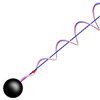
Corkscrew Animation
Quicktime
The Vela jet appears to resemble a corkscrew or helix, spinning regularly at a rate of about three times per year. The immediate conclusion suggested a slow wobbling, or precession, of the Vela Pulsar (i.e., involving no external forces), an effect that has been sought for decades - with some hints of success - but never robustly proven.
[Runtime: 00:24]
Quicktime
- Low Res (1 MB)
The Vela jet appears to resemble a corkscrew or helix, spinning regularly at a rate of about three times per year. The immediate conclusion suggested a slow wobbling, or precession, of the Vela Pulsar (i.e., involving no external forces), an effect that has been sought for decades - with some hints of success - but never robustly proven.
[Runtime: 00:24]
(Credit: NASA/CXC/Univ of Toronto/M.Durant et al)

Did Somebody Call the Ghostbusters?
Quicktime MPEG With closed-captions (at YouTube)
Millions of people around the world believe in ghosts, many of them even claim to have seen one. Well, now you can count yourself among them! This spooky new image shows a massive star in its afterlife. You could say it's a 'ghost star'.
A large star comes to the end of its life when it runs out of fuel. At this point the star's outer layers are blown away in a powerful explosion, and the core collapses in on itself. While the cast off outer layers can create some fascinating and colorful patterns, it's at the core that things get really interesting. This haunting space picture shows the dense, leftover core of a massive star after it has gone through its dramatic end-of-life explosion.
While the outer layers are blown away, the core collapses in on itself. Enough material to make a Sun like ours (and then some!) is squashed into an area much smaller than an average city! The core then begins its afterlife as a new type of star.
In this picture the core has been reborn as a 'pulsar'. This is a star that spins around extremely quickly - turning even faster than a helicopter rotor! As it whips round, the pulsars spews out jets of material, can you see one stretching upwards in this picture?
[Runtime: 01:47]
Quicktime MPEG With closed-captions (at YouTube)
Millions of people around the world believe in ghosts, many of them even claim to have seen one. Well, now you can count yourself among them! This spooky new image shows a massive star in its afterlife. You could say it's a 'ghost star'.
A large star comes to the end of its life when it runs out of fuel. At this point the star's outer layers are blown away in a powerful explosion, and the core collapses in on itself. While the cast off outer layers can create some fascinating and colorful patterns, it's at the core that things get really interesting. This haunting space picture shows the dense, leftover core of a massive star after it has gone through its dramatic end-of-life explosion.
While the outer layers are blown away, the core collapses in on itself. Enough material to make a Sun like ours (and then some!) is squashed into an area much smaller than an average city! The core then begins its afterlife as a new type of star.
In this picture the core has been reborn as a 'pulsar'. This is a star that spins around extremely quickly - turning even faster than a helicopter rotor! As it whips round, the pulsars spews out jets of material, can you see one stretching upwards in this picture?
[Runtime: 01:47]
(Credit: NASA/CXC/April Jubett)
Return to Vela Pulsar Jet (January 7, 2013)


Revised: July 10, 2023