

CXC Home | Search | Help | Image Use Policy | Latest Images | Privacy | Accessibility | Glossary | Q&A
Tour of DEM L50
Quicktime MPEG With closed-captions (at YouTube)
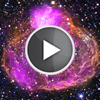
DEM L50 is what astronomers call a superbubble. These objects are found in regions where massive stars have formed, raced through their evolution, and exploded as supernovas. Winds from the massive stars and shock waves from the supernovas carve out huge cavities in the gas and dust around them, creating superbubbles. This composite contains X-rays from Chandra and optical data from ground-based telescopes. The superbubble in DEM L50 is giving off about 20 times more X-rays than expected by standard models. Researchers think that supernova shock waves striking the walls of the cavities and hot material evaporating from the cavity walls may be responsible for this additional X-ray emission.
[Runtime: 00:51]
Quicktime MPEG With closed-captions (at YouTube)
DEM L50 is what astronomers call a superbubble. These objects are found in regions where massive stars have formed, raced through their evolution, and exploded as supernovas. Winds from the massive stars and shock waves from the supernovas carve out huge cavities in the gas and dust around them, creating superbubbles. This composite contains X-rays from Chandra and optical data from ground-based telescopes. The superbubble in DEM L50 is giving off about 20 times more X-rays than expected by standard models. Researchers think that supernova shock waves striking the walls of the cavities and hot material evaporating from the cavity walls may be responsible for this additional X-ray emission.
[Runtime: 00:51]
(Credit: NASA/CXC/A. Hobart)

Beautiful But Deadly
Quicktime MPEG With closed-captions (at YouTube)
It seems that there is a twist in nature: the more beautiful something is, the more deadly it also might be. For example, some of the most colorful animals, insects and flowers can also be among the most poisonous. Is that also true in space? This new space image shows a pink bubble of gas glowing against a shining field of stars. Well, this pretty cloud is another of nature's dangerous beauties - it's shooting out huge amounts of intense, deadly radiation! Fortunately, we humans are safe from it however.
The glowing cloud of gas and dust in this picture is called a 'Super-bubble'. They are found in areas where lots of massive stars have formed fairly recently. These baby stars blow out intense winds and massive stars 'live fast and die young'. They speed through their lives to explode as powerful supernovas. It's these destructive events that have carved-out the center of the cloud, leaving behind just a ring of gas and dust.
The chaos taking place inside these giant super-bubbles stretches far beyond the hollowed cloud in the form of potentially dangerous X-ray radiation. Scientists have discovered that this particular cloud gives off 20 times more of these intense rays than they expected! So, here's another example of something that's beautiful but might be deadly! Our advice is: always enjoy beautiful things from a safe distance!
[Runtime: 02:02]
Quicktime MPEG With closed-captions (at YouTube)
It seems that there is a twist in nature: the more beautiful something is, the more deadly it also might be. For example, some of the most colorful animals, insects and flowers can also be among the most poisonous. Is that also true in space? This new space image shows a pink bubble of gas glowing against a shining field of stars. Well, this pretty cloud is another of nature's dangerous beauties - it's shooting out huge amounts of intense, deadly radiation! Fortunately, we humans are safe from it however.
The glowing cloud of gas and dust in this picture is called a 'Super-bubble'. They are found in areas where lots of massive stars have formed fairly recently. These baby stars blow out intense winds and massive stars 'live fast and die young'. They speed through their lives to explode as powerful supernovas. It's these destructive events that have carved-out the center of the cloud, leaving behind just a ring of gas and dust.
The chaos taking place inside these giant super-bubbles stretches far beyond the hollowed cloud in the form of potentially dangerous X-ray radiation. Scientists have discovered that this particular cloud gives off 20 times more of these intense rays than they expected! So, here's another example of something that's beautiful but might be deadly! Our advice is: always enjoy beautiful things from a safe distance!
[Runtime: 02:02]
(Credit: NASA/CXC/April Jubett)
Return to DEM L50 (January 28, 2013)


Revised: July 10, 2023