

CXC Home | Search | Help | Image Use Policy | Latest Images | Privacy | Accessibility | Glossary | Q&A
Tour of V1647 Ori
Quicktime MPEG
This video begins with optical observations of the nebula M78, a star formation region located in our galaxy about 1300 light years from earth. The view zooms into a nearby region containing McNeil's Nebula, first noticed in 2004 when it was lit up by a protostar named V1647 Orionis, a stellar infant still partly swaddled in its birth cloud. Protostars have not yet developed the energy-generating capabilities of a normal star such as the sun, which fuses hydrogen into helium in its core. For V1647 Ori, that stage lies millions of years in the future. Until then, the protostar shines from the heat energy released by the gas that continues to fall onto it, much of which originates in a rotating circumstellar disk.
[Runtime: 01:32]
Quicktime MPEG
This video begins with optical observations of the nebula M78, a star formation region located in our galaxy about 1300 light years from earth. The view zooms into a nearby region containing McNeil's Nebula, first noticed in 2004 when it was lit up by a protostar named V1647 Orionis, a stellar infant still partly swaddled in its birth cloud. Protostars have not yet developed the energy-generating capabilities of a normal star such as the sun, which fuses hydrogen into helium in its core. For V1647 Ori, that stage lies millions of years in the future. Until then, the protostar shines from the heat energy released by the gas that continues to fall onto it, much of which originates in a rotating circumstellar disk.
[Runtime: 01:32]
(Credit: NASA/CXC/A. Hobart)
Artist's animation of V1647 Ori
Quicktime MPEG
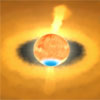
A zoom into V1647 Orionis shows an animation, an artist's representation of magnetic fields and intense X-ray hot spots thousands of times hotter than the rest of the star. These spots are thought to be the footprints of streams that transfer gas from a disk that still surrounds the young star. Scientists think that magnetic reconnection events--the energy source for outbursts from our own sun--channel and drive the gas flows. The star, which spins once in about a day, rotates faster than the disk, and constantly winds up the magnetic fields, which release a great deal of energy when they snap back into lower-energy states. This protostar's X-ray variations are giving astronomers a rare glimpse of energetic phenomena accompanying the "toddler" phase of a low-mass star.
[Runtime: 00:50]
Quicktime MPEG
A zoom into V1647 Orionis shows an animation, an artist's representation of magnetic fields and intense X-ray hot spots thousands of times hotter than the rest of the star. These spots are thought to be the footprints of streams that transfer gas from a disk that still surrounds the young star. Scientists think that magnetic reconnection events--the energy source for outbursts from our own sun--channel and drive the gas flows. The star, which spins once in about a day, rotates faster than the disk, and constantly winds up the magnetic fields, which release a great deal of energy when they snap back into lower-energy states. This protostar's X-ray variations are giving astronomers a rare glimpse of energetic phenomena accompanying the "toddler" phase of a low-mass star.
[Runtime: 00:50]
(Credit: NASA/CXC/A. Hobart)
Return to V1647 Ori (July 3, 2012)



Revised: April 30, 2020