

CXC Home | Search | Help | Image Use Policy | Latest Images | Privacy | Accessibility | Glossary | Q&A
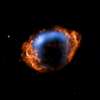
Tour of G1.9+0.3
Quicktime MPEG
About a hundred and forty years ago, the light from a supernova explosion in our galaxy reached the Earth, but no one saw it. That's because, as this infrared version shows, the center of the Milky Way contains thick bands of gas and dust, making it impossible for astronomers to detect this explosion using optical telescopes. However, the debris field created by the supernova shines brightly in x-ray and radio wavelengths. A combination of data from NASA's Chandra X-ray Observatory in space and the Very Large Array of radio dishes in New Mexico allowed astronomers to identify this object and nail down its age. The discovery of this supernova remnant helps astronomers better understand how often these stellar time-bombs go off in our galaxy.
[Runtime: 0.46]
Quicktime MPEG
About a hundred and forty years ago, the light from a supernova explosion in our galaxy reached the Earth, but no one saw it. That's because, as this infrared version shows, the center of the Milky Way contains thick bands of gas and dust, making it impossible for astronomers to detect this explosion using optical telescopes. However, the debris field created by the supernova shines brightly in x-ray and radio wavelengths. A combination of data from NASA's Chandra X-ray Observatory in space and the Very Large Array of radio dishes in New Mexico allowed astronomers to identify this object and nail down its age. The discovery of this supernova remnant helps astronomers better understand how often these stellar time-bombs go off in our galaxy.
[Runtime: 0.46]
(Credit: X-ray (NASA/CXC/NCSU/S.Reynolds et al.); Radio (NSF/NRAO/VLA/Cambridge/D.Green et al.); Infrared (2MASS/UMass/IPAC-Caltech/NASA/NSF/CfA/E.Bressert))
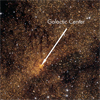
Zoom into G1.9+0.3
Quicktime MPEG
Beginning with a wide-field look at the center of the Milky Way from the Two Micron All Sky Survey, the view zooms into the Galactic Center before panning about a thousand light years away to where G1.9+0.3 is located. While most optical light is blocked by thick clouds of gas and dust in this part of the Galaxy, X-ray and radio radiation can penetrate them. A combination of data from Chandra and the VLA allowed for the discovery of a recent supernova explosion that would have appeared in the night sky during the late 19th century if it was unobscured.
[Runtime: 00:35]
Quicktime MPEG
Beginning with a wide-field look at the center of the Milky Way from the Two Micron All Sky Survey, the view zooms into the Galactic Center before panning about a thousand light years away to where G1.9+0.3 is located. While most optical light is blocked by thick clouds of gas and dust in this part of the Galaxy, X-ray and radio radiation can penetrate them. A combination of data from Chandra and the VLA allowed for the discovery of a recent supernova explosion that would have appeared in the night sky during the late 19th century if it was unobscured.
[Runtime: 00:35]
(Credit: X-ray (NASA/CXC/NCSU/S.Reynolds et al.); Radio (NSF/NRAO/VLA/
Cambridge/ D.Green et al.); Infrared (2MASS/UMass/IPAC-Caltech/NASA/NSF/CfA/E.Bressert)
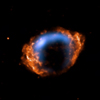
Comparison of X-ray and Radio Images
Quicktime MPEG
In order to determine the age of G1.9+0.3, astronomers needed to track how quickly it is expanding. By comparing a radio image from 1985 to a Chandra image taken in 2007, scientists see the ring of debris expand. The expansion rate was confirmed with another radio observation with the VLA in 2008. The difference in size between these images gives clear evidence for expansion, allowing the age of the remnant and the time since the original supernova explosion (about 140 years) to be estimated.
[Runtime: 00:35]
Quicktime MPEG
In order to determine the age of G1.9+0.3, astronomers needed to track how quickly it is expanding. By comparing a radio image from 1985 to a Chandra image taken in 2007, scientists see the ring of debris expand. The expansion rate was confirmed with another radio observation with the VLA in 2008. The difference in size between these images gives clear evidence for expansion, allowing the age of the remnant and the time since the original supernova explosion (about 140 years) to be estimated.
[Runtime: 00:35]
(Credit: X-ray (NASA/CXC/NCSU/S.Reynolds et al.); Radio (NSF/NRAO/VLA/
Cambridge/D.Green et al.)
Animation of G1.9+0.3
Quicktime MPEG
This animation begins with a view of the Milky Way from above the plane of the galaxy, where the Galactic center and bulge is unobscured by dust and gas. The viewer then travels towards the center of the Galaxy and zooms into the bright, crowded central bulge of the Milky Way, where a supernova explosion occurs. The ejecta from the explosion rushes outwards where it interacts with the gas surrounding the explosion, causing the formation of a supernova remnant which shines brightly in X-rays and radio waves. This is the scenario scientists envision occurred with G1.9+0.3
[Runtime: 00:23]
Quicktime MPEG
This animation begins with a view of the Milky Way from above the plane of the galaxy, where the Galactic center and bulge is unobscured by dust and gas. The viewer then travels towards the center of the Galaxy and zooms into the bright, crowded central bulge of the Milky Way, where a supernova explosion occurs. The ejecta from the explosion rushes outwards where it interacts with the gas surrounding the explosion, causing the formation of a supernova remnant which shines brightly in X-rays and radio waves. This is the scenario scientists envision occurred with G1.9+0.3
[Runtime: 00:23]
(Credit: NASA/CXC/A. Hobart)
Chandra Spacecraft Animation
Quicktime MPEG
Quicktime MPEG
This artist's conception begins with the Chandra X-ray Observatory as
it passes in front of the Moon. Chandra, one of NASA's "Great
Observatories," does not orbit closely around the Earth. Instead, its
highly elliptical orbit takes as far as one-third the distance to the
Moon. Operating in space since 1999, Chandra detects and images X-ray
sources that lie within our Solar System to those billions of light
years away. The results from Chandra help explore high-energy
phenomena and provide insights into the Universe's structure and
evolution.
[Runtime: 00:31]
Return to G1.9+0.3 (May 14, 2008)



Revised: June 08, 2012