

CXC Home | Search | Help | Image Use Policy | Latest Images | Privacy | Accessibility | Glossary | Q&A
Tour of Centaurus A
Quicktime MPEG
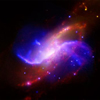
The galaxy NGC 4258 has its arms crossed. At least it appears that it does. A composite image of NGC 4258, about 25 million light-years from Earth, shows an X-shaped pattern when seen in different types of light. Infrared radiation from the Spitzer Space Telescope and optical light data from the Digitized Sky Survey show one set of arms, which are made from stars and dust from the galaxy. However, x-ray data from the Chandra X-ray Observatory and radio emission from the Very Large Array reveal a different pair of arms. These dislocated arms are the result of shockwaves, generated by the giant black hole in the center of NGC 4258.
[Runtime: 043]
(Credit: X-ray: NASA/CXC/Univ. of Maryland/A.S. Wilson et al.; Optical: Pal.Obs. DSS; IR: NASA/JPL-Caltech; VLA: NRAO/AUI/NSF)
Quicktime MPEG
The galaxy NGC 4258 has its arms crossed. At least it appears that it does. A composite image of NGC 4258, about 25 million light-years from Earth, shows an X-shaped pattern when seen in different types of light. Infrared radiation from the Spitzer Space Telescope and optical light data from the Digitized Sky Survey show one set of arms, which are made from stars and dust from the galaxy. However, x-ray data from the Chandra X-ray Observatory and radio emission from the Very Large Array reveal a different pair of arms. These dislocated arms are the result of shockwaves, generated by the giant black hole in the center of NGC 4258.
[Runtime: 043]
(Credit: X-ray: NASA/CXC/Univ. of Maryland/A.S. Wilson et al.; Optical: Pal.Obs. DSS; IR: NASA/JPL-Caltech; VLA: NRAO/AUI/NSF)
A Multiwavelength View of NGC 4258
Quicktime MPEG
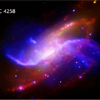
For decades, astronomers have known about the so-called anomalous arms in the spiral galaxy NGC 4258. This motion graphic shows NGC 4258 from the viewpoint of multiple space and ground-based observations. Visible light (seen in gold) from the Digitized Sky Survey and infrared light (red) from the Spitzer Space Telescope reveals two prominent arms. However, radio data (purple) from the Very Large Array and X-ray data (blue) from Chandra show two additional, offset arms. By combining all of these data, scientists have found evidence that the mysterious X-ray arms are due to shock waves generated by the supermassive black hole in the nucleus of NGC 4258. The shock waves heat the gas in the disk, causing it to radiate brightly in X-rays and other wavelengths.
[Runtime: 0:18]
(Credit: X-ray: NASA/CXC/Univ. of Maryland/A.S. Wilson et al. Optical: Optical: Pal.Obs. DSS; IR: NASA/JPL-Caltech; VLA: NRAO/AUI/NSF)
Quicktime MPEG
For decades, astronomers have known about the so-called anomalous arms in the spiral galaxy NGC 4258. This motion graphic shows NGC 4258 from the viewpoint of multiple space and ground-based observations. Visible light (seen in gold) from the Digitized Sky Survey and infrared light (red) from the Spitzer Space Telescope reveals two prominent arms. However, radio data (purple) from the Very Large Array and X-ray data (blue) from Chandra show two additional, offset arms. By combining all of these data, scientists have found evidence that the mysterious X-ray arms are due to shock waves generated by the supermassive black hole in the nucleus of NGC 4258. The shock waves heat the gas in the disk, causing it to radiate brightly in X-rays and other wavelengths.
[Runtime: 0:18]
(Credit: X-ray: NASA/CXC/Univ. of Maryland/A.S. Wilson et al. Optical: Optical: Pal.Obs. DSS; IR: NASA/JPL-Caltech; VLA: NRAO/AUI/NSF)
Return to NGC 4258 (10 Apr 07)


Revised: April 22, 2020