



CXC Home | Search | Help | Image Use Policy | Latest Images | Privacy | Accessibility | Glossary | Q&A
1
Chandra X-ray Image of M33 X-7
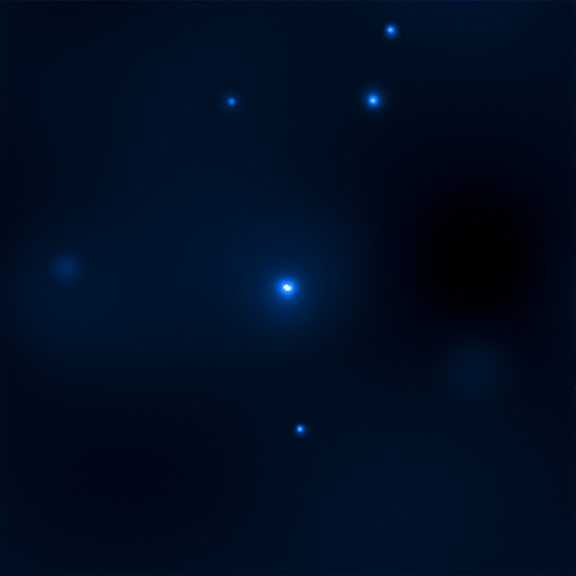
These two Chandra images show M33 X-7 when the black hole in this binary is not being eclipsed (left) and when it is being eclipsed (right). M33 X-7 is located in the center of the image. X-rays from a disk of hot gas close to the black hole cause M33 X-7 to be bright when it is outside eclipse. During eclipse some X-rays are still detected because of scattering of the disk's X-rays by the companion star's atmosphere or wind. The other X-ray sources are unrelated to M33 X-7. The differences in shape between the sources in the two panels are an instrumental effect.
(Credit: NASA/CXC/CfA/P.Plucinsky et al.)
These two Chandra images show M33 X-7 when the black hole in this binary is not being eclipsed (left) and when it is being eclipsed (right). M33 X-7 is located in the center of the image. X-rays from a disk of hot gas close to the black hole cause M33 X-7 to be bright when it is outside eclipse. During eclipse some X-rays are still detected because of scattering of the disk's X-rays by the companion star's atmosphere or wind. The other X-ray sources are unrelated to M33 X-7. The differences in shape between the sources in the two panels are an instrumental effect.
(Credit: NASA/CXC/CfA/P.Plucinsky et al.)
2
Chandra X-ray & Hubble Optical Images of M33 X-7
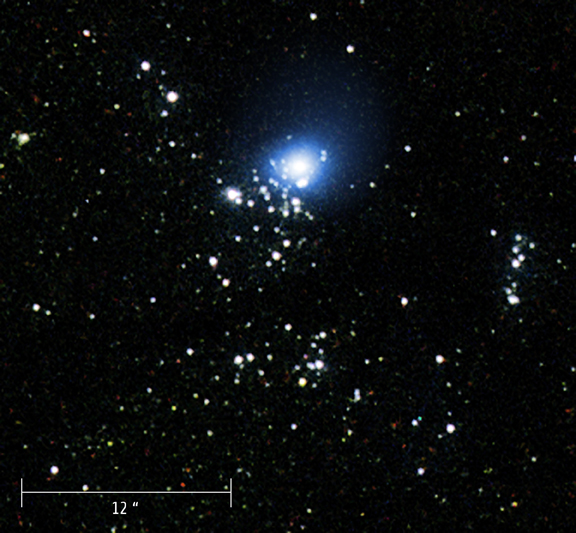
The composite image includes data from NASA's Chandra X-ray Observatory (blue) and the Hubble Space Telescope. The bright objects in the inset image are young, massive stars around M33 X-7, and the bright, blue Chandra source is M33 X-7 itself. X-rays from Chandra reveals how long the black hole is eclipsed by the companion star, which indicates the size of the companion.
(Credit: X-ray: NASA/CXC/CfA/P.Plucinsky et al.; Optical: NASA/STScI/SDSU/J.Orosz et al. )
The composite image includes data from NASA's Chandra X-ray Observatory (blue) and the Hubble Space Telescope. The bright objects in the inset image are young, massive stars around M33 X-7, and the bright, blue Chandra source is M33 X-7 itself. X-rays from Chandra reveals how long the black hole is eclipsed by the companion star, which indicates the size of the companion.
(Credit: X-ray: NASA/CXC/CfA/P.Plucinsky et al.; Optical: NASA/STScI/SDSU/J.Orosz et al. )
3
Gemini Optical Image of M33 X-7
Astronomers have located an exceptionally massive black hole - almost 16 times the mass of the Sun - in orbit around a huge companion star. By combining observations from NASA's Chandra X-ray Observatory with optical data from the Gemini telescope, the black hole known as M33 X-7 was determined to be the most massive black hole in its class. This result has intriguing implications for the evolution and ultimate fate of massive stars.
(Credit: AURA/Gemini Obs./SDSU/J.Orosz et al.)
Astronomers have located an exceptionally massive black hole - almost 16 times the mass of the Sun - in orbit around a huge companion star. By combining observations from NASA's Chandra X-ray Observatory with optical data from the Gemini telescope, the black hole known as M33 X-7 was determined to be the most massive black hole in its class. This result has intriguing implications for the evolution and ultimate fate of massive stars.
(Credit: AURA/Gemini Obs./SDSU/J.Orosz et al.)
4
Kitt Peak Optical Image of M33
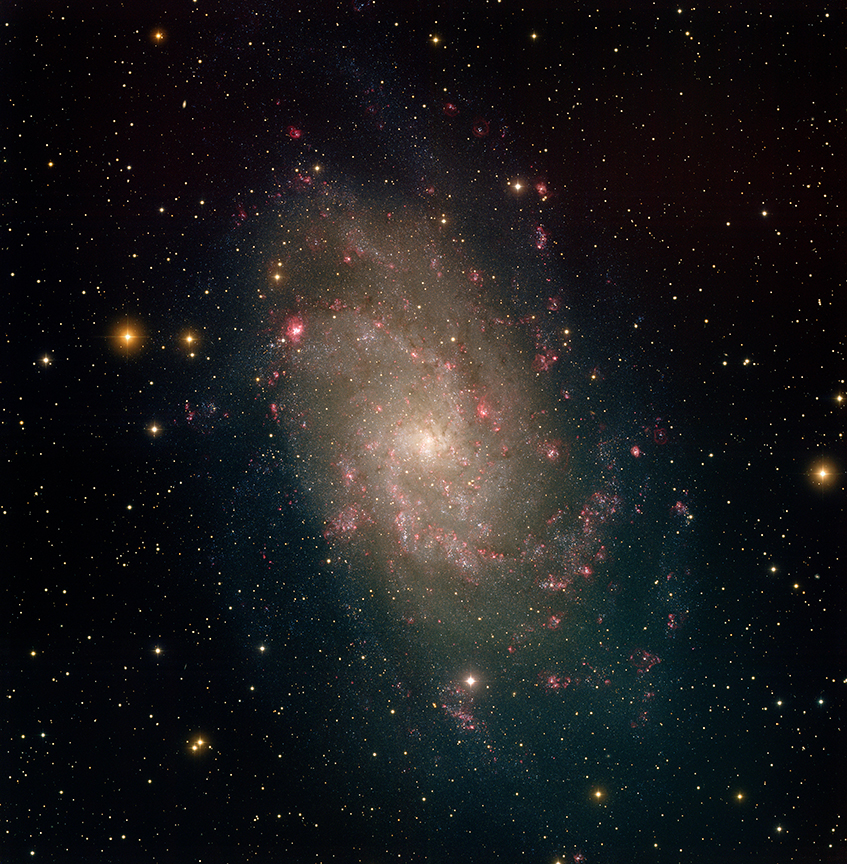
Located in the constellation of Triangulum, M33 is a nearby face-on spiral galaxy. It is over thirty thousand light years across. M33, our galaxy and the Andromeda Galaxy (a.k.a. M31) are the three major galaxies of our corner of the Universe, a small group of galaxies known as "The Local Group."
(Credit: NOAO/AURA/NSF/T.A.Rector)
Located in the constellation of Triangulum, M33 is a nearby face-on spiral galaxy. It is over thirty thousand light years across. M33, our galaxy and the Andromeda Galaxy (a.k.a. M31) are the three major galaxies of our corner of the Universe, a small group of galaxies known as "The Local Group."
(Credit: NOAO/AURA/NSF/T.A.Rector)
5
Artist's Illustration of M33 X-7
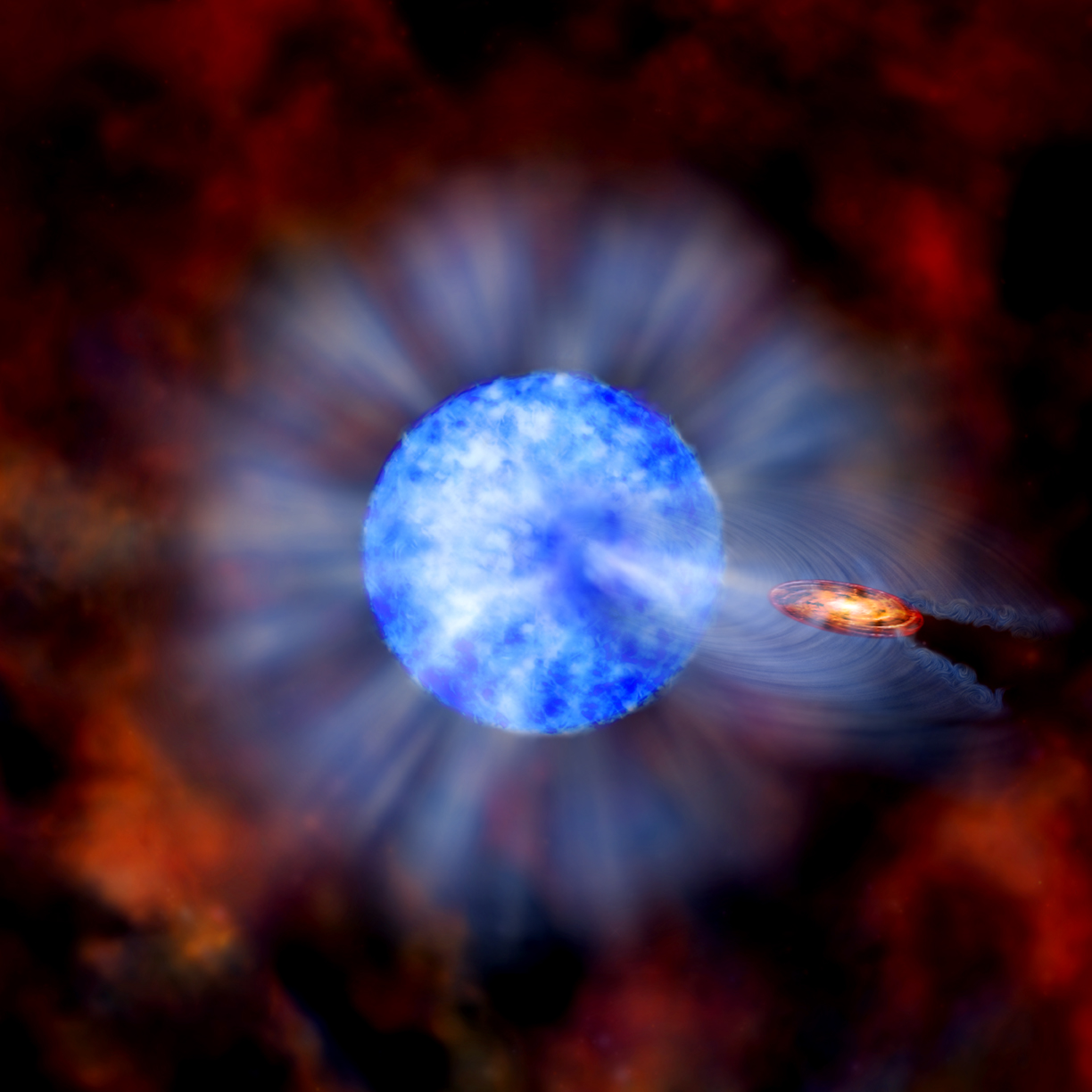
An artist's conception shows M33 X-7, a binary system in the galaxy M33 where a black hole is in orbit with a large star. Material from the large blue companion star is seen being pulled toward the black hole by its powerful gravity. A disk of this material (orange) is swept into orbit around the black hole, fed by winds flowing out from the star. This wind is disrupted by the black hole, causing turbulence and ripples beyond the disk.
(Credit: NASA/CXC/M.Weiss)
An artist's conception shows M33 X-7, a binary system in the galaxy M33 where a black hole is in orbit with a large star. Material from the large blue companion star is seen being pulled toward the black hole by its powerful gravity. A disk of this material (orange) is swept into orbit around the black hole, fed by winds flowing out from the star. This wind is disrupted by the black hole, causing turbulence and ripples beyond the disk.
(Credit: NASA/CXC/M.Weiss)
Return to M33 X-7 (October 17, 2007)


Revised: June 07, 2022