


CXC Home | Search | Help | Image Use Policy | Latest Images | Privacy | Accessibility | Glossary | Q&A
1
Chandra X-ray Images of the Eagle Nebula (M16)
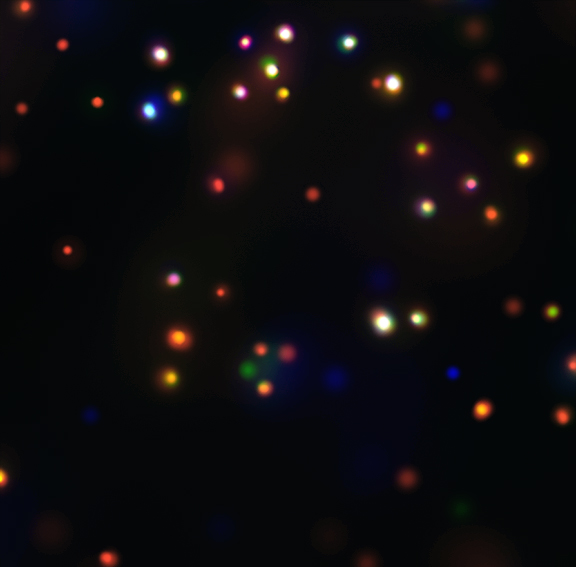
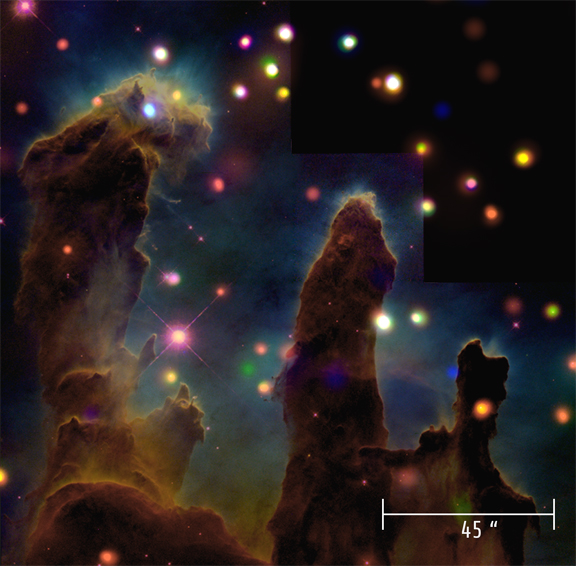
A new look at the famous "Pillars of Creation" with NASA's Chandra X-ray Observatory has allowed astronomers to peer inside the dark columns of gas and dust. This penetrating view of the Eagle Nebula reveals how much star formation is happening inside these iconic structures.
Scale: Image is 2.5 arcmin across
(Credit: X-ray: NASA/CXC/U.Colorado/Linsky et al.; Optical: NASA/ESA/STScI/ASU/J.Hester & P.Scowen)
A new look at the famous "Pillars of Creation" with NASA's Chandra X-ray Observatory has allowed astronomers to peer inside the dark columns of gas and dust. This penetrating view of the Eagle Nebula reveals how much star formation is happening inside these iconic structures.
Scale: Image is 2.5 arcmin across
(Credit: X-ray: NASA/CXC/U.Colorado/Linsky et al.; Optical: NASA/ESA/STScI/ASU/J.Hester & P.Scowen)
2
Beyond the Pillars of Creation
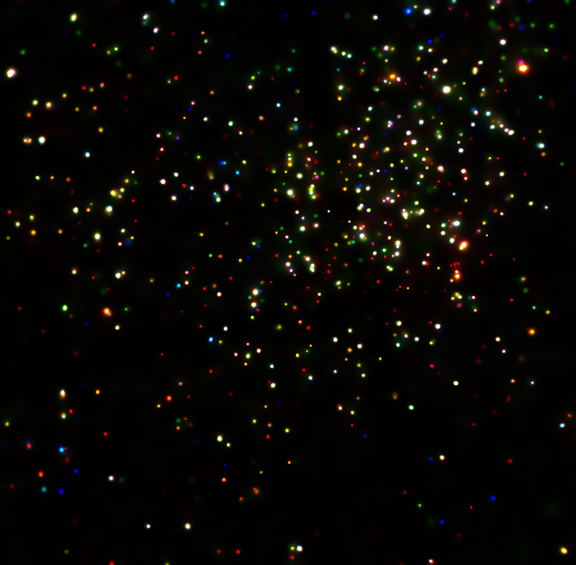
This composite image shows a much larger region of sky than the image focussing on the Pillars of Creation. The complete Chandra data contains over a thousand X-ray sources, most of them young stars with masses close to that of the Sun. Hundreds of these objects are visible near the center of the young galactic cluster NGC 6611, seen in the upper right part of the image. These young stars may have formed in pillars of dust and gas that are now extinct. The Hubble Space Telescope image of the Pillars of Creation is shown in the lower left.
Scale: Images are 7.7 x 7.9 arcmin
(Credit: X-ray: NASA/CXC/U.Colorado/Linsky et al.; Optical: NASA/ESA/STScI/ASU/J.Hester & P.Scowen))
This composite image shows a much larger region of sky than the image focussing on the Pillars of Creation. The complete Chandra data contains over a thousand X-ray sources, most of them young stars with masses close to that of the Sun. Hundreds of these objects are visible near the center of the young galactic cluster NGC 6611, seen in the upper right part of the image. These young stars may have formed in pillars of dust and gas that are now extinct. The Hubble Space Telescope image of the Pillars of Creation is shown in the lower left.
Scale: Images are 7.7 x 7.9 arcmin
(Credit: X-ray: NASA/CXC/U.Colorado/Linsky et al.; Optical: NASA/ESA/STScI/ASU/J.Hester & P.Scowen))
3
Chandra X-ray & Hubble Optical Image of the Eagle Nebula (M16), Labeled
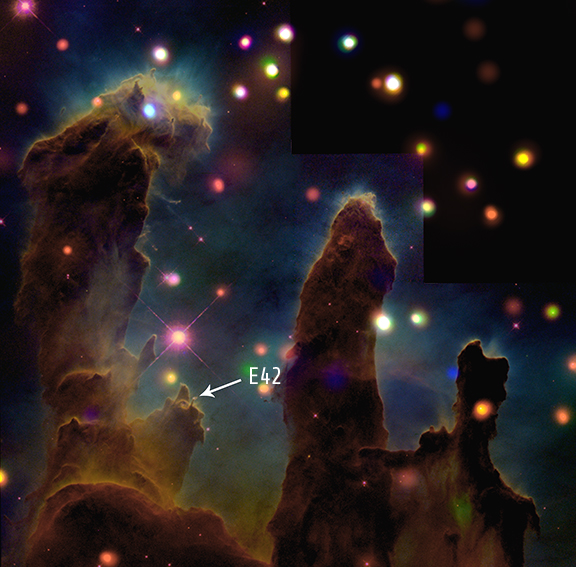
An interesting aspect of the Pillars of Creation is the evaporating gaseous globules, or EGGs, where stars are believed to be forming. X-rays were not detected from these dense, compact pockets of gas, suggesting that most of the EGGs do not contain enshrouded stars. However, 11 of the 73 EGGs contain infant stellar objects seen in the infrared and 4 of these are massive enough to form a star. One of them (E42) is estimated to have about the mass of the Sun and could represent one of the earliest stages of evolution of our nearest star.
Scale: Image is 2.5 arcmin across
(Credit: X-ray: NASA/CXC/U.Colorado/Linsky et al.; Optical: NASA/ESA/STScI/ASU/J.Hester & P.Scowen)
An interesting aspect of the Pillars of Creation is the evaporating gaseous globules, or EGGs, where stars are believed to be forming. X-rays were not detected from these dense, compact pockets of gas, suggesting that most of the EGGs do not contain enshrouded stars. However, 11 of the 73 EGGs contain infant stellar objects seen in the infrared and 4 of these are massive enough to form a star. One of them (E42) is estimated to have about the mass of the Sun and could represent one of the earliest stages of evolution of our nearest star.
Scale: Image is 2.5 arcmin across
(Credit: X-ray: NASA/CXC/U.Colorado/Linsky et al.; Optical: NASA/ESA/STScI/ASU/J.Hester & P.Scowen)
4
Hubble Optical Image of the Eagle Nebula (M16)
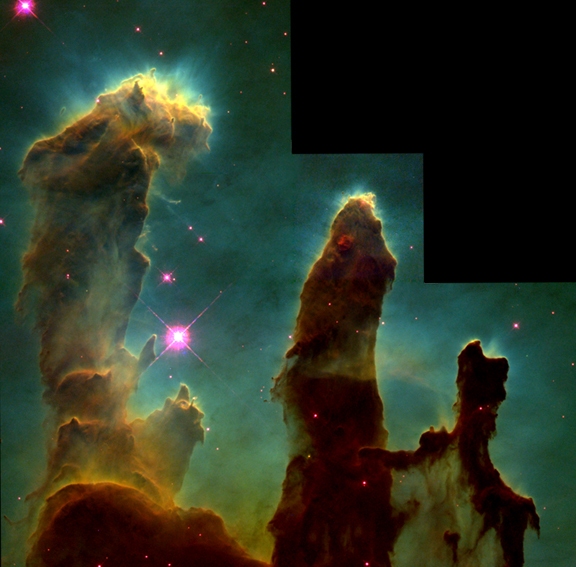
This classic image from the Hubble telescope shows newborn stars emerging from "eggs" - dense, compact pockets of interstellar gas called evaporating gaseous globules (EGGs). The Eagle nebula, also known as M16, is a nearby star-forming region 7,000 light years from Earth in the constellation Serpens.
Scale: Image is 2.5 arcmin across
(Credit: NASA/ESA/STScI/ASU/J.Hester & P.Scowen)
More Information
This classic image from the Hubble telescope shows newborn stars emerging from "eggs" - dense, compact pockets of interstellar gas called evaporating gaseous globules (EGGs). The Eagle nebula, also known as M16, is a nearby star-forming region 7,000 light years from Earth in the constellation Serpens.
Scale: Image is 2.5 arcmin across
(Credit: NASA/ESA/STScI/ASU/J.Hester & P.Scowen)
More Information
5
A Great Observatories Perspective of the Eagle Nebula (M16)
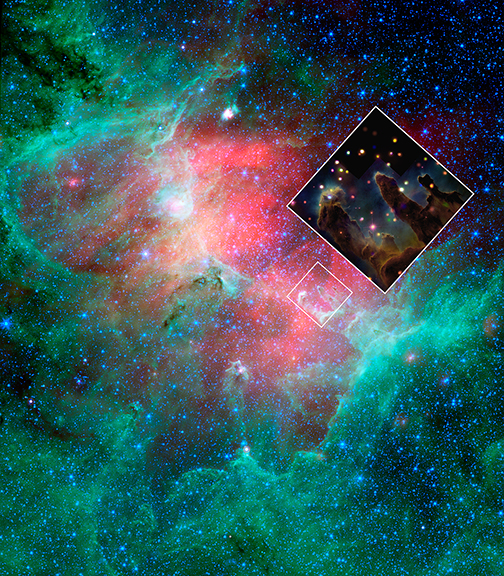
The Eagle Nebula ("Pillars of Creation") looks very different when viewed through three of NASA's orbiting observatories. The infrared image from the Spitzer Space Telescope and the famous Hubble Space Telescope image show the gas and dust of this star-forming region. The X-ray image from Chandra allows astronomers to peer through the obscuring material, and shows that the Eagle Nebula may be past its prime in terms of making stars. One young star is found inside the pillars, which scientists estimate to be 4 or 5 times more massive than the Sun.
Scale: Image is 28 x 32 arcmin
More Information on Hubble and Spitzer
(Credit: X-ray: NASA/CXC/U.Colorado/Linsky et al.; Optical: NASA/ESA/STScI/ASU/J.Hester & P.Scowen; Infrared: NASA/JPL-Caltech/SSC/N.Flagey & A.Noriega-Crespo)
The Eagle Nebula ("Pillars of Creation") looks very different when viewed through three of NASA's orbiting observatories. The infrared image from the Spitzer Space Telescope and the famous Hubble Space Telescope image show the gas and dust of this star-forming region. The X-ray image from Chandra allows astronomers to peer through the obscuring material, and shows that the Eagle Nebula may be past its prime in terms of making stars. One young star is found inside the pillars, which scientists estimate to be 4 or 5 times more massive than the Sun.
Scale: Image is 28 x 32 arcmin
More Information on Hubble and Spitzer
(Credit: X-ray: NASA/CXC/U.Colorado/Linsky et al.; Optical: NASA/ESA/STScI/ASU/J.Hester & P.Scowen; Infrared: NASA/JPL-Caltech/SSC/N.Flagey & A.Noriega-Crespo)
Return to The Eagle Nebula (M16) (15 Feb 07)


Revised: June 07, 2022