

CXC Home | Search | Help | Image Use Policy | Latest Images | Privacy | Accessibility | Glossary | Q&A
Images of DEM L238 and DEM L249
Quicktime MPEG
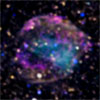
The sequence shows an optical image and then a composite of Chandra X-ray data (blue) and optical data (white) of DEM L238 and DEM L249, two supernova remnants in the Large Magellanic Cloud. The view then shows how DEM L238 appears in the three bands of X-ray emission (low-energy X-rays in red, medium energies in green and high energies in blue). The central region of DEM L238 is green which indicates that it is rich in iron, identifying it as a Type Ia supernova that came from the explosion of a much younger star than expected.
[Runtime: 0:12]
(Credit: X-ray: NASA/CXC/NCSU/K.Borkowski; Optical: NOAO/CTIO/MCELS)
Quicktime MPEG
The sequence shows an optical image and then a composite of Chandra X-ray data (blue) and optical data (white) of DEM L238 and DEM L249, two supernova remnants in the Large Magellanic Cloud. The view then shows how DEM L238 appears in the three bands of X-ray emission (low-energy X-rays in red, medium energies in green and high energies in blue). The central region of DEM L238 is green which indicates that it is rich in iron, identifying it as a Type Ia supernova that came from the explosion of a much younger star than expected.
[Runtime: 0:12]
(Credit: X-ray: NASA/CXC/NCSU/K.Borkowski; Optical: NOAO/CTIO/MCELS)
Comparison of Type Ia Supernovas
Quicktime MPEG
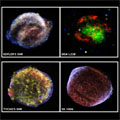
This sequence compares the Chandra image of DEM L238 with the Chandra image of 3 Type Ia supernova remnants located in the Milky Way. The X-ray emission for Kepler's remnant contains a bright central region similar to DEM L238, while the X-ray emission for Tycho's remnant and SN 1006 are generally much more uniform. These results suggest that the stars that exploded and caused the DEM L238 and Kepler supernova remnants were much younger than the stars that produced the Tycho and SN 1006 remnants.
[Runtime: 0:20]
(Credit: NASA/CXC)
Quicktime MPEG
This sequence compares the Chandra image of DEM L238 with the Chandra image of 3 Type Ia supernova remnants located in the Milky Way. The X-ray emission for Kepler's remnant contains a bright central region similar to DEM L238, while the X-ray emission for Tycho's remnant and SN 1006 are generally much more uniform. These results suggest that the stars that exploded and caused the DEM L238 and Kepler supernova remnants were much younger than the stars that produced the Tycho and SN 1006 remnants.
[Runtime: 0:20]
(Credit: NASA/CXC)
Return to DEM L238 and DEM L249 (04 Jan 07)


Revised: April 22, 2020