

CXC Home | Search | Help | Image Use Policy | Latest Images | Privacy | Accessibility | Glossary | Q&A
Scale Chandra Images to Full Moon
Quicktime MPEG
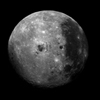
This survey, taken in a region of the Bootes constellation, involved 126 separate Chandra exposures of 5,000-seconds each, making it the largest contiguous field ever obtained by the observatory. At 9.3 square degrees, it is over 40 times larger than the full moon seen on the night sky, which is shown in this graphic for scale.
[Runtime: 0:12]
(Credit: X-ray: NASA/CXC/CfA/R.Hickox et al.; Moon: NASA/JPL)
Quicktime MPEG
This survey, taken in a region of the Bootes constellation, involved 126 separate Chandra exposures of 5,000-seconds each, making it the largest contiguous field ever obtained by the observatory. At 9.3 square degrees, it is over 40 times larger than the full moon seen on the night sky, which is shown in this graphic for scale.
[Runtime: 0:12]
(Credit: X-ray: NASA/CXC/CfA/R.Hickox et al.; Moon: NASA/JPL)
Comparing Different Black Holes
Quicktime MPEG
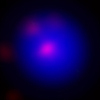
This sequence shows four black holes from the Bootes field. The first two black holes are obscured by thick rings of gas. Because such a ring blocks certain types of radiation, these black holes are only are seen in X-ray (blue) and infrared (red) light. The last two black holes are not enshrouded by this ring of material, and, therefore, emit X-ray, infrared, and optical (green) radiation. These objects helps astronomers better understand the properties of these monster black holes.
[Runtime: 0:08]
(Credit: X-ray: NASA/CXC/CfA/R.Hickox et al.; Infrared: NASA/JPL/Caltech/P.Eisenhardt & D.Stern et al.; Optical: NOAO/B.Jannuzi & A.Dey et al.)
Quicktime MPEG
This sequence shows four black holes from the Bootes field. The first two black holes are obscured by thick rings of gas. Because such a ring blocks certain types of radiation, these black holes are only are seen in X-ray (blue) and infrared (red) light. The last two black holes are not enshrouded by this ring of material, and, therefore, emit X-ray, infrared, and optical (green) radiation. These objects helps astronomers better understand the properties of these monster black holes.
[Runtime: 0:08]
(Credit: X-ray: NASA/CXC/CfA/R.Hickox et al.; Infrared: NASA/JPL/Caltech/P.Eisenhardt & D.Stern et al.; Optical: NOAO/B.Jannuzi & A.Dey et al.)
Black Hole Animation
Quicktime MPEG
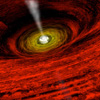
This animation illustrates the activity surrounding a black hole. While the matter that has passed the black hole's "event horizon" can't be seen, material swirling outside this threshold is accelerated to millions of degrees and radiates in X-rays. At the end of the animation, the black hole is shown shrouded in a cloud of gas and dust, obscuring it from most angles at wavelengths other than the X-rays picked up by the Chandra X-ray Observatory.
[Runtime: 0:27]
(Animation: CXC/A.Hobart)
Still Photo
Quicktime MPEG
This animation illustrates the activity surrounding a black hole. While the matter that has passed the black hole's "event horizon" can't be seen, material swirling outside this threshold is accelerated to millions of degrees and radiates in X-rays. At the end of the animation, the black hole is shown shrouded in a cloud of gas and dust, obscuring it from most angles at wavelengths other than the X-rays picked up by the Chandra X-ray Observatory.
[Runtime: 0:27]
(Animation: CXC/A.Hobart)
Still Photo
Return to Bootes Field (12 Mar 07)


Revised: April 22, 2020