




CXC Home | Search | Help | Image Use Policy | Latest Images | Privacy | Accessibility | Glossary | Q&A
Download Image
More Information
More Images
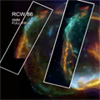
Chandra X-ray Image
of RCW 86
of RCW 86
(Credit: NASA/CXC/Univ. of Utrecht/J.Vink et al.)
Animation & Video
More Releases
Related Images
RCW 86:
New Evidence Links Stellar Remains to Oldest Recorded Supernova

Credit: Chandra: NASA/CXC/Univ. of Utrecht/J.Vink et al. XMM-Newton: ESA/Univ. of Utrecht/J.Vink et al.

New Evidence Links Stellar Remains to Oldest Recorded Supernova

Credit: Chandra: NASA/CXC/Univ. of Utrecht/J.Vink et al. XMM-Newton: ESA/Univ. of Utrecht/J.Vink et al.
Visual Description:
The combined image from the Chandra and XMM-Newton X-ray observatories of RCW 86 shows the expanding ring of debris that was created after a massive star in the Milky Way collapsed onto itself and exploded. Both the Chandra and XMM images show low energy X-rays in red, medium energies in green and high energies in blue. The Chandra observations focused on the northeast (left-hand) side of RCW 86, and show that X-ray radiation is produced both by high-energy electrons accelerated in a magnetic field (blue) as well as heat from the blast itself (red).
Properties of the shell in the Chandra image, along with the remnant's size and a basic understanding of how supernovas expand, were used to help determine the age of RCW 86. The new data revealed that RCW 86 was created by a star that exploded about 2,000 years ago. This age matches observations of a new bright star by Chinese astronomers in 185 A.D. (and possibly Romans as well) and may be the oldest known recordings of a supernova. Supernova explosions in galaxies like ours are rare, and none have been recorded in hundreds of years.
|
||||||||||||||||||||||||||||
Visual Description:
The X-ray image of the supernova remnant RCW 86 shows a large, bright, irregular circular object that resembles an outlined glowing ball. At the edges of the remnant, there are wispy, bright tendrils around the perimeter. On the right side is a close-up of just a small portion of the remnant from the upper left. The colors are a pretty combination of aqua green and burnt orange. The combined image of X-ray observations from the Chandra and XMM-Newton of RCW 86 shows the expanding ring of debris that was created after a massive star in the Milky Way collapsed onto itself and exploded. Both the Chandra and XMM-Newton images have low energy X-rays colored in red, medium energies in green and high energies in blue. The Chandra observations focused on the northeast (left-hand) side of RCW 86 show that X-ray radiation is produced both by high-energy electrons accelerated in a magnetic field (blue) as well as heat from the blast itself (red).


Revised: October 07, 2026