


CXC Home | Search | Help | Image Use Policy | Latest Images | Privacy | Accessibility | Glossary | Q&A
1
Experimental Simulations of SN Shock Waves
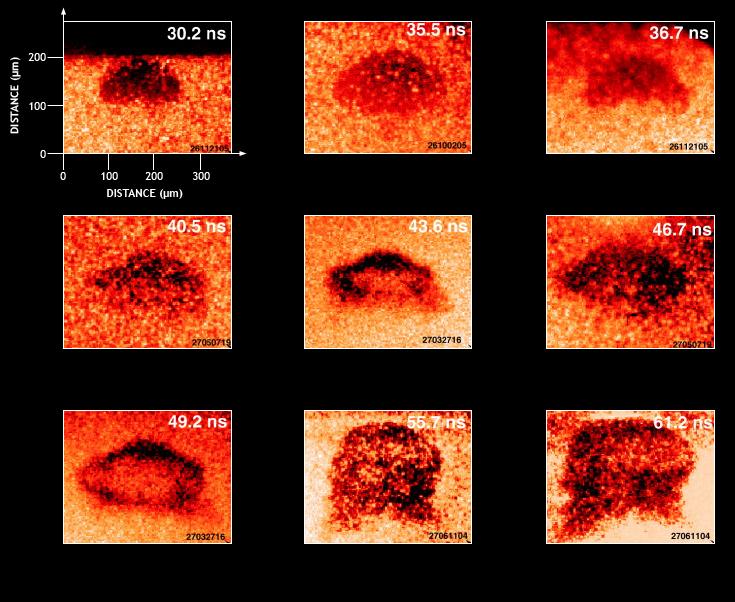
This sequence of laboratory images shows experimental simulations of the interaction of supernova shock waves with dense interstellar clouds. In these experiments, a strong shock wave sweeps over a vaporized copper ball that has a diameter roughly equal to a human hair. The cloud is compressed, and then expands in about 40 nanoseconds to form an oval bar and cap structure much like that seen in Puppis A.
Reference:Klein et al. 2003 apj 583, 245 The Astrophysical Journal, 583:245-259, 2003 January 20
(Credit: UC Berkeley, R.Klein et al.)
This sequence of laboratory images shows experimental simulations of the interaction of supernova shock waves with dense interstellar clouds. In these experiments, a strong shock wave sweeps over a vaporized copper ball that has a diameter roughly equal to a human hair. The cloud is compressed, and then expands in about 40 nanoseconds to form an oval bar and cap structure much like that seen in Puppis A.
Reference:Klein et al. 2003 apj 583, 245 The Astrophysical Journal, 583:245-259, 2003 January 20
(Credit: UC Berkeley, R.Klein et al.)
2
Chandra X-ray Image of Puppis A
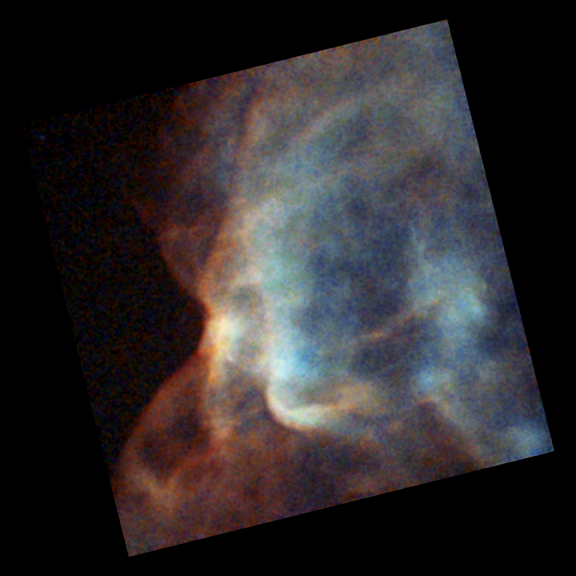
Chandra's three-color image of a region of Puppis A reveals a cloud being torn apart by a shockwave produced by a supernova explosion. This is the first X-ray detection of such a process in an advanced phase. The blue vertical bar and the blue fuzzy ball or cap to the right show how the cloud has been spread out into an oval-shaped structure that is almost empty in the center. Understanding how shock waves interact with clouds is important for answering key questions such as the role supernovas play in heating interstellar gas and triggering the collapse of large interstellar clouds to form new generations of stars.
(Credit: NASA/CXC/GSFC/U.Hwang et al.)
Chandra's three-color image of a region of Puppis A reveals a cloud being torn apart by a shockwave produced by a supernova explosion. This is the first X-ray detection of such a process in an advanced phase. The blue vertical bar and the blue fuzzy ball or cap to the right show how the cloud has been spread out into an oval-shaped structure that is almost empty in the center. Understanding how shock waves interact with clouds is important for answering key questions such as the role supernovas play in heating interstellar gas and triggering the collapse of large interstellar clouds to form new generations of stars.
(Credit: NASA/CXC/GSFC/U.Hwang et al.)
3
ROSAT X-ray Image of Puppis A, Wide-Field
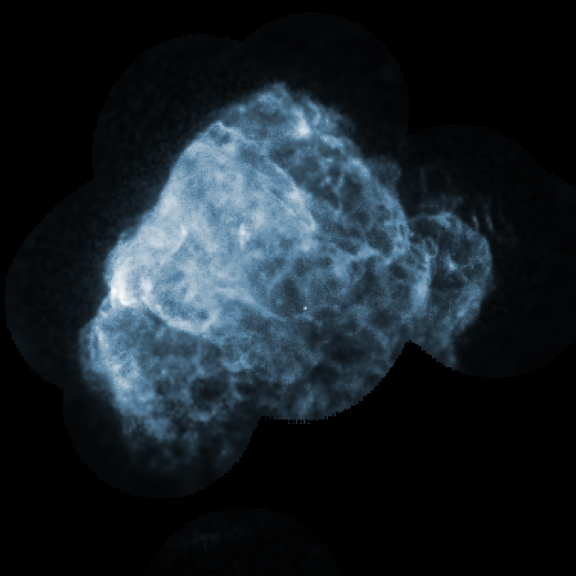
This X-ray image from the Roentgensatellite or ROSAT - a joint venture between Germany, the United Kingdom and the United States - may offer a view of a recently formed neutron stars' X-ray glow. Pictured is the supernova remnant Puppis A, one of the brightest sources in the X-ray sky, with shocked gas clouds still expanding and radiating X-rays. A faint pinpoint source of X-rays is visible (white dot near center) which is likely a young neutron star, kicked out by the asymmetric explosion and moving away from the site of the original supernova at about 600 miles per second.
(Credit: NASA/GSFC/S.Snowden et al.)
This X-ray image from the Roentgensatellite or ROSAT - a joint venture between Germany, the United Kingdom and the United States - may offer a view of a recently formed neutron stars' X-ray glow. Pictured is the supernova remnant Puppis A, one of the brightest sources in the X-ray sky, with shocked gas clouds still expanding and radiating X-rays. A faint pinpoint source of X-rays is visible (white dot near center) which is likely a young neutron star, kicked out by the asymmetric explosion and moving away from the site of the original supernova at about 600 miles per second.
(Credit: NASA/GSFC/S.Snowden et al.)
Return to Puppis A (15 Feb 06)



Revised: December 01, 2022