

CXC Home | Search | Help | Image Use Policy | Latest Images | Privacy | Accessibility | Glossary | Q&A
1
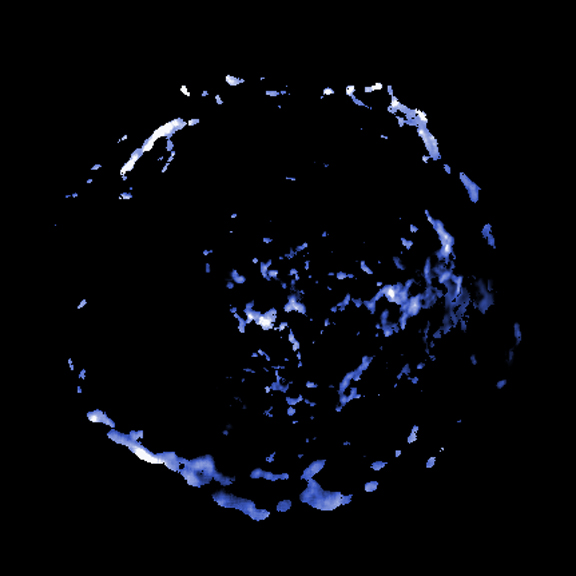
Acceleration Map of Cassiopeia A
This figure shows regions in Cas A where the X-ray emission is generated by electrons spiraling along magnetic field lines and being accelerated as they pass across the remnant's shock front. In this acceleration map, the brighter parts of the image show where the acceleration is occurring relatively quickly. In the brightest areas the electrons are being accelerated almost as fast as theoretically possible.
Scale: Image is 7.3 arcmin across
(Credit: NASA/CXC/MIT/UMass Amherst/M.D.Stage et al.)
This figure shows regions in Cas A where the X-ray emission is generated by electrons spiraling along magnetic field lines and being accelerated as they pass across the remnant's shock front. In this acceleration map, the brighter parts of the image show where the acceleration is occurring relatively quickly. In the brightest areas the electrons are being accelerated almost as fast as theoretically possible.
Scale: Image is 7.3 arcmin across
(Credit: NASA/CXC/MIT/UMass Amherst/M.D.Stage et al.)
2
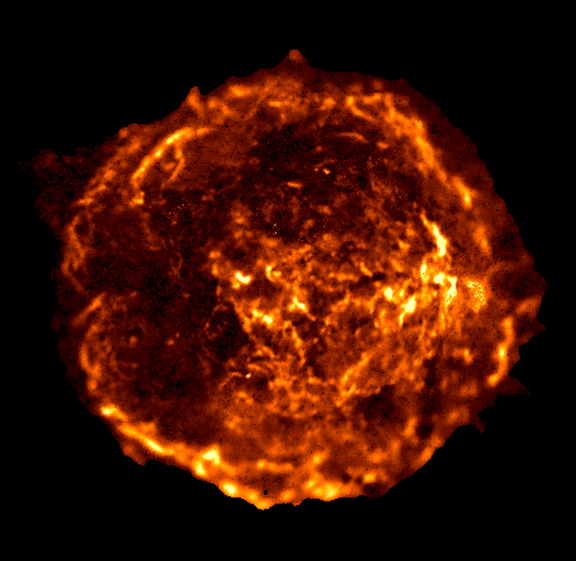
Temperature Map of Cassiopeia A
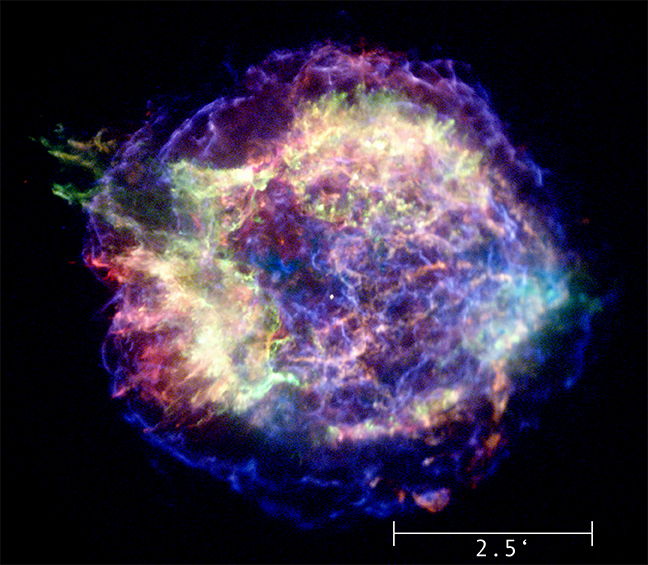
This image shows the temperature of the gas in the supernova remnant Cas A, assuming that the X-ray emission is caused by heat generated by the stellar explosion. Brighter regions represent higher temperatures. Although most of the remnant's X-ray emission is explained by heat from the explosion, in some regions the X-ray emission appears to be caused by a different mechanism. In the brightest regions of the image, corresponding to the blue regions in the 3-color image, energetic electrons spiral along magnetic field lines and are accelerated, generating X-rays that are detected by Chandra.
Scale: Image is 7.3 arcmin across
(Credit: NASA/CXC/MIT/UMass Amherst/M.D.Stage et al.)
This image shows the temperature of the gas in the supernova remnant Cas A, assuming that the X-ray emission is caused by heat generated by the stellar explosion. Brighter regions represent higher temperatures. Although most of the remnant's X-ray emission is explained by heat from the explosion, in some regions the X-ray emission appears to be caused by a different mechanism. In the brightest regions of the image, corresponding to the blue regions in the 3-color image, energetic electrons spiral along magnetic field lines and are accelerated, generating X-rays that are detected by Chandra.
Scale: Image is 7.3 arcmin across
(Credit: NASA/CXC/MIT/UMass Amherst/M.D.Stage et al.)
3
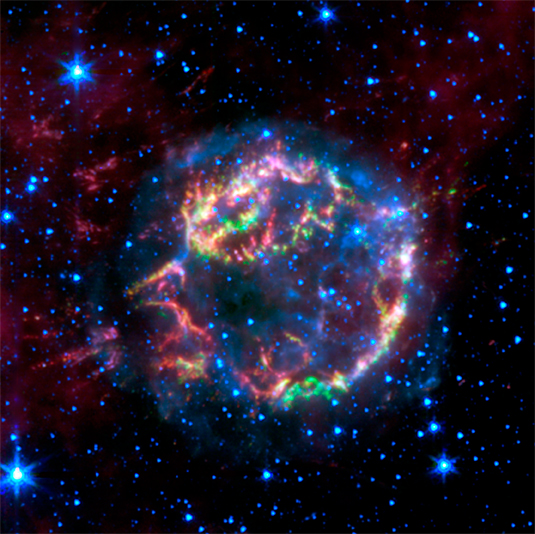
Spitzer Infrared Image of Cassiopeia A
This image from NASA's Spitzer Space Telescope shows Cassiopeia A in infrared light. The faint, blue glow surrounding the dead star is material that was energized by a shock wave, called the forward shock, which was created when the star blew up. The forward shock is now located at the outer edge of the blue glow. Stars are also seen in blue. Green, yellow and red primarily represent material that was ejected in the explosion and heated by a slower shock wave, called the reverse shock wave. The picture was taken by Spitzer's infrared array camera and is a composite of 3.6-micron light (blue); 4.5-micron light (green); and 8.0-micron light (red). Note, image is rotated counterclockwise from the Chandra orientation.
More Information at Spitzer
(Credit: NASA/JPL-Caltech/L.Rudnick (Univ. of Minn.))
This image from NASA's Spitzer Space Telescope shows Cassiopeia A in infrared light. The faint, blue glow surrounding the dead star is material that was energized by a shock wave, called the forward shock, which was created when the star blew up. The forward shock is now located at the outer edge of the blue glow. Stars are also seen in blue. Green, yellow and red primarily represent material that was ejected in the explosion and heated by a slower shock wave, called the reverse shock wave. The picture was taken by Spitzer's infrared array camera and is a composite of 3.6-micron light (blue); 4.5-micron light (green); and 8.0-micron light (red). Note, image is rotated counterclockwise from the Chandra orientation.
More Information at Spitzer
(Credit: NASA/JPL-Caltech/L.Rudnick (Univ. of Minn.))
4
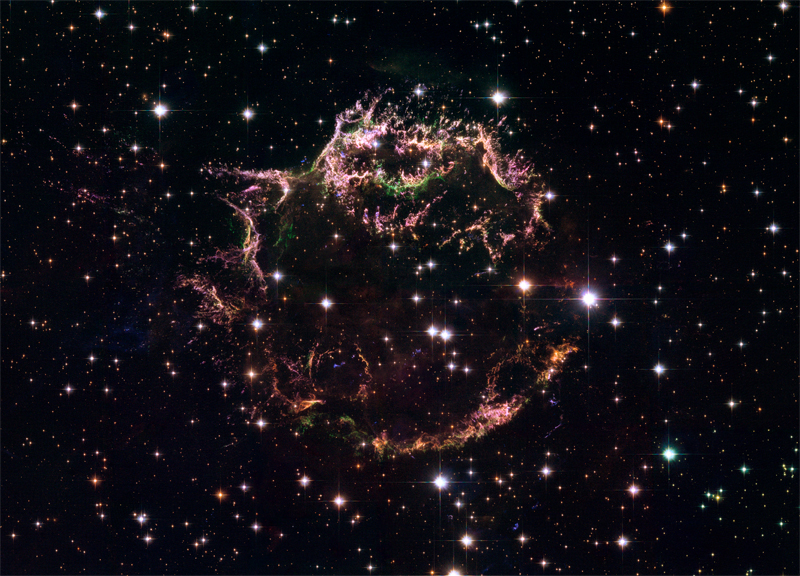
Hubble Optical Image of Cassiopeia A
This image taken with NASA's Hubble Space Telescope provides a detailed look at Cassiopeia A in optical light. The Hubble image shows the complex and intricate structure of the star's shattered fragments. The image is a composite made from 18 separate images taken in December 2004 using Hubble's Advanced Camera for Surveys (ACS).
More Information at Hubble
(Credit: NASA/ESA/Hubble Heritage (STScI/AURA))
This image taken with NASA's Hubble Space Telescope provides a detailed look at Cassiopeia A in optical light. The Hubble image shows the complex and intricate structure of the star's shattered fragments. The image is a composite made from 18 separate images taken in December 2004 using Hubble's Advanced Camera for Surveys (ACS).
More Information at Hubble
(Credit: NASA/ESA/Hubble Heritage (STScI/AURA))
Return to Cassiopeia A (15 Nov 06)


Revised: June 07, 2022