

CXC Home | Search | Help | Image Use Policy | Latest Images | Privacy | Accessibility | Glossary | Q&A
Sequence of "Bullet Cluster" Images
Quicktime MPEG
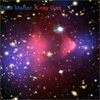
This is a sequence of images of the galaxy cluster 1E 0657-56, also known as the bullet cluster. The optical image from the Magellan and the Hubble Space Telescope shows galaxies in orange and white. Hot gas, which contains the bulk of the normal matter in the cluster, is shown by the Chandra X-ray image (pink). Gravitational lensing, the distortion of background images by mass in the cluster, reveals the mass of the cluster is dominated by dark matter (blue). This is the first clear separation between normal and dark matter.
[Runtime: 0:15]
(Credit: X-ray: NASA/CXC/CfA/M.Markevitch et al. Optical: NASA/STScI; Magellan/U.Arizona/D.Clowe et al. Lensing Map: NASA/STScI; ESO WFI; Magellan/U.Arizona/D.Clowe et al.)
Quicktime MPEG
This is a sequence of images of the galaxy cluster 1E 0657-56, also known as the bullet cluster. The optical image from the Magellan and the Hubble Space Telescope shows galaxies in orange and white. Hot gas, which contains the bulk of the normal matter in the cluster, is shown by the Chandra X-ray image (pink). Gravitational lensing, the distortion of background images by mass in the cluster, reveals the mass of the cluster is dominated by dark matter (blue). This is the first clear separation between normal and dark matter.
[Runtime: 0:15]
(Credit: X-ray: NASA/CXC/CfA/M.Markevitch et al. Optical: NASA/STScI; Magellan/U.Arizona/D.Clowe et al. Lensing Map: NASA/STScI; ESO WFI; Magellan/U.Arizona/D.Clowe et al.)
Animation of Cluster Collision
Quicktime MPEG
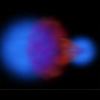
This animation shows an artist's representation of the huge collision in the bullet cluster. Hot gas, containing most of the normal matter in the cluster, is shown in red and dark matter is in blue. During the collision the hot gas in each cluster is slowed and distorted by a drag force, similar to air resistance. A bullet-shaped cloud of gas forms in one of the clusters. In contrast, the dark matter is not slowed by the impact, because it does not interact directly with itself or the gas except through gravity, and separates from the normal matter. The animation ends by dissolving into an image showing the hot gas seen with Chandra (pink) and the cluster mass as inferred by gravitational lensing (blue), which is mostly dark matter.
View Stills
[Runtime: 0:15]
(Credit: NASA/CXC/M.Weiss)
Quicktime MPEG
This animation shows an artist's representation of the huge collision in the bullet cluster. Hot gas, containing most of the normal matter in the cluster, is shown in red and dark matter is in blue. During the collision the hot gas in each cluster is slowed and distorted by a drag force, similar to air resistance. A bullet-shaped cloud of gas forms in one of the clusters. In contrast, the dark matter is not slowed by the impact, because it does not interact directly with itself or the gas except through gravity, and separates from the normal matter. The animation ends by dissolving into an image showing the hot gas seen with Chandra (pink) and the cluster mass as inferred by gravitational lensing (blue), which is mostly dark matter.
View Stills
[Runtime: 0:15]
(Credit: NASA/CXC/M.Weiss)
Galaxy Cluster in Perspective
Quicktime MPEG
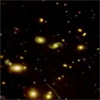
This motion graphic begins with a close-up of one of the galaxies, a spiral galaxy approximately the same size as the Milky Way, within the galaxy cluster known as 1E 0657-56. The view then pulls out to show over a thousand galaxies in this cluster. These immense objects are among the largest structures in the Universe.
[Runtime: 0:19]
(Credit: NASA/STScI; Magellan/U.Arizona/D.Clowe et al.)
Quicktime MPEG
This motion graphic begins with a close-up of one of the galaxies, a spiral galaxy approximately the same size as the Milky Way, within the galaxy cluster known as 1E 0657-56. The view then pulls out to show over a thousand galaxies in this cluster. These immense objects are among the largest structures in the Universe.
[Runtime: 0:19]
(Credit: NASA/STScI; Magellan/U.Arizona/D.Clowe et al.)
3D Animation of Cluster Collision
Quicktime MPEG
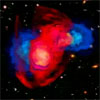
This visualization shows how astronomers believe the "bullet cluster" was created and will continue to develop. Courtesy of John Wise of the Kavli Institute for Particle Astrophysics and Cosmology.
[Runtime: 0:39]
(Credit: KIPAC/John Wise)
Quicktime MPEG
This visualization shows how astronomers believe the "bullet cluster" was created and will continue to develop. Courtesy of John Wise of the Kavli Institute for Particle Astrophysics and Cosmology.
[Runtime: 0:39]
(Credit: KIPAC/John Wise)
Return to 1E 0657-56 (21 Aug 06)


Revised: April 22, 2020