




CXC Home | Search | Help | Image Use Policy | Latest Images | Privacy | Accessibility | Glossary | Q&A
1
Illustration of MS 0735.6+7421
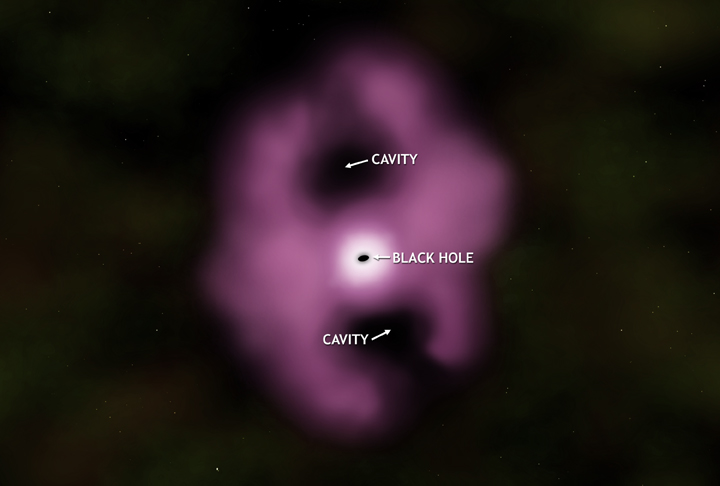
This image shows the Chandra X-ray image of the galaxy cluster MS 0735.6+7421 (left) in context with a labeled illustration of the system (right). The two giant cavities (dark red regions) found in the X-ray emitting, hot gas (bright red) in the galaxy cluster are evidence for the massive eruption. A supermassive black hole at the center of the bright X-ray emission caused the eruption.
Scale: X-ray image is 4.2 arcmin per side
(Credit: X-ray image: NASA/CXC/Ohio U./B.McNamara et al.; Illustration: NASA/CXC/M.Weiss)
This image shows the Chandra X-ray image of the galaxy cluster MS 0735.6+7421 (left) in context with a labeled illustration of the system (right). The two giant cavities (dark red regions) found in the X-ray emitting, hot gas (bright red) in the galaxy cluster are evidence for the massive eruption. A supermassive black hole at the center of the bright X-ray emission caused the eruption.
Scale: X-ray image is 4.2 arcmin per side
(Credit: X-ray image: NASA/CXC/Ohio U./B.McNamara et al.; Illustration: NASA/CXC/M.Weiss)
2
MS 0735.6+7421 Comparison with Perseus
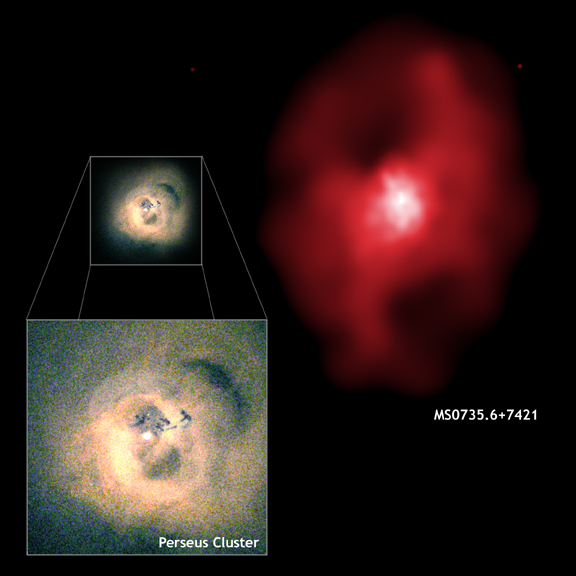
This montage compares the physical size of the cavities found in MS 0735 and the Perseus cluster, another well-known galaxy cluster with cavities. These two clusters are at very different distances -- Perseus is about 250 million light years away and MS 0735 is almost three billion light years away. To make a direct size comparison, the Perseus cluster is shrunk to simulate its appearance at the farther distance of MS 0735. From this comparison, it is obvious that the cavities in MS 0735 are much larger than those found in Perseus.
Scale: MS 0735: Image is 4.2 arcmin per side; Perseus: Image is 284 arcsec per side
(Credit: MS 0735: NASA/CXC/Ohio U./B.McNamara et al.; Perseus: NASA/CXC/IoA/A.Fabian et al.)
This montage compares the physical size of the cavities found in MS 0735 and the Perseus cluster, another well-known galaxy cluster with cavities. These two clusters are at very different distances -- Perseus is about 250 million light years away and MS 0735 is almost three billion light years away. To make a direct size comparison, the Perseus cluster is shrunk to simulate its appearance at the farther distance of MS 0735. From this comparison, it is obvious that the cavities in MS 0735 are much larger than those found in Perseus.
Scale: MS 0735: Image is 4.2 arcmin per side; Perseus: Image is 284 arcsec per side
(Credit: MS 0735: NASA/CXC/Ohio U./B.McNamara et al.; Perseus: NASA/CXC/IoA/A.Fabian et al.)
3
VLA Radio & Chandra X-ray Composite of MS 0735.6+7421
This image compares Chandra's X-ray image of MS 0735.6+7421 with a radio image taken by NRAO's Very Large Array (VLA). The radio image shows jets of high energy particles (in blue) that pushed the hot gas aside to create the cavities visible in the Chandra image. The radio data was taken on June 28, 1993.
Scale: Image is 4.2 arcmin per side
(Credit: X-ray: NASA/CXC/Ohio U./B.McNamara et al.; Radio: NRAO/AUI/NSF)
This image compares Chandra's X-ray image of MS 0735.6+7421 with a radio image taken by NRAO's Very Large Array (VLA). The radio image shows jets of high energy particles (in blue) that pushed the hot gas aside to create the cavities visible in the Chandra image. The radio data was taken on June 28, 1993.
Scale: Image is 4.2 arcmin per side
(Credit: X-ray: NASA/CXC/Ohio U./B.McNamara et al.; Radio: NRAO/AUI/NSF)
4
KPNO Optical Image of MS0735.6+7421
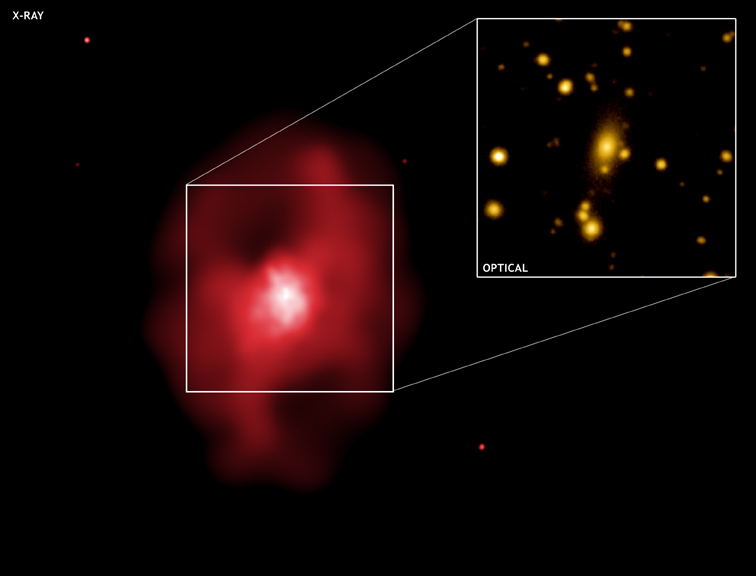
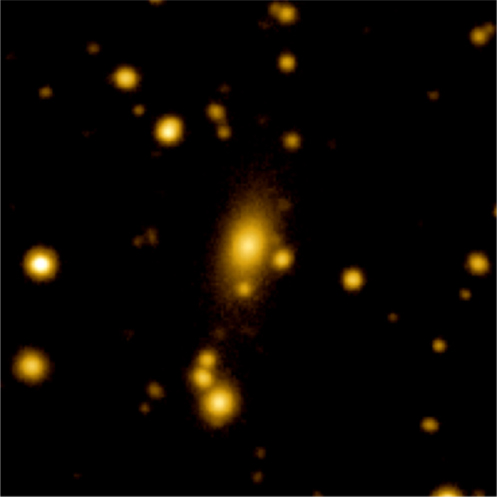
This optical image of MS0735.6+7421 was taken by the Kitt Peak National Observatory (KPNO) and shows a smaller field of view than the Chandra data. The large elliptical galaxy at the center of the image contains the supermassive black hole that generated the cavities in the Chandra image. The optical/X-ray comparison shows that the cavities are much larger than the elliptical galaxy. Other, smaller galaxies in the cluster are also visible in this image. Some of the relatively bright objects around the elliptical galaxy are stars that are unrelated to the galaxy cluster.
Scale: Optical image is 1.5 arcmin per side, X-ray image is 4.2 arcmin per side
(Credit: KPNO Optical: NSF/NOAO/KPNO/B.McNamara)
This optical image of MS0735.6+7421 was taken by the Kitt Peak National Observatory (KPNO) and shows a smaller field of view than the Chandra data. The large elliptical galaxy at the center of the image contains the supermassive black hole that generated the cavities in the Chandra image. The optical/X-ray comparison shows that the cavities are much larger than the elliptical galaxy. Other, smaller galaxies in the cluster are also visible in this image. Some of the relatively bright objects around the elliptical galaxy are stars that are unrelated to the galaxy cluster.
Scale: Optical image is 1.5 arcmin per side, X-ray image is 4.2 arcmin per side
(Credit: KPNO Optical: NSF/NOAO/KPNO/B.McNamara)
5
Artist's Depiction of Eruption from Supermassive Black Hole
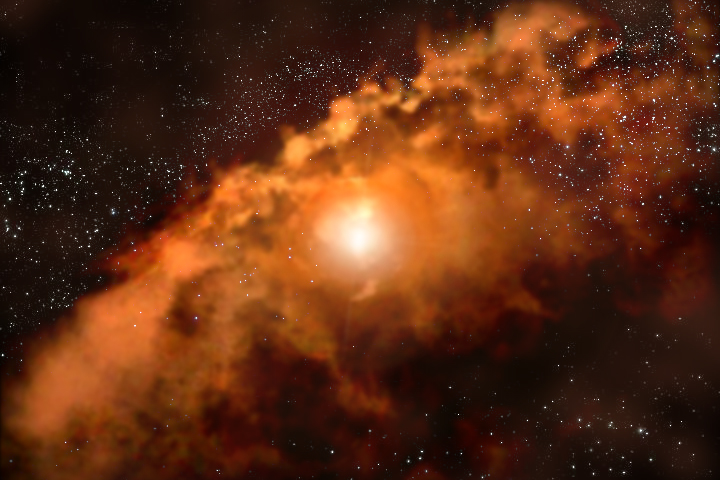
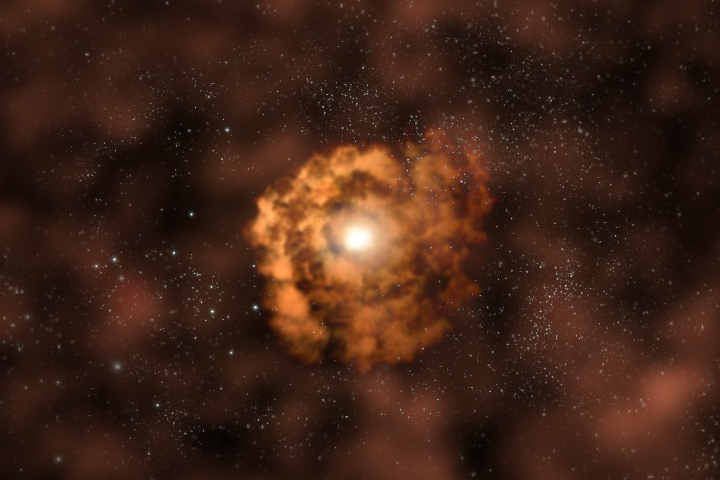
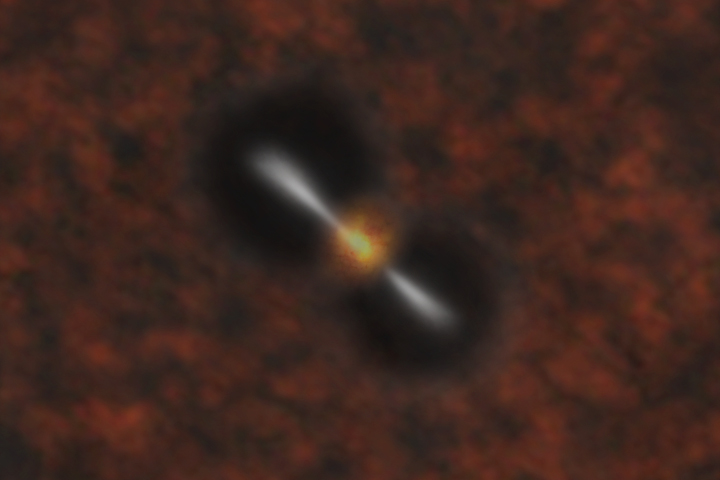
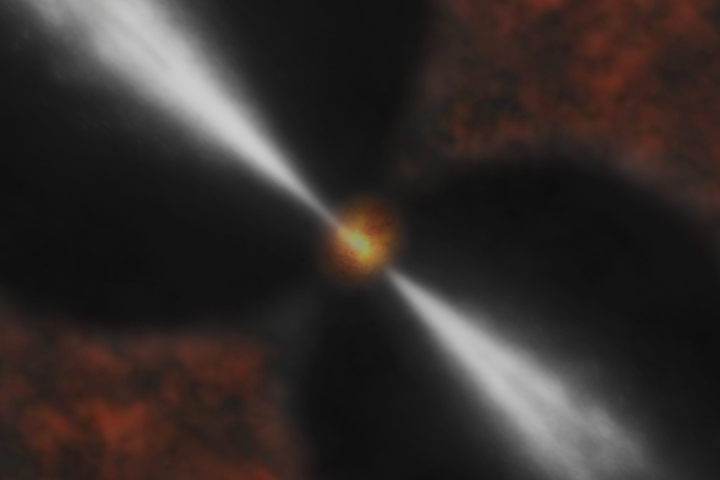
These four stills from an animation depict an eruption caused by a supermassive black hole. Gas and dust seen in a reddish-brown disk (upper left) are being pulled around by the enormous gravity of the supermassive black hole, which is buried in the center of a large elliptical galaxy (upper right). The view then zooms out to show the full view of the galaxy, which is surrounded by hot gas (lower left) that pervades the galaxy cluster. White jets, fueled from material falling onto the black hole, then erupt from the black hole and push gas backwards to create the dark cavities in the cluster gas as seen in the final panel.
View Black Hole Eruption Animation (Illustrations: NASA/CXC/A.Hobart)
These four stills from an animation depict an eruption caused by a supermassive black hole. Gas and dust seen in a reddish-brown disk (upper left) are being pulled around by the enormous gravity of the supermassive black hole, which is buried in the center of a large elliptical galaxy (upper right). The view then zooms out to show the full view of the galaxy, which is surrounded by hot gas (lower left) that pervades the galaxy cluster. White jets, fueled from material falling onto the black hole, then erupt from the black hole and push gas backwards to create the dark cavities in the cluster gas as seen in the final panel.
View Black Hole Eruption Animation (Illustrations: NASA/CXC/A.Hobart)
6
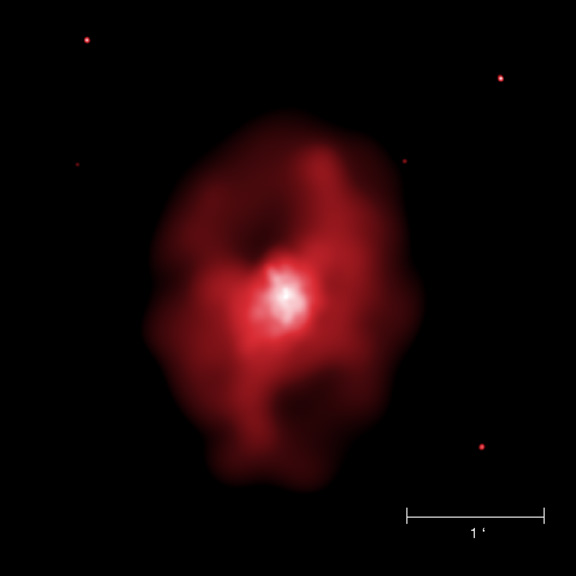
Chandra X-ray Image with Scale Bar
Scalebar = 1 arcmin
(Credit: NASA/CXC/Ohio U./B.McNamara et al.)
Scalebar = 1 arcmin
(Credit: NASA/CXC/Ohio U./B.McNamara et al.)
Return to MS 0735.6+7421 (05 Jan 05)


Revised: July 16, 2008