



CXC Home | Search | Help | Image Use Policy | Latest Images | Privacy | Accessibility | Glossary | Q&A
1
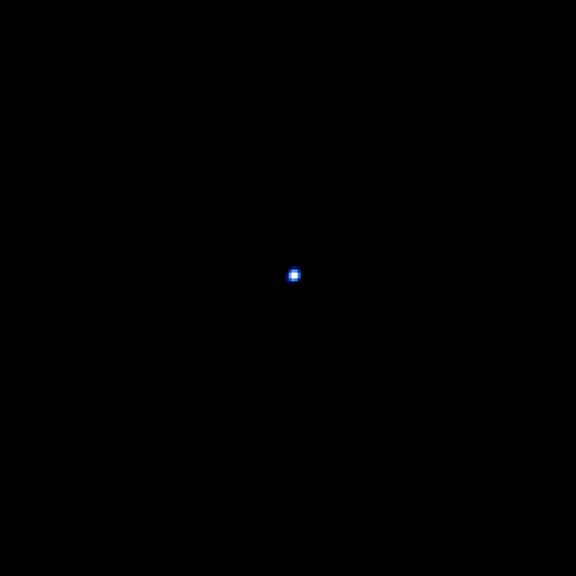
Chandra X-ray Image of GRB 050709
Scientists have solved a 35-year-old mystery of the origin of powerful, explode-second flashes of light called short gamma-ray bursts. These flashes, brighter than a billion suns yet lasting only a few milliseconds, have been simply too fast to catch until now.
Scale: Image is 160 arcsec per side
(Credit: NASA/CXC/Caltech/D.Fox et al.)
Scientists have solved a 35-year-old mystery of the origin of powerful, explode-second flashes of light called short gamma-ray bursts. These flashes, brighter than a billion suns yet lasting only a few milliseconds, have been simply too fast to catch until now.
Scale: Image is 160 arcsec per side
(Credit: NASA/CXC/Caltech/D.Fox et al.)
2
Illustration of a Gamma-Ray Burst
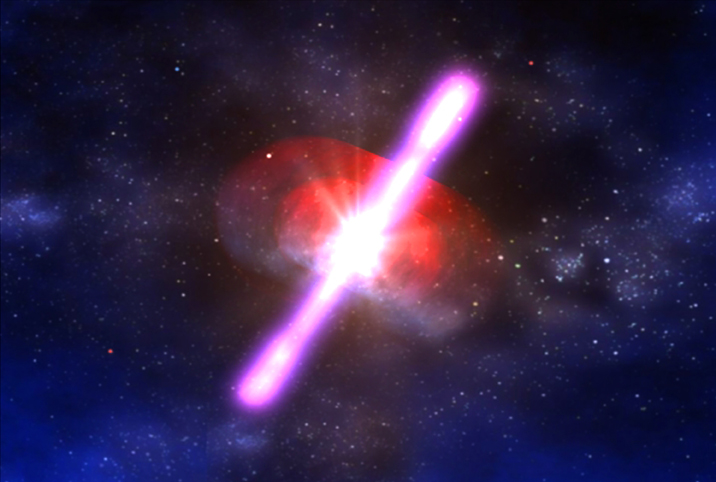
Gamma-ray bursts are common, yet random, and fleeting events that have mystified astronomers since their discovery in the late 1960s. Many scientists say longer bursts (more than four seconds in duration) are caused by massive star explosions; shorter bursts (less than two seconds in duration) are caused by mergers of binary systems with black holes or neutron stars. While uncertainty remains, most scientists say in either scenario a new black hole is born.
(Illustration: NASA/D.Berry)
View the animation
Gamma-ray bursts are common, yet random, and fleeting events that have mystified astronomers since their discovery in the late 1960s. Many scientists say longer bursts (more than four seconds in duration) are caused by massive star explosions; shorter bursts (less than two seconds in duration) are caused by mergers of binary systems with black holes or neutron stars. While uncertainty remains, most scientists say in either scenario a new black hole is born.
(Illustration: NASA/D.Berry)
View the animation
3
Illustration of Colliding Neutron Stars
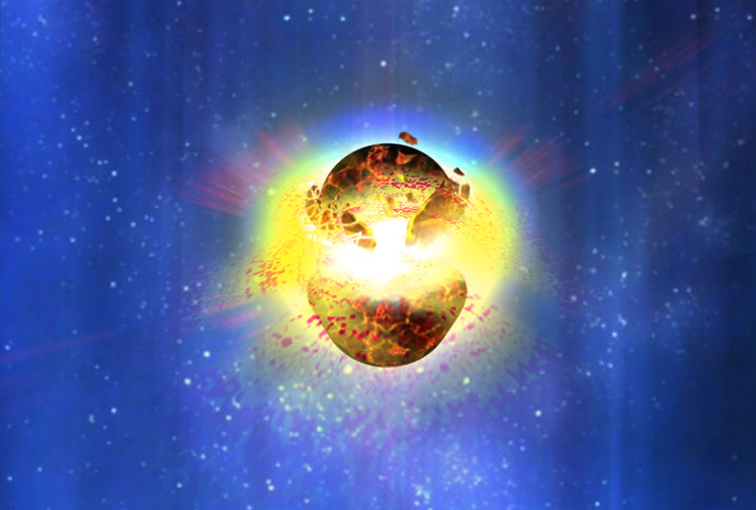
The most likely explanation for GRB050709 is that it was produced by a collision of two neutron stars, or a neutron star and a black hole. Such a collision would result in the formation of a black hole (or a larger black hole), and could generate a beam of high-energy particles that could account for the powerful gamma-ray pulse as well as observed radio, optical and X-ray afterglows.
(Illustration: NASA/D.Berry)
View the animation
The most likely explanation for GRB050709 is that it was produced by a collision of two neutron stars, or a neutron star and a black hole. Such a collision would result in the formation of a black hole (or a larger black hole), and could generate a beam of high-energy particles that could account for the powerful gamma-ray pulse as well as observed radio, optical and X-ray afterglows.
(Illustration: NASA/D.Berry)
View the animation
4
Hubble Optical Image of GRB 050709
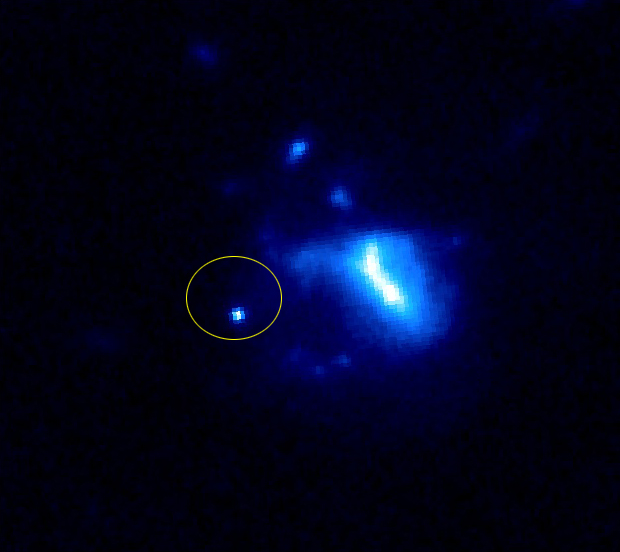
This Hubble Space Telescope optical image shows the afterglow and host galaxy of the HETE short burst of July 9, 2005. The bright, point-like afterglow is located to the left (yellow circle), on the outskirts of its extended, irregularly-shaped host galaxy. The host galaxy is of a similar age to the Milky Way, but about one-tenth the size. Both the burst and its host galaxy are located 2 billion light years from Earth. The colors indicate the intensity of light as seen by the Advanced Camera for Surveys instrument on Hubble.
(Credit: NASA/STScI/Penn State/D.Fox)
View the animation
This Hubble Space Telescope optical image shows the afterglow and host galaxy of the HETE short burst of July 9, 2005. The bright, point-like afterglow is located to the left (yellow circle), on the outskirts of its extended, irregularly-shaped host galaxy. The host galaxy is of a similar age to the Milky Way, but about one-tenth the size. Both the burst and its host galaxy are located 2 billion light years from Earth. The colors indicate the intensity of light as seen by the Advanced Camera for Surveys instrument on Hubble.
(Credit: NASA/STScI/Penn State/D.Fox)
View the animation
5
Chandra X-ray Image of GRB 050709, Full-field
This image shows the Chandra X-ray Observatory observation of the sky surrounding the afterglow and host galaxy of the HETE short burst of July 9, 2005. The circle indicates the region of sky from which HETE saw the burst. The box, inset, indicates where the X-ray and optical afterglow of the burst was ultimately found. The bright X-ray afterglow of the burst is apparent in the middle of this box. The colors indicate the intensity of the X-ray emission (1.0-7.0 keV) as seen by the Advanced CCD Imaging Spectrometer instrument on Chandra.
(Credit: NASA/CXC/Caltech/D.Fox et al.)
This image shows the Chandra X-ray Observatory observation of the sky surrounding the afterglow and host galaxy of the HETE short burst of July 9, 2005. The circle indicates the region of sky from which HETE saw the burst. The box, inset, indicates where the X-ray and optical afterglow of the burst was ultimately found. The bright X-ray afterglow of the burst is apparent in the middle of this box. The colors indicate the intensity of the X-ray emission (1.0-7.0 keV) as seen by the Advanced CCD Imaging Spectrometer instrument on Chandra.
(Credit: NASA/CXC/Caltech/D.Fox et al.)
6
Illustration of GRB 050709's Location
Gamma-ray bursts, the most powerful explosions known, were first detected in the late 1960s. They are random, fleeting, and can occur from any region of the sky. Try finding the location of a camera flash somewhere in a vast sports stadium and you'll have a sense of the challenge facing gamma-ray burst hunters. Solving this mystery took unprecedented coordination among scientists using a multitude of ground-based telescopes and NASA satellites. This illustration shows the location of GRB 050709.
(Illustration: NASA/D.Berry)
Gamma-ray bursts, the most powerful explosions known, were first detected in the late 1960s. They are random, fleeting, and can occur from any region of the sky. Try finding the location of a camera flash somewhere in a vast sports stadium and you'll have a sense of the challenge facing gamma-ray burst hunters. Solving this mystery took unprecedented coordination among scientists using a multitude of ground-based telescopes and NASA satellites. This illustration shows the location of GRB 050709.
(Illustration: NASA/D.Berry)
Return to GRB 050709 (05 Oct 05)



Revised: June 07, 2022