



CXC Home | Search | Help | Image Use Policy | Latest Images | Privacy | Accessibility | Glossary | Q&A
1
Chandra X-ray Image of Earth Aurora on Feb 15, 2004
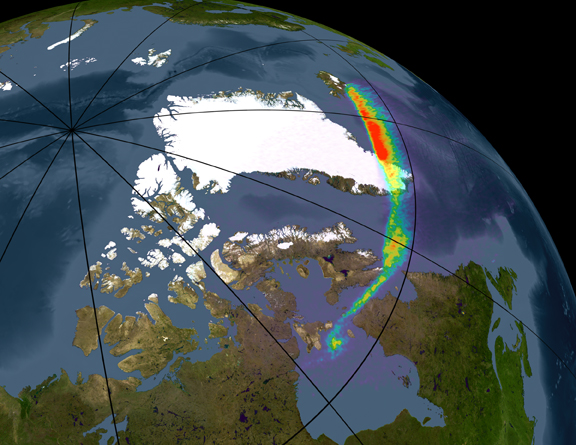
On February 15, 2004, Chandra observed X-rays produced by an aurora in the north-polar region of Earth. The X-rays, superimposed on a model of Earth, are seen as the violet-yellow-red arc stretching from northern Canada on the upper left to the Hudson Bay on the lower right. To obtain this data, Chandra was aimed at a fixed point in the sky, and the Earth's motion carried the auroral regions through the field of view. The shadowed area defines the day-night boundary at sea level. The X-ray activity is taking place at approximately 100 kilometers above the Earth.
Scale: Distance from the North pole to the black circle is 3,340 km (2,075 miles)
(Credit: X-ray: NASA/MSFC/CXC/A.Bhardwaj & R.Elsner, et al.; Earth model: NASA/GSFC/L.Perkins & G.Shirah)
On February 15, 2004, Chandra observed X-rays produced by an aurora in the north-polar region of Earth. The X-rays, superimposed on a model of Earth, are seen as the violet-yellow-red arc stretching from northern Canada on the upper left to the Hudson Bay on the lower right. To obtain this data, Chandra was aimed at a fixed point in the sky, and the Earth's motion carried the auroral regions through the field of view. The shadowed area defines the day-night boundary at sea level. The X-ray activity is taking place at approximately 100 kilometers above the Earth.
Scale: Distance from the North pole to the black circle is 3,340 km (2,075 miles)
(Credit: X-ray: NASA/MSFC/CXC/A.Bhardwaj & R.Elsner, et al.; Earth model: NASA/GSFC/L.Perkins & G.Shirah)
2
Chandra X-ray Images of Earth Aurora on Jan 24, 30, Feb 15 & Apr 13, 2004
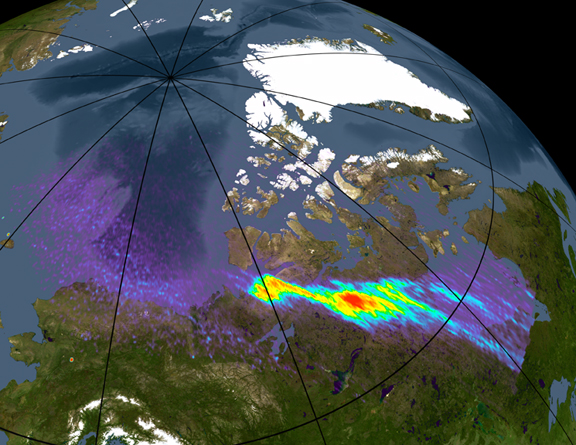
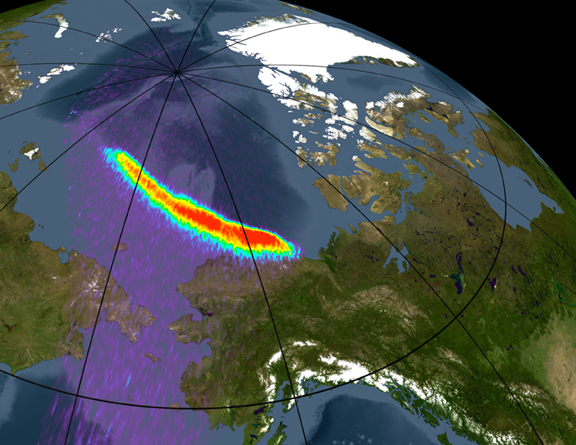
Chandra observed the Earth 10 times over a four-month period in 2004. From the ground, the aurora are well known to change dramatically over time, and this is the case in X-ray light as well. The X-rays in this sample of the Chandra observations, which have been superimposed on a simulated image of the Earth, are seen here at four different epochs.
Scale: Distance from the North pole to the black circle is 3,340 km (2,075 miles)
(Credit: X-ray: NASA/MSFC/CXC/A.Bhardwaj & R.Elsner, et al.; Earth model: NASA/GSFC/L.Perkins & G.Shirah)
Chandra observed the Earth 10 times over a four-month period in 2004. From the ground, the aurora are well known to change dramatically over time, and this is the case in X-ray light as well. The X-rays in this sample of the Chandra observations, which have been superimposed on a simulated image of the Earth, are seen here at four different epochs.
Scale: Distance from the North pole to the black circle is 3,340 km (2,075 miles)
(Credit: X-ray: NASA/MSFC/CXC/A.Bhardwaj & R.Elsner, et al.; Earth model: NASA/GSFC/L.Perkins & G.Shirah)
3
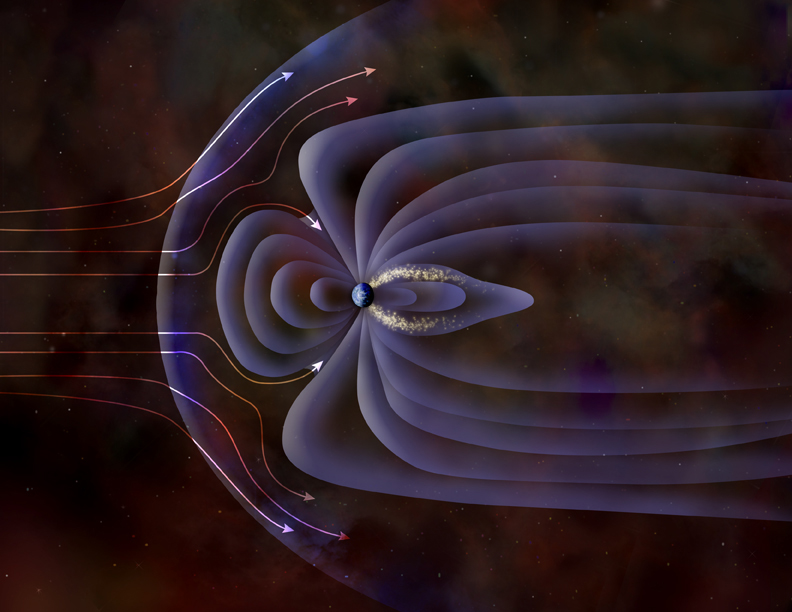
Illlustration of Earth's Magnetosphere and Auroras
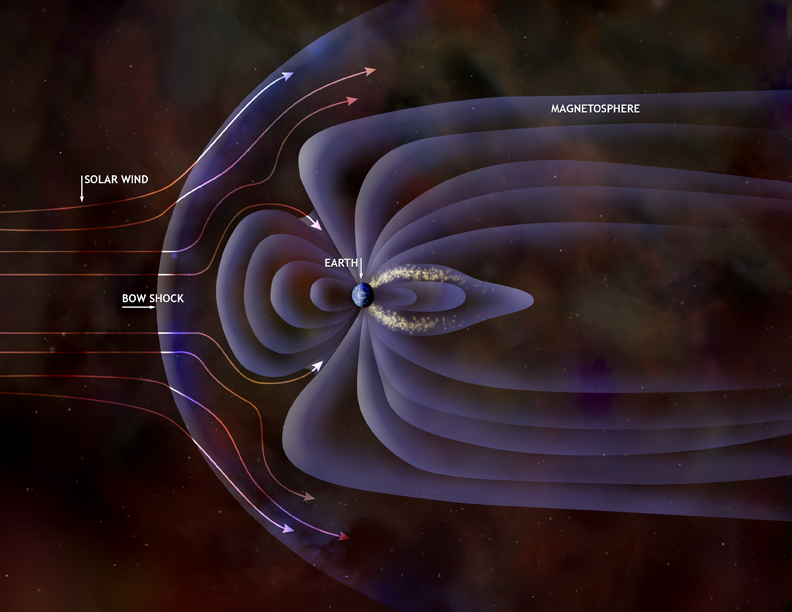
The hot gas in the outer layers of the Sun constantly rushes away as the solar wind. When the solar wind encounters Earth's magnetic field, it creates a swept-back cavity, called the magnetosphere. During solar storms the wind is intensified, large electric voltages are created in the magnetosphere and accelerate electrons to high energies. When these electrons spiral along the magnetic field into Earth s polar regions they collide with atoms high in the atmosphere and produce auroras.
(Illlustration: NASA/CXC/M.Weiss)
The hot gas in the outer layers of the Sun constantly rushes away as the solar wind. When the solar wind encounters Earth's magnetic field, it creates a swept-back cavity, called the magnetosphere. During solar storms the wind is intensified, large electric voltages are created in the magnetosphere and accelerate electrons to high energies. When these electrons spiral along the magnetic field into Earth s polar regions they collide with atoms high in the atmosphere and produce auroras.
(Illlustration: NASA/CXC/M.Weiss)
Return to Earth Aurora (28 Dec 05)



Revised: July 16, 2008