

CXC Home | Search | Help | Image Use Policy | Latest Images | Privacy | Accessibility | Glossary | Q&A
Black Hole Animation
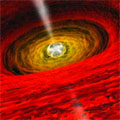
QuickTime MPEG This animation illustrates the activity surrounding a black hole. While matter that has passed the black hole's "event horizon" (point of no return) cannot be seen, material swirling outside this threshold is accelerated to millions of degrees and radiates in X-rays. At the end of the animation, the black hole is shown shrouded in a cloud of gas and dust, obscuring it from most angles at wavelengths other than the X-rays picked up by the Chandra X-ray Observatory.
[Runtime: 0:27]
(Animation: NASA/CXC/A.Hobart)
Still Photo
QuickTime MPEG This animation illustrates the activity surrounding a black hole. While matter that has passed the black hole's "event horizon" (point of no return) cannot be seen, material swirling outside this threshold is accelerated to millions of degrees and radiates in X-rays. At the end of the animation, the black hole is shown shrouded in a cloud of gas and dust, obscuring it from most angles at wavelengths other than the X-rays picked up by the Chandra X-ray Observatory.
[Runtime: 0:27]
(Animation: NASA/CXC/A.Hobart)
Still Photo
Focus on Black Holes in the Chandra Deep Field North
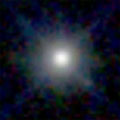
QuickTime MPEG This sequence demonstrates how X-rays are needed to find black holes. Beginning with the Chandra Deep Field North, the view zooms into an X-ray close-up of a black hole over 10 billion light years away. When it dissolves into an optical image, the host galaxy is clearly bright in the center indicating the presence of a growing black hole. On the other hand, a relatively nearby black hole is bright in X-ray light, but an optical image looks like a "normal" spiral galaxy. Therefore, this black hole would have been missed without the X-ray information.
[Run Time: 0:15]
(Animation: X-ray image: NASA/CXC/PSU/D.M.Alexander, F.E.Bauer, W.N.Brandt et al.
Optical image: NASA/ESA/The GOODS Team)
View Still Images of the Animation
QuickTime MPEG This sequence demonstrates how X-rays are needed to find black holes. Beginning with the Chandra Deep Field North, the view zooms into an X-ray close-up of a black hole over 10 billion light years away. When it dissolves into an optical image, the host galaxy is clearly bright in the center indicating the presence of a growing black hole. On the other hand, a relatively nearby black hole is bright in X-ray light, but an optical image looks like a "normal" spiral galaxy. Therefore, this black hole would have been missed without the X-ray information.
[Run Time: 0:15]
(Animation: X-ray image: NASA/CXC/PSU/D.M.Alexander, F.E.Bauer, W.N.Brandt et al.
Optical image: NASA/ESA/The GOODS Team)
View Still Images of the Animation
Illustrations of Disks around Black Holes
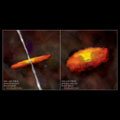
QuickTime MPEG These two illustrations show the difference between the very biggest supermassive black holes in the Universe and relatively smaller ones. In each case, the black hole is swallowing large amounts of gas from a surrounding disk. The first illustration is of a black hole with a mass between about 10 million and 100 million Suns. Here, the central black hole is obscured by a thick donut-shaped cloud of dust and gas. The second shows the growth of a larger black hole, with a mass greater than 100 million Suns. This black hole is surrounded by much a thinner torus of dust and gas.
[Run Time: 0:12]
(Animation: NASA/CXC/M.Weiss)
View Still Images of the Animation
QuickTime MPEG These two illustrations show the difference between the very biggest supermassive black holes in the Universe and relatively smaller ones. In each case, the black hole is swallowing large amounts of gas from a surrounding disk. The first illustration is of a black hole with a mass between about 10 million and 100 million Suns. Here, the central black hole is obscured by a thick donut-shaped cloud of dust and gas. The second shows the growth of a larger black hole, with a mass greater than 100 million Suns. This black hole is surrounded by much a thinner torus of dust and gas.
[Run Time: 0:12]
(Animation: NASA/CXC/M.Weiss)
View Still Images of the Animation
Return to Lockman Hole (15 Feb 05)


Revised: April 22, 2020