






CXC Home | Search | Help | Image Use Policy | Latest Images | Privacy | Accessibility | Glossary | Q&A
Download Image
More Information
More Images
Related Images


N49B:
Supernova Remnant Reveals Magnesium in Abundance

Supernova Remnant Reveals Magnesium in Abundance
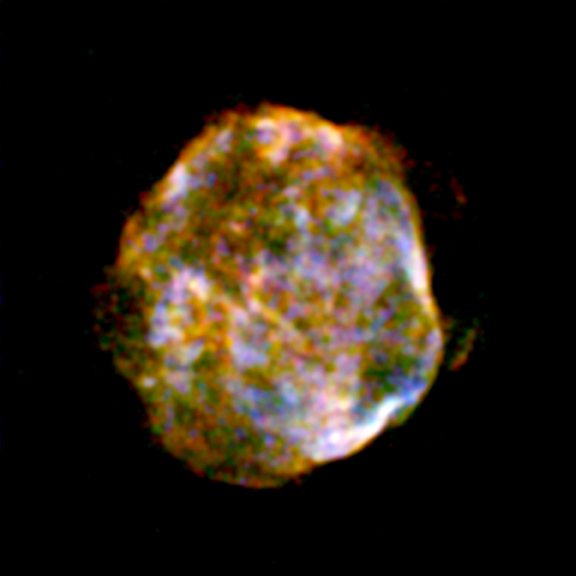
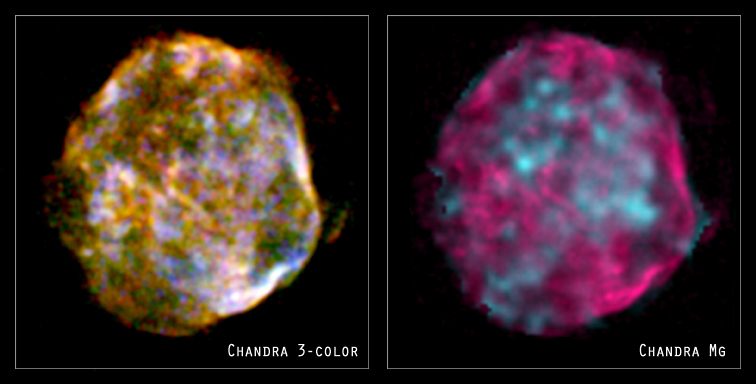
The Chandra image of N49B (left), the remains of an exploded star, shows a cloud of multimillion degree gas that has been expanding for about 10,000 years. A specially processed version of this image (right) reveals unexpectedly large concentrations of the element magnesium (blue-green).
Magnesium, created deep inside the star and ejected in the supernova explosion, is usually associated with correspondingly high concentrations of oxygen. However, the Chandra data indicate that the amount of oxygen in N49B is not exceptional. This poses a puzzle as to how the excess magnesium was created, or, alternatively, how the excess oxygen has escaped detection.
The amount of magnesium in N49B is estimated to be about equal to the total mass of the Sun. Since the Sun contains only about 0.1% of magnesium by mass, the total mass of magnesium N49B is about a thousand times that in the Sun and its planets.
Magnesium, the eighth most abundant material in the Earth's crust, is a mineral needed by every cell of our bodies. It helps maintain normal muscle and nerve function, keeps heart rhythm steady, and bones strong. It is also involved in energy metabolism and protein synthesis. Fortunately for us, and thanks to stars such as the one that produced N49B, there is an abundant supply of magnesium in the Universe.
|
||||||||||||||||||||||||||||||
Visual Description:
This Chandra X-ray Observatory image of supernova remnant N49B features two images side by side. Both images have the same large circular shapes in the center. Overall the first image is dominated by yellow, green and purple colors, while the second image is predominantly magenta and aqua. The Chandra image of N49B on the left shows a cloud of multimillion degree gas that has been expanding for about 10,000 years. A specially processed version of this image (on the right) reveals unexpectedly large concentrations of the element magnesium (colored blue-green). Magnesium, created deep inside the star and ejected in the supernova explosion, is usually associated with correspondingly high concentrations of oxygen. However, the Chandra data indicate that the amount of oxygen in N49B is not exceptional. This poses a puzzle as to how the excess magnesium was created, or, alternatively, how the excess oxygen has escaped detection.


Revised: September 08, 2025