




CXC Home | Search | Help | Image Use Policy | Latest Images | Privacy | Accessibility | Glossary | Q&A
Download Image
More Information
More Images
More Releases
Related Images


NGC 346:
A Heart in the Darkness

A Heart in the Darkness
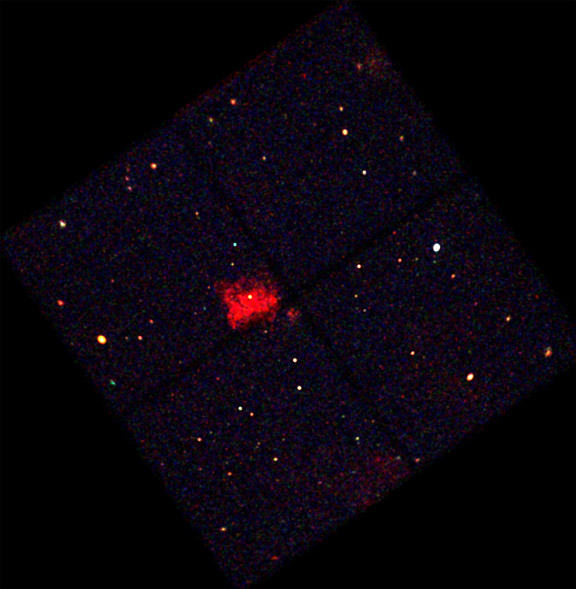
This Chandra image of the young star cluster NGC 346 highlights a heart-shaped cloud of 8 million-degree Celsius gas in the central region. Evidence from radio, optical and ultraviolet telescopes suggests that the hot cloud, which is about 100 light years across, is the remnant of a supernova explosion that occurred thousands of years ago.
The progenitor could have been a companion of the massive young star that is responsible for the bright X-ray source at the top center of the image. This young star, HD 5980, one of the most massive known, has been observed to undergo dramatic eruptions during the last decade. An alternative model for the origin of the hot cloud is that eruptions of HD 5980 long ago produced the cloud of hot gas, in a manner similar to the gas cloud observed around the massive star Eta Carinae.
Future observations will be needed to decide between the alternatives. Until then, the nature of the heart in the darkness will remain mysterious.
|
||||||||||||||||||||||||||
Visual Description:
This Chandra image of the young star cluster NGC 346 highlights a heart-shaped cloud of 8 million-degree Celsius gas in the central region. Evidence from radio, optical and ultraviolet telescopes suggests that the hot cloud, which is about 100 light years across, is the remnant of a supernova explosion that occurred thousands of years ago. The image looks like a hot pink heart floating in a vast area of blackness with two small blobs on the left and one on the right. A bright pink X-ray source at the top center of the heart shape in the image is HD 5980, one of the most massive stars known. This young star is known to have undergone dramatic eruptions in the past. Such eruptions could provide an alternative explanation for the existence of the hot gas cloud.


Revised: October 07, 2026