





CXC Home | Search | Help | Image Use Policy | Latest Images | Privacy | Accessibility | Glossary | Q&A
Download Image
More Information
More Images
Related Images
NGC 1700:
Giant X-Ray Disk Sheds Light On Galactic Merger

Giant X-Ray Disk Sheds Light On Galactic Merger
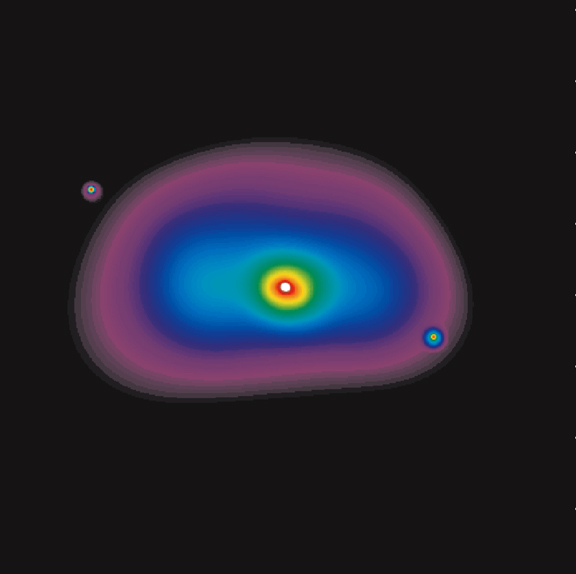
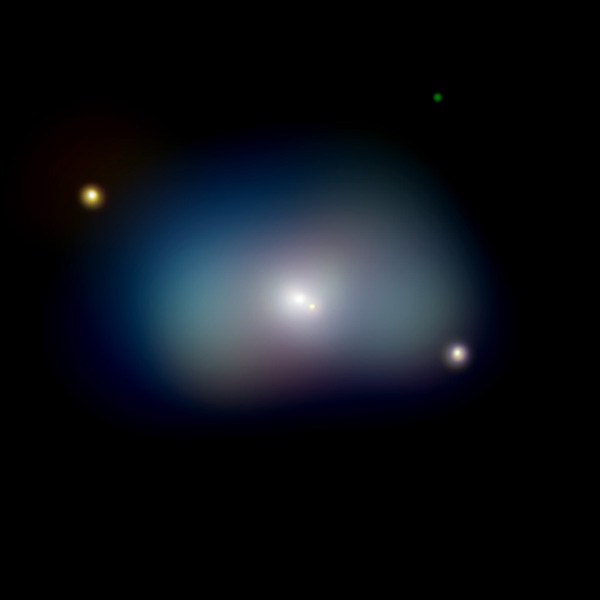
The Chandra image of the elliptical galaxy NGC 1700 shows a flattened oval of multi-million degree gas, supporting the idea that it is the result of a merger of two smaller galaxies about 3 billion years ago. To the lower right, another version of the Chandra image shows only the low-energy X-rays and reveals a giant inner disk. This disk of 6-million degree gas appears light blue in the multicolor image above.
The disk is 90,000 light years in diameter - roughly two-thirds the diameter of the Milky Way Galaxy - making it the largest disk of hot gas known. Analysis of the structure of the disk shows that it is rotating and appears to be cooling. The existence of a large, rotating disk of hot gas suggests that NGC 1700 was created by the merger of a rotating spiral galaxy and an elliptical galaxy containing hot gas.
|
||||||||||||||||||||||||||
Visual Description:
The Chandra image of the elliptical galaxy NGC 1700 shows a flattened oval of multi-million degree gas, supporting the idea that it is the result of a merger of two smaller galaxies about 3 billion years ago. The image has an irregular, slightly bulbous elliptical shape. There are a handful of bright spots scattered throughout the blue-grey galaxy, with some of the brightest concentrated towards the center of the image. The edges of the galaxy appear somewhat blurred, due to the nature of X-ray imaging and the diffuse structure of the galaxy itself. There is a barely perceptible giant inner disk. This disk of 6-million-degree gas appears light blue in the multicolor image. The disk is 90,000 light years in diameter -- roughly two-thirds the diameter of the Milky Way galaxy -- making it the largest disk of hot gas known at the time of observation. Analysis of the structure of the disk shows that it is rotating and appears to be cooling, suggesting that NGC 1700 was created by the merger of a rotating spiral galaxy and an elliptical galaxy containing hot gas.


Revised: September 08, 2025