






CXC Home | Search | Help | Image Use Policy | Latest Images | Privacy | Accessibility | Glossary | Q&A
Download Image
More Information
More Images
Animation & Video
More Releases

Related Images
NGC 4649:
Black Holes in Distant Galaxy Point to Wild Youth

Black Holes in Distant Galaxy Point to Wild Youth
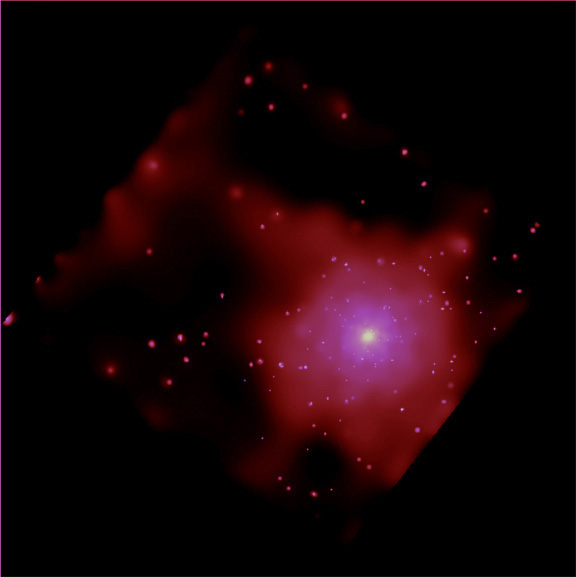
Chandra's image of the elliptical galaxy NGC 4649 reveals a large, bright cloud of hot gas and 165 point-like sources. As in the elliptical galaxies, NGC 4697 and NGC 1553, most of the point-like sources are due to black holes and neutron stars in binary star systems.
Black holes and neutron stars are the end state of the brightest and most massive stars. Chandra's detection of numerous neutron stars and black holes in this and other elliptical galaxies shows that these galaxies once contained many very bright, massive stars, in marked contrast to the present population of low-mass faint stars that now dominate elliptical galaxies.
Many of the X-ray binaries are in "globular star clusters," round balls of stars that contain about one million stars in a volume where typically only one would be found. This suggests that the extraordinarily dense environment of globular clusters may be a good place for black holes or neutron stars to capture a companion star.
The hot gas cloud filling the galaxy has a temperature of about 10 million degrees Celsius. In the bright central region there appear to be bright fingers of X-ray emission which could be due to rising cells of hot gas.
|
||||||||||||||||||||||||||||
Visual Description:
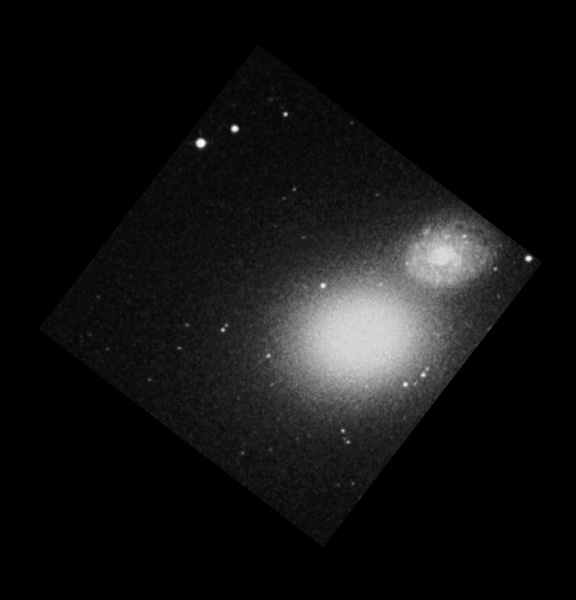
A Chandra X-ray Observatory image of the elliptical galaxy NGC 4649, also known as M60 or Messier 60, is dominated by red and pink hues. The galaxy's central region is highlighted by a bright pink spot, which stands out from the surrounding fainter spots. NGC 4649 is an elliptical galaxy, a type of galaxy characterized by a round or oval shape with no distinct arms or spiral patterns. This galaxy is one of the most massive and luminous in the Virgo Cluster, a group of over 1,300 galaxies located about 54 million light-years away from Earth. Chandra's image of the elliptical galaxy reveals a large, bright cloud of hot gas and 165 point-like sources. Most of the point-like sources are due to black holes and neutron stars in binary star systems. The hot gas cloud filling the galaxy has a temperature of about 10 million degrees Celsius. In the bright central region there appear to be bright fingers of X-ray emission which could be due to rising cells of hot gas.


Revised: October 07, 2026