




CXC Home | Search | Help | Image Use Policy | Latest Images | Privacy | Accessibility | Glossary | Q&A
Download Image
More Information
More Images
More Releases

Related Images

NGC 1569:
Dwarf Galaxy Gives universe A Breath of Fresh Oxygen

Dwarf Galaxy Gives universe A Breath of Fresh Oxygen
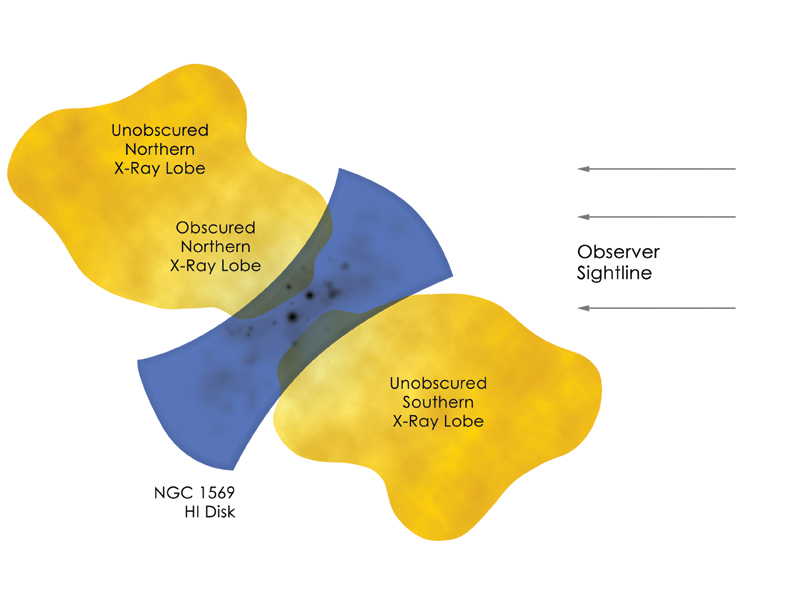
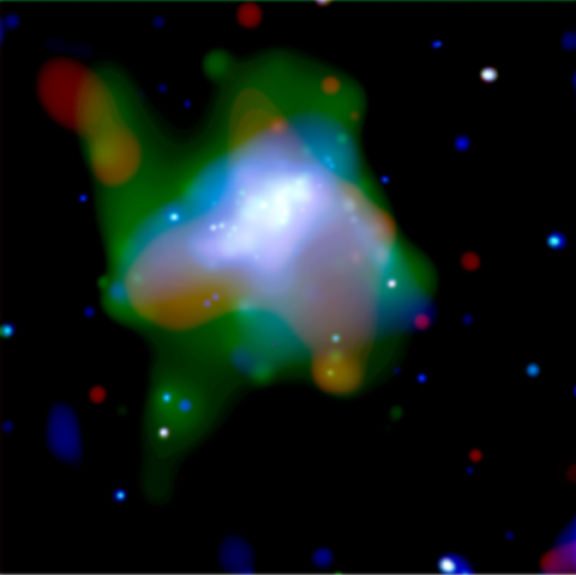
The Chandra image of NGC 1569, a dwarf galaxy 7 million light years from Earth, shows large hot bubbles, or lobes extending above and below a disk of gas along the equator of the galaxy. The 27-hour observation allowed scientists to measure for the first time the concentration of oxygen, neon, magnesium, and silicon in the bubbles and the disk. They found that bubbles contain oxygen equal to the oxygen contained in 3 million suns.
For the last 10 million to 20 million years NGC 1569 has been undergoing a burst of star formation and supernova explosions, perhaps triggered by a collision with a massive gas cloud. The supernovas eject oxygen and other heavy elements at high velocity into the gas in the galaxy, heating it to millions of degrees. Hot gas boils off the gaseous disk of the galaxy to form the bubbles, which expand out of the galaxy at speeds of hundreds of thousands of miles per hour.
Dwarf galaxies are much smaller than ordinary galaxies like our Milky Way. Because of their size, they have relatively low gravity and matter can escape from them more easily. This property, combined with the fact that dwarf galaxies are the most common type of galaxy in the universe, makes them very important in understanding how the universe was seeded with various elements billions of years ago, when galaxies were forming.
|
||||||||||||||||||||||||||
Visual Description:
The Chandra X-ray Observatory image of the dwarf galaxy NGC 1569 features a variety of blobs and colors. The main subject of the image is the dwarf galaxy NGC 1569, which appears as a large, highly irregularly-shaped object in the center of the image. The galaxy has a mottled appearance, consisting of shades of red, blue, and green, as well as white, on a black background, with some areas appearing brighter or darker than others. There are several bright spots scattered throughout the galaxy, varying in size and shape. NGC 1569 is 7 million light years away from Earth, and shows large hot bubbles, or lobes extending above and below a disk of gas along the equator of the galaxy. The 27-hour Chandra observation allowed scientists to measure for the first time the concentration of oxygen, neon, magnesium, and silicon in the bubbles and the disk. They found that bubbles contain oxygen equal to the oxygen contained in 3 million suns.


Revised: September 08, 2025