







CXC Home | Search | Help | Image Use Policy | Latest Images | Privacy | Accessibility | Glossary | Q&A
Download Image
More Information
More Images
More Releases
Related Images

N132D:
Glowing Remnant from a Star-Shattering Explosion

Glowing Remnant from a Star-Shattering Explosion
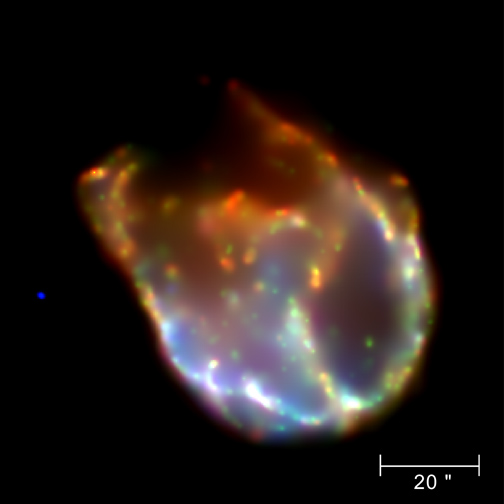
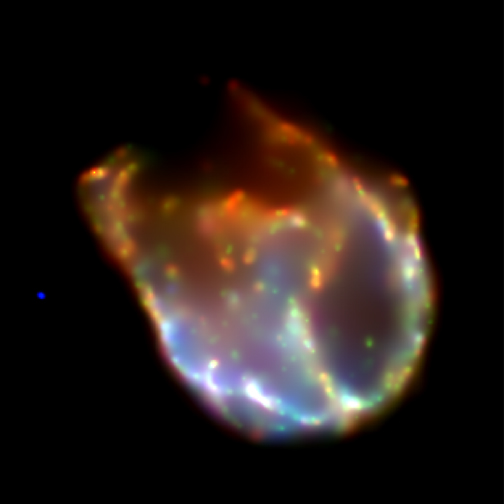
This "true color" Chandra image of N132D shows the beautiful, complex remnant of an explosion of a massive star in the Large Magellanic Cloud, a nearby galaxy about 160,000 light years from Earth. The colors represent different ranges of X-rays, with red, green, and blue representing, low, medium, and higher X-ray energies respectively.
Supernova remnants comprise debris of a stellar explosion and any matter in the vicinity that is affected by the expanding debris. In the case of N132D, the horseshoe shape of the remnant is thought to be due to shock waves from the collision of the supernova ejecta with cool giant gas clouds. As the shock waves move through the gas they heat it to millions of degrees, producing the glowing X-ray shell.
|
||||||||||||||||||||||||||||
Visual Description:
The Chandra X-ray Observatory image of the supernova remnant N132D, the remains of an exploded star, features a bright, glowing object in the center, surrounded by a dark background. The object appears to be shaped like a filled in horseshoe, with multiple tentacle-like structures around its center and the perimeter. The object has a smooth, almost translucent appearance, with a vibrant, neon-like glow emanating from its center. The tentacle-like structures are made up of various shades of purple, pink, and blue, creating an eye-catching contrast against the dark background. The Chandra image of N132D shows the beautiful, complex remnant of the explosion of a massive star in the Large Magellanic Cloud, a nearby galaxy about 160,000 light years from Earth. The colors represent different ranges of X-rays, with red, green, and blue revealing low, medium, and higher X-ray energies respectively. Supernova remnants comprise debris of a stellar explosion and any matter in the vicinity that is affected by the expanding debris. In the case of N132D, the horseshoe shape of the remnant is thought to be due to shock waves from the collision of the supernova ejecta with cool giant gas clouds. As the shock waves move through the gas they heat it to millions of degrees, producing the glowing X-ray shell.


Revised: September 08, 2025