





CXC Home | Search | Help | Image Use Policy | Latest Images | Privacy | Accessibility | Glossary | Q&A
Download Image
More Information
More Images
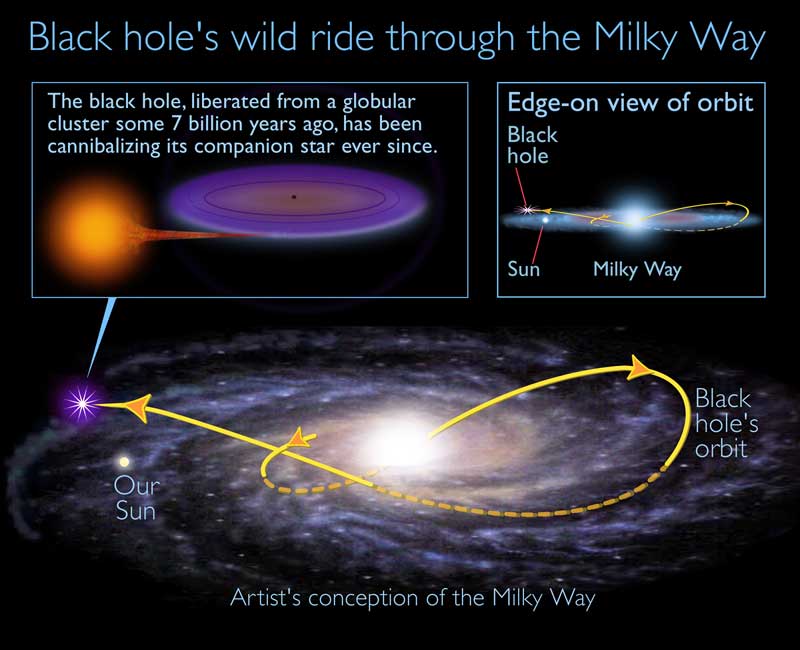
Artist's Illustration of Black Hole Moving Through Milky Way
(Credit: STScI/A.Feild/Office of Public Outreach)
Related Images


XTE J1118+480:
Chandra Pinpoints Edge Of Accretion Disk Around Black Hole

Chandra Pinpoints Edge Of Accretion Disk Around Black Hole
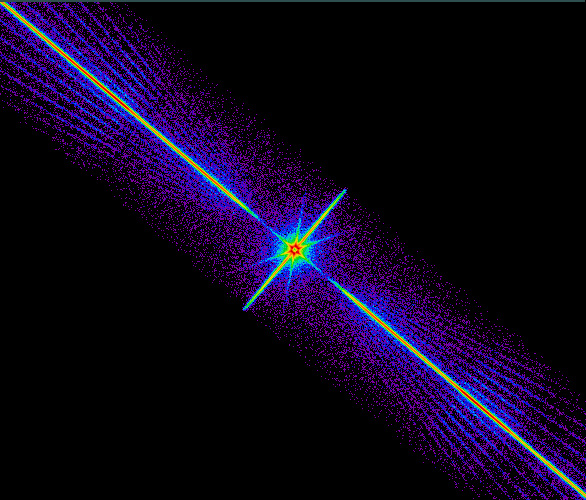
This Chandra X-ray Observatory image is a spectrum of a black hole, which is similar to the colorful spectrum of sunlight produced by a prism. The X-rays of interest are shown here recorded in the bright stripe that runs rightward and leftward from the center of the image. These X-rays are sorted precisely according to their energy with the highest-energy X-rays near the center of the image and the lower-energy X-rays farther out. The spectrum was obtained by using the Low Energy Transmission Grating (LETG), which intercepts X-rays and changes their direction by amounts that depend sensitively on the X-ray energy. The LETG is activated by swinging an assembly into position behind the mirrors and in front of the instrument that detects the X-rays. The assembly holds 540 gold transmission gratings; when in place behind the mirrors, the gratings intercept the X-rays reflected from the telescope. The bright spot at the center is due to a fraction of the X-ray radiation that is not deflected by the LETG. The spokes that intersect the central spot and the faint diagonal rays that flank the spectrum itself are artifacts due to the structure that supports the LETG grating elements
A team of scientists led by Jeffrey McClintock (Harvard-Smithsonian Center for Astrophysics) used the LETG in conjunction with the Advanced CCD Imaging Spectrometer (ACIS) detector to observe the black hole binary system known as XTE J1118+480 for 27,000 seconds on April 18, 2000. This "X-ray nova," so-called because it undergoes occasional eruptions followed by long periods of dormancy, contains a Sun-like star orbiting a black hole.
|
||||||||||||||||||||||||||
Visual Description:
This Chandra X-ray Observatory image features a black hole called XTE J1118+480. The image displays various colors, including blue, green, and purple, which are used to depict the intensity of the X-ray radiation emitted by the black hole. The image shows a structure in the shape of an X or cross. It is a grating spectrum of a black hole, which is similar to the colorful spectrum of sunlight produced by a prism. The X-rays shown here are recorded in the bright stripe that runs rightward and leftward from the center of the image. These X-rays are sorted precisely according to their energy with the highest-energy X-rays near the center of the image and the lower-energy X-rays farther out. A bright spot at the center is due to a fraction of the X-ray radiation that is not deflected by the instrument. Spokes that intersect the central spot and the faint diagonal rays that flank the spectrum itself are artifacts.


Revised: September 09, 2025