


CXC Home | Search | Help | Image Use Policy | Latest Images | Privacy | Accessibility | Glossary | Q&A
1
Neutron Star X-ray binary systems in
the globular cluster M15
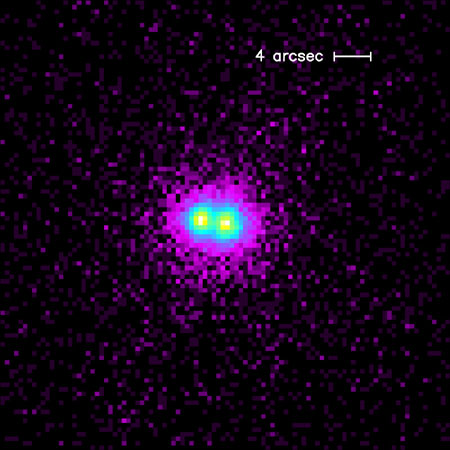
This Chandra image, with a scale bar, shows two neutron star X-ray binary systems 2U2127 and M15 X-2 in the globular cluster M15. Their proximity on the sky made it impossible for previous X-ray telescopes to resolve the individual sources.
(Credit: NASA/GSFC/N.White, L.Angelini )
This Chandra image, with a scale bar, shows two neutron star X-ray binary systems 2U2127 and M15 X-2 in the globular cluster M15. Their proximity on the sky made it impossible for previous X-ray telescopes to resolve the individual sources.
(Credit: NASA/GSFC/N.White, L.Angelini )
2
Hubble Space Telescope Image of
central region of M15
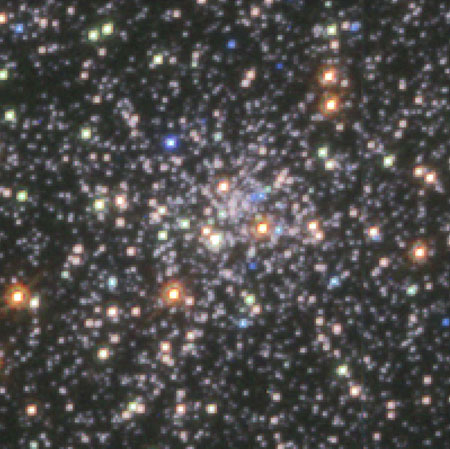
This Hubble "Wide Field Planetary Camera 2" image reveals the central region of the globular cluster M15. Here we see the core, with about a thousand stars confined within the innermost 1.6 light years of the cluster. Images in ultraviolet, blue, and visual light were combined for this picture so that the colors roughly correspond to the surface temperatures of stars in M15. Hot stars appear blue, while cooler stars appear reddish-orange.
(Credit:NASA/HST -- P. Guhathakurta (UCO/Lick Observatory, UC Santa Cruz), B. Yanny (Fermi National Accelerator Lab), D. Schneider (Pennsylvania State Univ.), J. Bahcall (Inst. for Advanced Study))
This Hubble "Wide Field Planetary Camera 2" image reveals the central region of the globular cluster M15. Here we see the core, with about a thousand stars confined within the innermost 1.6 light years of the cluster. Images in ultraviolet, blue, and visual light were combined for this picture so that the colors roughly correspond to the surface temperatures of stars in M15. Hot stars appear blue, while cooler stars appear reddish-orange.
(Credit:NASA/HST -- P. Guhathakurta (UCO/Lick Observatory, UC Santa Cruz), B. Yanny (Fermi National Accelerator Lab), D. Schneider (Pennsylvania State Univ.), J. Bahcall (Inst. for Advanced Study))
3
Annotated Hubble Space Telescope
Image of Central Region of M15
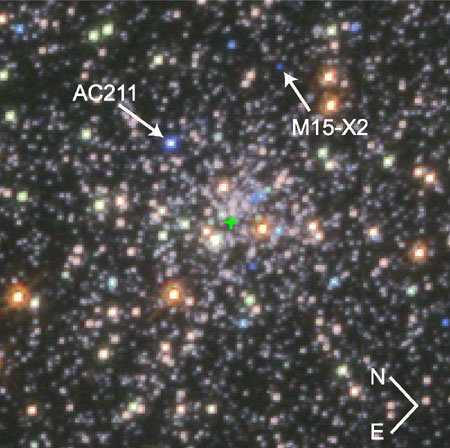
The Chandra observation involves two X-ray binary systems: One contains neutron star 4U2127 orbiting around normal star AC211, the latter of which can be seen as a blue star in this Hubble image. The other binary contains the newly named M15-X2 neutron star, likely associated with a second, unnamed blue star. The Hubble image had the necessary resolution to clearly differentiate between the two optical stars, yet could not identify neutron star binary systems, which are visible in X-rays.
The Chandra observation involves two X-ray binary systems: One contains neutron star 4U2127 orbiting around normal star AC211, the latter of which can be seen as a blue star in this Hubble image. The other binary contains the newly named M15-X2 neutron star, likely associated with a second, unnamed blue star. The Hubble image had the necessary resolution to clearly differentiate between the two optical stars, yet could not identify neutron star binary systems, which are visible in X-rays.
4
Chandra X-ray Image with Scale
Bar
Scale bar = 5 arcsec
Credit: NASA/GSFC/N.White, L.Angelini
Scale bar = 5 arcsec
Credit: NASA/GSFC/N.White, L.Angelini
Return to M15 (06 Sep 01)



Revised: May 17, 2022