


CXC Home | Search | Help | Image Use Policy | Latest Images | Privacy | Accessibility | Glossary | Q&A
1
2
3
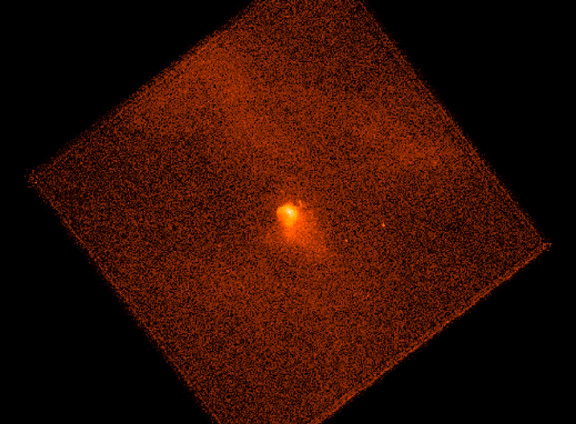
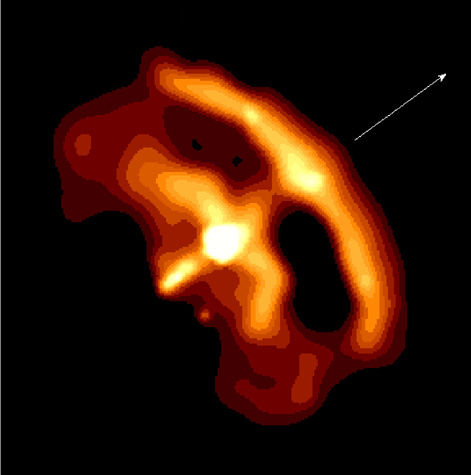
Vela Pulsar
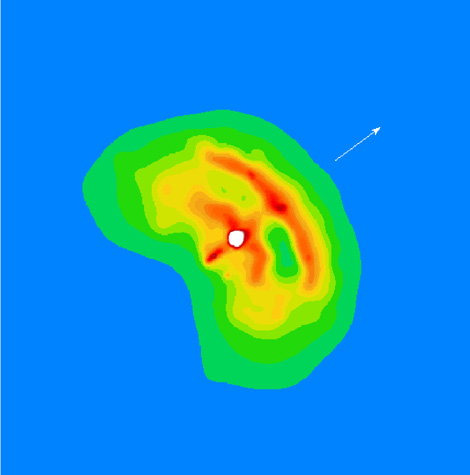
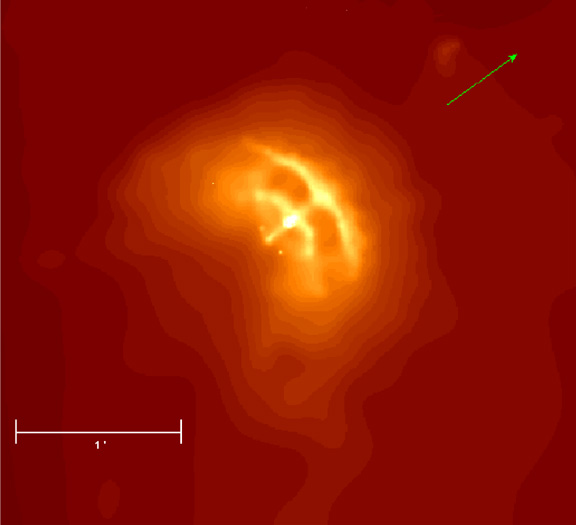
Same as above, but a different color scheme. The colors represent X-ray intensities with white being the most intense, then red, orange, yellow and green.
Chandra X-ray Observatory HRC image
Scale: Image is 3.5 arcmin on a side. (1 arcmin = 0.2 light year at a distance of 800 light years)
(Credit: NASA/PSU/G. Pavlov et al.)
Same as above, but a different color scheme. The colors represent X-ray intensities with white being the most intense, then red, orange, yellow and green.
Chandra X-ray Observatory HRC image
Scale: Image is 3.5 arcmin on a side. (1 arcmin = 0.2 light year at a distance of 800 light years)
(Credit: NASA/PSU/G. Pavlov et al.)
4
5
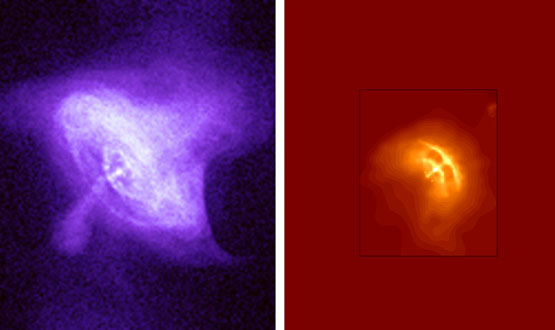
Crab Nebula and the Vela supernova
remnants.
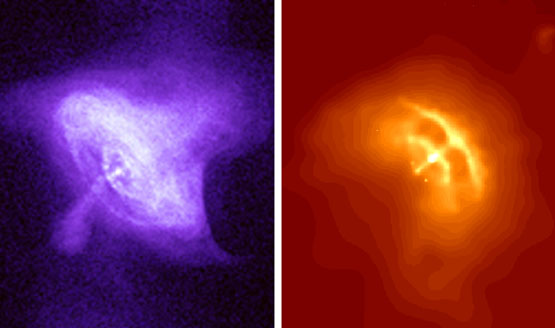
These images show the region of space around two rapidly rotating neutron stars in the Crab Nebula (left) and the Vela (right) supernova remnants. A magnetized, rapidly rotating neutron star produces electric voltages of several quadrillion volts. Particles are pulled off the neutron star and accelerated to speeds near the speed of light. A blizzard of electrons and anti-matter electrons, or positrons, is produced by these particles. The jets, and rings are thought to be caused by this process. The images have been scaled so that the ring structures will be in the right proportion to their actual size. The inner Crab ring is 1 light year in diameter; in Vela it is 0.1 light year.
(Credit: NASA/CXC/SAO; Right: NASA/PSU/G. Pavlov et al.)
These images show the region of space around two rapidly rotating neutron stars in the Crab Nebula (left) and the Vela (right) supernova remnants. A magnetized, rapidly rotating neutron star produces electric voltages of several quadrillion volts. Particles are pulled off the neutron star and accelerated to speeds near the speed of light. A blizzard of electrons and anti-matter electrons, or positrons, is produced by these particles. The jets, and rings are thought to be caused by this process. The images have been scaled so that the ring structures will be in the right proportion to their actual size. The inner Crab ring is 1 light year in diameter; in Vela it is 0.1 light year.
(Credit: NASA/CXC/SAO; Right: NASA/PSU/G. Pavlov et al.)
6
Crab Nebula and Vela Supernova
Remnants.
These images show the region of space around two rapidly rotating neutron stars in the Crab Nebula (left) and the Vela (right) supernova remnants. A magnetized, rapidly rotating neutron star produces electric voltages of several quadrillion volts. Particles are pulled off the neutron star and accelerated to speeds near the speed of light. A blizzard of electrons and anti-matter electrons, or positrons, is produced by these particles. The jets, and rings are thought to be caused by this process. The inner Crab ring is 1 light year in diameter; in Vela it is 0.1 light year.
(Credit: NASA/CXC/SAO; Right: NASA/PSU/G. Pavlov et al.)
These images show the region of space around two rapidly rotating neutron stars in the Crab Nebula (left) and the Vela (right) supernova remnants. A magnetized, rapidly rotating neutron star produces electric voltages of several quadrillion volts. Particles are pulled off the neutron star and accelerated to speeds near the speed of light. A blizzard of electrons and anti-matter electrons, or positrons, is produced by these particles. The jets, and rings are thought to be caused by this process. The inner Crab ring is 1 light year in diameter; in Vela it is 0.1 light year.
(Credit: NASA/CXC/SAO; Right: NASA/PSU/G. Pavlov et al.)
7
Return to Vela Pulsar (06 Jun 00)


Revised: July 08, 2008