
The Nobel-Winning Black Hole
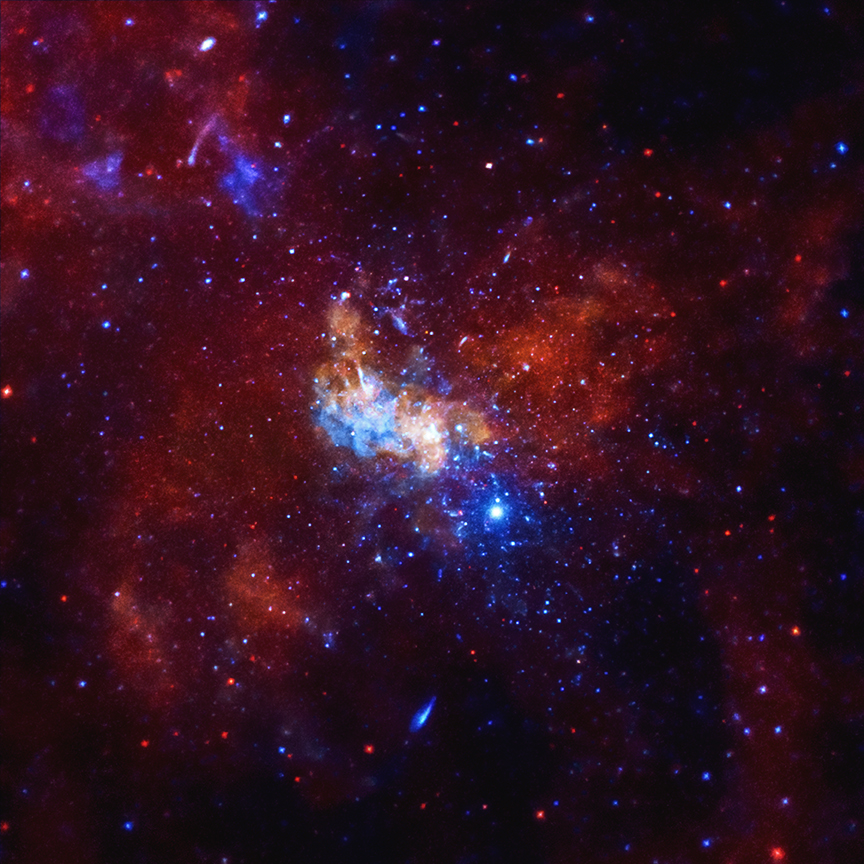
The winners of the 2020 Nobel Prize in Physics were announced this week: a trio of astrophysicists won for their work — both theoretical and observational — of black holes. Two of the three, Dr. Andrea Ghez of the University of California at Los Angeles and Reinhard Genzel of the Max Planck Institute for Extraterrestrial Physics in Germany — were cited “for the discovery of a supermassive compact object at the center of our galaxy”.
There are black holes throughout our Galaxy and across the Universe, but the one at the Milky Way's center, known as Sagittarius A* (Sgr A*), is particularly fascinating. At a distance of about 26,000 light years from Earth, Sgr A* is the closest supermassive black hole to us. Both Ghez and Genzel have spent decades tracking stars and clouds of dust near Sgr A* to learn more about the black hole and its environment.
Data Sonification: Sounds from Around the Milky Way
Your browser does not support the video tag.
 Explore Solos Sonification Credit: NASA/CXC/SAO/K. Arcand, SYSTEM Sounds (M. Russo, A. Santaguida)
The center of our Milky Way galaxy is too distant for us to visit in person, but we can still explore it. Telescopes give us a chance to see what the Galactic Center looks like in different types of light. By translating the inherently digital data (in the form of ones and zeroes) captured by telescopes in space into images, astronomers create visual representations that would otherwise be invisible to us.
But what about experiencing these data with other senses like hearing? Sonification is the process that translates data into sound, and a new project brings the center of the Milky Way to listeners for the first time. The translation begins on the left side of the image and moves to the right, with the sounds representing the position and brightness of the sources. The light of objects located towards the top of the image are heard as higher pitches while the intensity of the light controls the volume. Stars and compact sources are converted to individual notes while extended clouds of gas and dust produce an evolving drone. The crescendo happens when we reach the bright region to the lower right of the image. This is where the 4-million-solar-mass supermassive black hole at the center of the Galaxy, known as Sagittarius A* (A-star), resides, and where the clouds of gas and dust are the brightest.
Users can listen to data from this region, roughly 400 light years across, either as "solos" from NASA's Chandra X-ray Observatory, Hubble Space Telescope, and Spitzer Space Telescope, or together as an ensemble in which each telescope plays a different instrument. Each image reveals different phenomena happening in this region about 26,000 light years from Earth. The Hubble image outlines energetic regions where stars are being born, while Spitzer's infrared image shows glowing clouds of dust containing complex structures. X-rays from Chandra reveal gas heated to millions of degrees from stellar explosions and outflows from Sagittarius A*.
In addition to the Galactic Center, this project has also produced sonified versions of the remains of a supernova called Cassiopeia A, or Cas A, and the "Pillars of Creation" located in Messier 16.
NASA's Chandra Opens Treasure Trove of Cosmic Delights

Chandra Archive Collection: A Montage of Light From Space
Credit: NASA/CXC/SAO, NASA/STScI, NASA/JPL-Caltech/SSC, ESO/NAOJ/NRAO, NRAO/AUI/NSF, NASA/CXC/SAO/PSU, and NASA/ESA
Humanity has "eyes" that can detect all different types of light through telescopes around the globe and a fleet of observatories in space. From radio waves to gamma rays, this "multiwavelength" approach to astronomy is crucial to getting a complete understanding of objects in space.
This compilation gives examples of images from different missions and telescopes being combined to better understand the science of the universe. Each of these images contains data from NASA's Chandra X-ray Observatory as well as other telescopes. Various types of objects are shown (galaxies, supernova remnants, stars, planetary nebulas), but together they demonstrate the possibilities when data from across the electromagnetic spectrum are assembled.
Debris from Stellar Explosion Not Slowed After 400 Years
Astronomers have used NASA's Chandra X-ray Observatory to record material blasting away from the site of an exploded star at speeds faster than 20 million miles per hour. This is about 25,000 times faster than the speed of sound on Earth.
Kepler's supernova remnant is the debris from a detonated star that is located about 20,000 light years away from Earth in our Milky Way galaxy. In 1604 early astronomers, including Johannes Kepler who became the object's namesake, saw the supernova explosion that destroyed the star.
We now know that Kepler's supernova remnant is the aftermath of a so-called Type Ia supernova, where a small dense star, known as a white dwarf, reaches a critical mass limit after interacting with a companion star and undergoes a thermonuclear explosion that shatters the white dwarf and launches its remains outward.
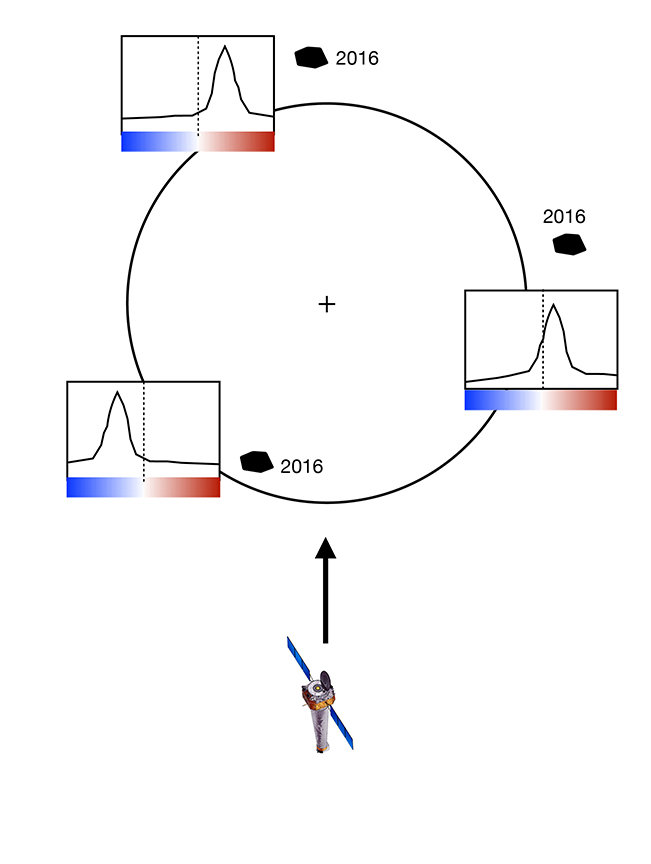
The latest study tracked the speed of 15 small "knots" of debris in Kepler's supernova remnant, all glowing in X-rays, all glowing in X-rays. The fastest knot was measured to have a speed of 23 million miles per hour, the highest speed ever detected of supernova remnant debris in X-rays. The average speed of the knots is about 10 million miles per hour, and the blast wave is expanding at about 15 million miles per hour. These results independently confirm the 2017 discovery of knots travelling at speeds more than 20 million miles per hour in Kepler's supernova remnant.
Researchers in the latest study estimated the speeds of the knots by analyzing Chandra X-ray spectra, which give the intensity of X-rays at different wavelengths, obtained in 2016. By comparing the wavelengths of features in the X-ray spectrum with laboratory values and using the Doppler effect, they measured the speed of each knot along the line of sight from Chandra to the remnant. They also used Chandra images obtained in 2000, 2004, 2006 and 2014 to detect changes in position of the knots and measure their speed perpendicular to our line of sight. These two measurements combined to give an estimate of each knot's true speed in three-dimensional space. A graphic gives a visual explanation for how motions of knots in the images and the X-ray spectra were combined to estimate the total speeds.
The Origins of Particle Ribbons in the Center of our Galaxy
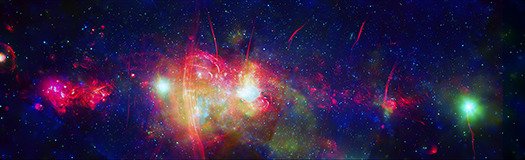
X-ray & Radio Image of the Milky Way's Galactic Center
Credit: X-Ray: NASA/CXC/UMass/D. Wang et al.; Radio: SARAO/MeerKAT
Astronomers are taking a closer look at a party brewing in the center of our Galaxy. The supermassive black hole that resides there, known as Sagittarius A*, appears to be throwing a celebration complete with flying cosmic ribbons.
However, the sheer scale of everything in space already tells us that these are no ordinary ribbons. They are actually gigantic filaments, up to 100 light years (about 588 trillion miles!) long and ⅓ of a light year thick. The filaments are produced by particles moving at relativistic speeds, meaning near the speed of light, spiraling around strong magnetic field lines in the center of the Galaxy.
History of SpARCS1049

Carter Rhea
We welcome Carter Rhea as our guest blogger and a co-author of a paper that is the subject of our latest press release. Carter completed his undergraduate degree in astronomy at the College of Charleston in Charleston South Carolina. Afterwards, he obtained a master’s degree in scientific computing and computational mechanics at Duke University. Instead of continuing with a PhD, he decided to return to astronomy. He just finished his master’s degree at l’Université de Montréal and will be continuing his Ph.D. there.
Galaxy clusters are an exceptional class of object – they are the largest structures in the Universe held together by gravity, and contain hundreds or thousands of individual galaxies, unseen dark matter, and a vast amount of hot gas that gives off X-rays.
In 2015, a team of astronomers led by Tracy Webb at McGill University in Montréal released the first study of SpARCS1049, which was quickly recognized as an exceptional member of this exceptional class. The team’s optical, infrared, and ultraviolet observations of this galaxy cluster revealed a complex structure of clumpy, cool emission regions forming a tail that trails away from the cluster’s central galaxy. As a reminder, galaxy clusters are the largest structures in the Universe held together by gravity. They are made up of three main things: hundreds or thousands of individual galaxies, unseen dark matter, and a vast amount of hot gas that gives off X-rays.
These regions, also known as “tidal tails,” are usually the remnants of a smaller galaxy that has merged with the central galaxy. Studying the near-infrared images revealed a truly surprising fact: the region around the central galaxy was forming stars at a prodigious rate of nearly 900 solar masses per year! (For comparison, our own galaxy -- the Milky Way -- is creating stars at a pedestrian rate of 3 solar masses per year.)
Happy Little Accidents: The Happenstance Finding of Obscured Growing Supermassive Black Holes with Chandra
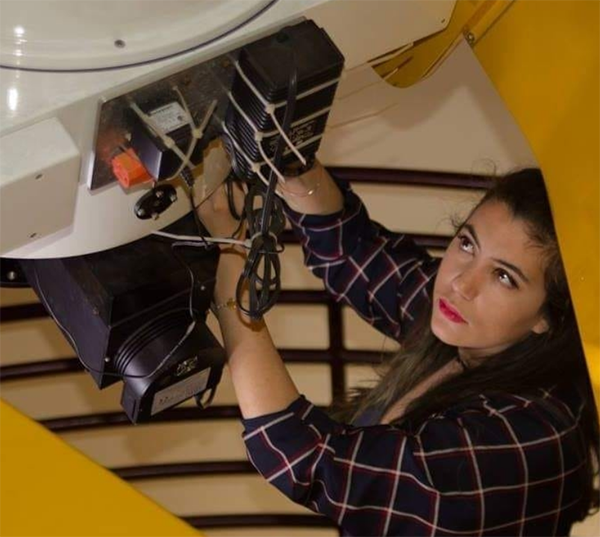
Erini Lambrides
We are delighted to welcome Erini Lambrides from Johns Hopkins University (JHU) in Baltimore Maryland as a guest blogger. She is the first author of a paper in the Astrophysical Journal that is the subject of our latest press release. Erini is a PhD candidate at JHU in the Department of Physics and Astronomy and will be defending her thesis next year. Prior to starting her PhD, she spent a year as a research assistant at Gemini Observatory North, and a year as a research assistant at the American Museum of Natural History in NYC. She got her BS with Honors in Physics at the University of Rochester. She was awarded a NASA Maryland Space Grant Fellowship to fund her PhD and outreach efforts. Her research is focused on quantifying the extent and impact of AGN-host galaxy co-evolution.
When one normally thinks of the scientific method, the following mantra rooted in elementary school days comes to mind: The Question, The Research, The Hypothesis, The Data, The Conclusion. Neatly lined, linear steps that seemingly underpin the entirety of humanity’s quest for knowledge about our physical world. I learned this when I was ten years old, but nearly twenty years later, as I trundle along my own scientific journey, I’ve learned that the steps of the scientific method more resemble an M.C. Escher painting.
My group and I have recently completed work on a peculiar class of astrophysical objects: growing supermassive black holes that are embedded in a thick cocoon of gas and dust. This work is exciting because we discovered that this particularly difficult-to-observe class of objects can be detected in greater numbers than previously thought. However, when I started this work, my goal was not to find these objects, nor was it even about this class of objects!
When An Unstoppable Force Meets an Immovable Object
The explosions of dying stars, known as supernovas, are some of the most powerful events in our entire universe, releasing more energy than the Sun will in its entire 10-billion-year lifetime. (The Sun is no small player, either—it produces the energy of nearly a trillion 1 megaton bombs every 10 seconds.)
The sheer power of a supernova explosion is enough to blast out debris at speeds of around 20 million miles per hour, generating shockwaves – pressure wavefronts that move faster than the speed of sound as they collide with surrounding gas and dust. As the shockwaves radiate outward into space, they dramatically heat this material up to temperatures of tens of millions of degrees, causing the supernova remnant to glow in X-rays.
Such immense, swift forces may seem completely unstoppable, but in the case of one supernova remnant in our Galaxy, G21.5-0.9, images from NASA's Chandra X-ray Observatory reveal that a mysterious presence was able to stop G21.5-0.9's shockwaves in their tracks.
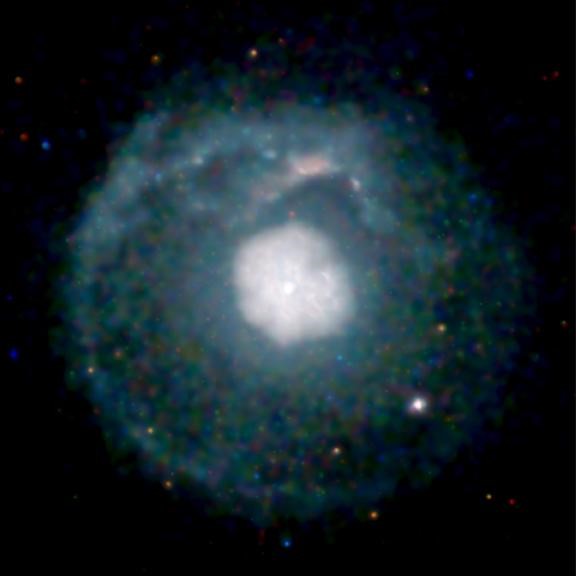
Supernova remnant G21.5-0.9
(Credit: NASA/CXC/U.Manitoba/H.Matheson & S.Safi-Harb)
Welcome to Emily Zhang, Chandra Summer Intern

Emily Zhang on the Athabasca Glacier in Banff National Park in Canada. Emily traveled there in the summer of 2018, coincidentally just after finishing her first research project at the CfA! Credit: Emily Zhang
We are delighted to introduce Emily Zhang, who is working as a summer intern in the Chandra X-ray Center at the Center for Astrophysics. Emily is spending half of her time working on astronomy research with Dr Pat Slane and half working on science communication with us in the Chandra Communications and Public Engagement group. She is an undergraduate at Columbia University majoring in astrophysics and (hopefully) concentrating in political science. We asked Emily some questions about her background and interests in astronomy and science communication.
How did your interest in astronomy develop?
I remember watching the TV show Nova with my parents when I was little, and thinking that outer space looked so beautiful and so different from the rest of the world I knew. I also remember going on trips to my local planetarium (the Hayden Planetarium at the Museum of Science in Boston) growing up, and coming out of their shows crying at how big the universe was. I have a vivid memory of checking out a book on black holes for kids from the library, and reading that if you went through a black hole, you could end up in a new universe with up to 11 dimensions. This was not something I understood at all as a 4th grader, but I was impressed.
Gazing at the Youngest Star From Chile
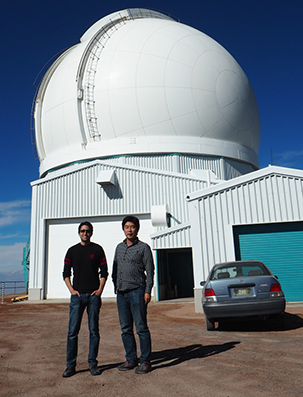
David Principe and Kenji Hamaguchi
As our guest blogger, we welcome Kenji Hamaguchi of the Center for Research and Exploration in Space Science & Technology and NASA’s Goddard Space Flight Center in Greenbelt, MD. He is part of the team that made the discovery described in our latest press release on an X-ray flare from a very young Sun-like star.
The observatory dome appeared over the hill. "Where is it standing?" I mumbled to myself. The Southern Astrophysical Research (SOAR) Telescope stands at the dead-end of a mountain ridge. The road just before the observatory has a bottleneck with steep slopes on both sides. The dome looked as if it were standing on the head of a spear. The telescope is a part of the Cerro Tololo Inter-American Observatory in Chile, along with the Gemini South observatory, and the Vera Rubin Observatory (formerly the LSST), which is now under construction. David Principe and I had come to the SOAR observatory in mid-December 2017, to take images of the extremely young star ("protostar") HOPS 383 at near-infrared wavelengths.
The observation we were undertaking was conducted in coordination with an observation of the same protostar with NASA’s Chandra X-ray Observatory. The Chandra observation aimed to find any sign of high-energy (X-ray) radiation from this newborn star. In contrast, the SOAR observation was designed to monitor the current status of an outburst from HOPS 383 that peaked in 2008. We planned to deepen the understanding of its nature by combining these two observing techniques.