
New Project Celebrates Views of the Very Big and Very Small

A new project from the Chandra X-ray Observatory reveals stunning connections between the vast universe and the microscopic world that we cannot see with the naked eye.
Chandra is one of NASA’s “Great Observatories”, which include the Hubble and James Webb Space Telescopes, that has offered unparalleled X-ray images of the cosmos for over a quarter century. Scientists regularly use Chandra, which is operated by the Smithsonian Astrophysical Observatory, in concert with other telescopes on the ground and in space.
Chandra’s “New Perspectives” project takes these space-based images and creates side-by-side comparisons with winning images from the Nikon Small World contest. The results from the latest Nikon Small World contest, an annual free microscopy competition, were announced in October 2025.
The goal of New Perspectives is to provide a new way to look at images from science — and realize the benefits from looking at our world from different points of view.
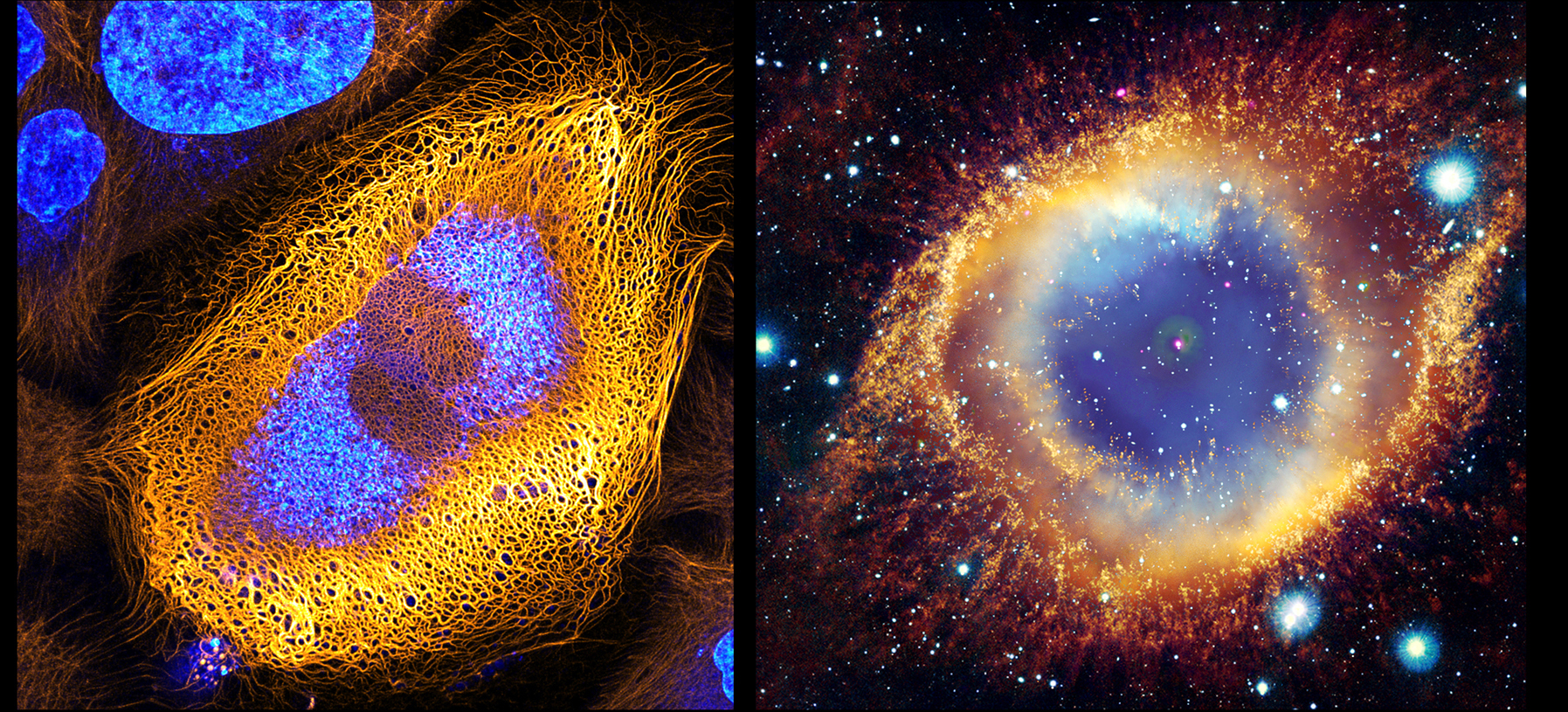
“Whether we’re studying a galaxy cluster millions of light-years away or a crystal formation at the micrometer scale, these images remind us of the shared beauty and complexity that define the natural world,” Dr. Kimberly Arcand, Chandra’s visualization and emerging technology scientist who led the project.
One pairing, for example, juxtaposes lab-grown human skin cells under a microscope with a planetary nebula observed by the Chandra X-ray Observatory, Hubble Space Telescope, and the European Southern Observatory—the beautiful, expanding remains of a dying Sun-like star. Though separated by scale and distance, both scenes reveal layers of structure, texture, and renewal, offering a reminder of the shared cycles of creation across the universe.
The new collection contains twenty-two image pairings. Each is accompanied by a short caption that briefly explains the science being shown. Together, they invite viewers to explore how scientists use light—visible and invisible—to uncover hidden details of the cosmos and of life on Earth. View the full collection at https://chandra.si.edu/micro/pairs.html.
For more information on this project, please contact Kimberly Arcand at cxcpub@cfa.harvard.edu
Information on the Chandra X-ray Observatory, including all the images it has captured over its lifetime, can be found at https://chandra.si.edu