

CXC Home | Search | Help | Image Use Policy | Latest Images | Privacy | Accessibility | Glossary | Q&A
 Not Labeled
 Labeled
1. 3D model of V745 Sco
This illustrated figure depicts the 3D model of the V745 Sco explosion. The blast wave is yellow, the mass ejected by the explosion is purple, and the disk of cooler material, which is mostly untouched by the effects of the blast wave, is blue. The cavity visible on the left side of the ejected material (see the labeled version) is the result of the debris from the white dwarf’s surface being slowed down as it strikes the red giant. (Credit: NASA/CXC/M.Weiss)
Related Photo Album
This illustrated figure depicts the 3D model of the V745 Sco explosion. The blast wave is yellow, the mass ejected by the explosion is purple, and the disk of cooler material, which is mostly untouched by the effects of the blast wave, is blue. The cavity visible on the left side of the ejected material (see the labeled version) is the result of the debris from the white dwarf’s surface being slowed down as it strikes the red giant. (Credit: NASA/CXC/M.Weiss)
Related Photo Album
2. Artist's Illustration of a White Dwarf Star in Orbit with a Black Hole
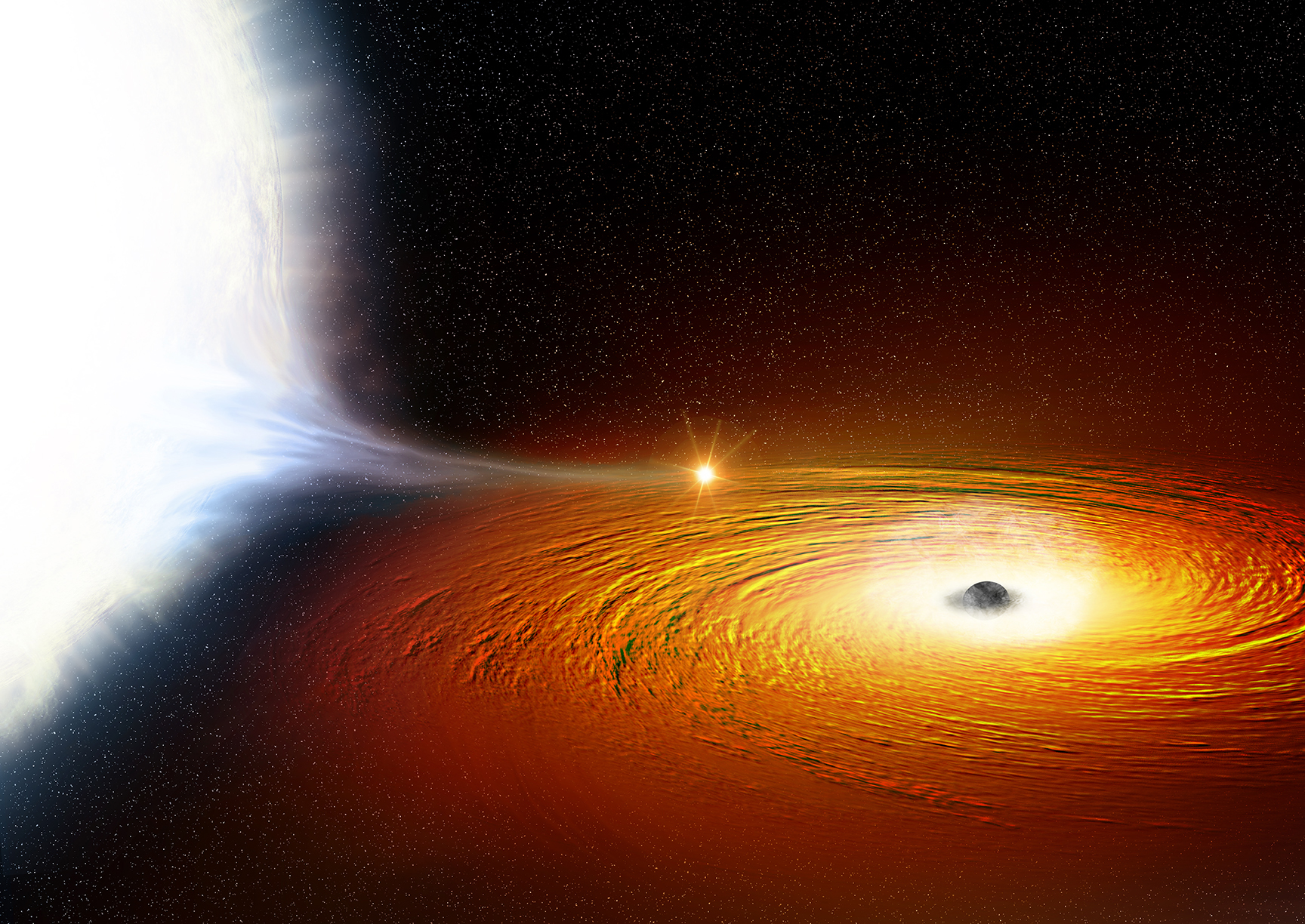
This artist's impression depicts a white dwarf star found in the closest known orbit around a black hole. As the circle around each other, the black hole's gravitational pull drags material from the white dwarf's outer layers toward it. Astronomers found that the white dwarf in X9 completes one orbit around the black hole in less than a half an hour. They estimate the white dwarf and black hole are separated by about 2.5 times the distance between the Earth and Moon — an extraordinarily small span in cosmic terms. (Illustration: NASA/CXC/M.Weiss)
Related Photo Album
This artist's impression depicts a white dwarf star found in the closest known orbit around a black hole. As the circle around each other, the black hole's gravitational pull drags material from the white dwarf's outer layers toward it. Astronomers found that the white dwarf in X9 completes one orbit around the black hole in less than a half an hour. They estimate the white dwarf and black hole are separated by about 2.5 times the distance between the Earth and Moon — an extraordinarily small span in cosmic terms. (Illustration: NASA/CXC/M.Weiss)
Related Photo Album
Download:
3. Accreting White Dwarf
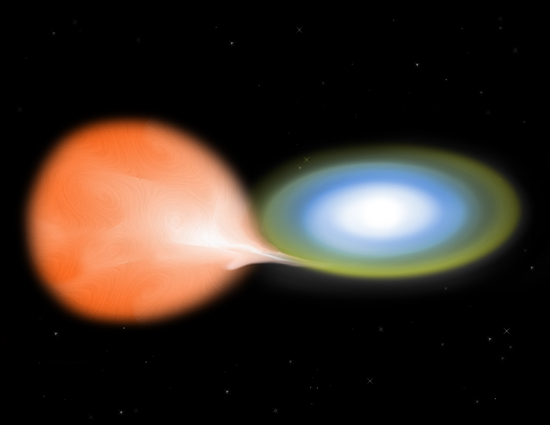
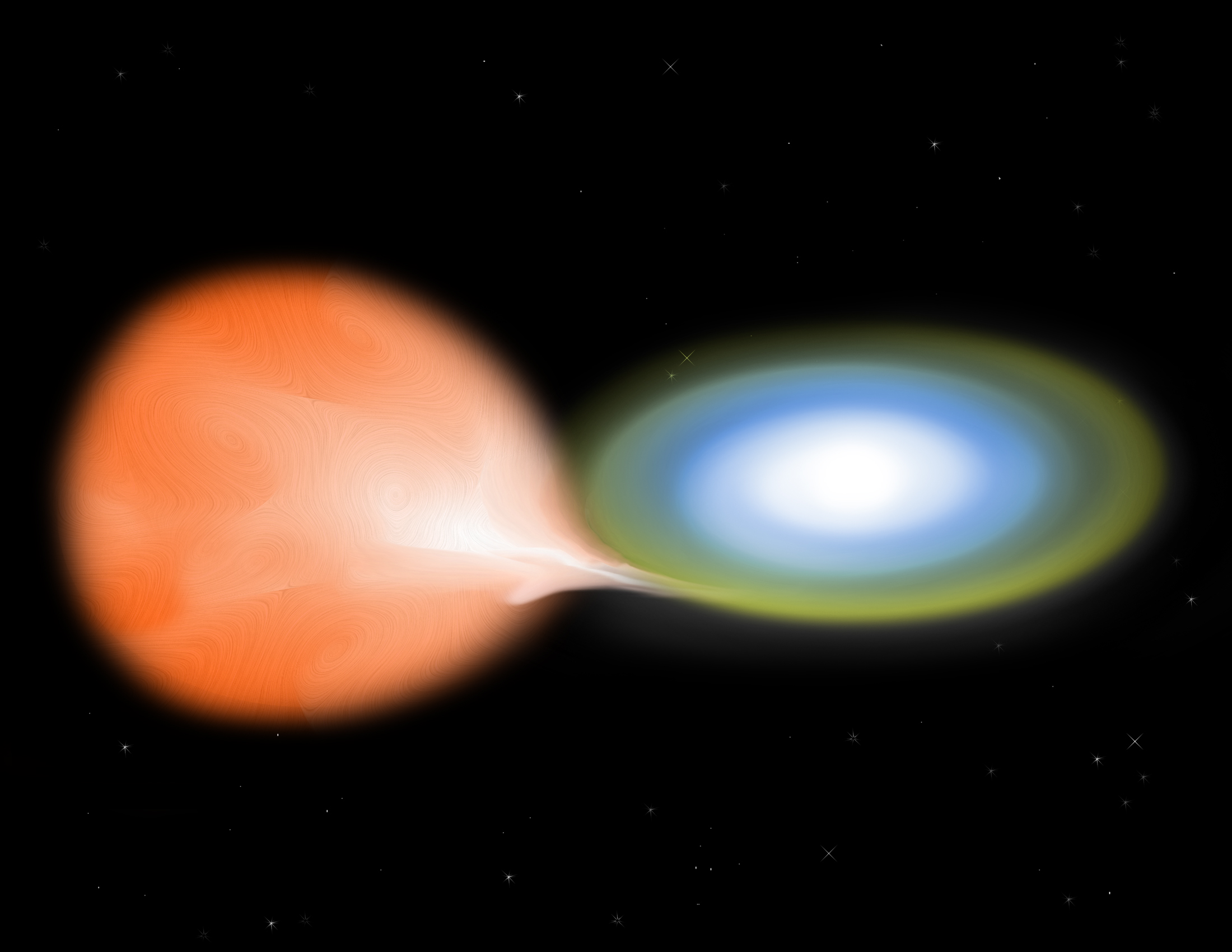
This illustration depicts gas flowing from the large red, companion star into a disk and then onto the white dwarf that is hidden inside the white area. As the gas flows ever closer to the white dwarf, it gets increasingly hotter, as indicated by the change in colors from yellow to white. When a sufficient amount of gas has accumulated on the white dwarf star, it will undergo a thermonuclear explosion that will eject the outer layers of the star in a nova outburst. (Illustration: NASA/CXC/M.Weiss)
Related Photo Album
This illustration depicts gas flowing from the large red, companion star into a disk and then onto the white dwarf that is hidden inside the white area. As the gas flows ever closer to the white dwarf, it gets increasingly hotter, as indicated by the change in colors from yellow to white. When a sufficient amount of gas has accumulated on the white dwarf star, it will undergo a thermonuclear explosion that will eject the outer layers of the star in a nova outburst. (Illustration: NASA/CXC/M.Weiss)
Related Photo Album
Download:
4. Accreting White Dwarf
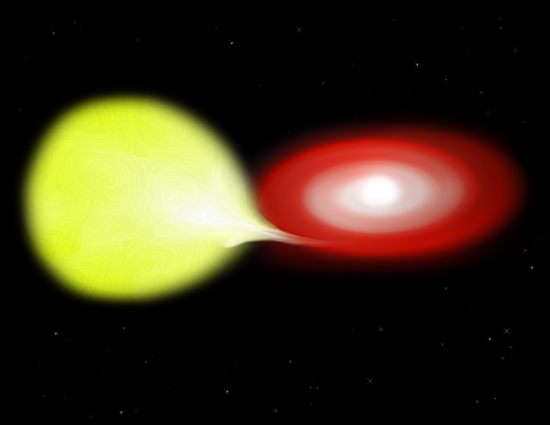
This illustration depicts gas flowing from the large red, companion star into a disk and then onto the white dwarf that is hidden inside the white area. As the gas flows ever closer to the white dwarf, it gets increasingly hotter, as indicated by the change in colors from yellow to white. When a sufficient amount of gas has accumulated on the white dwarf star, it will undergo a thermonuclear explosion that will eject the outer layers of the star in a nova outburst. (Illustration: NASA/CXC/M.Weiss)
Related Photo Album
This illustration depicts gas flowing from the large red, companion star into a disk and then onto the white dwarf that is hidden inside the white area. As the gas flows ever closer to the white dwarf, it gets increasingly hotter, as indicated by the change in colors from yellow to white. When a sufficient amount of gas has accumulated on the white dwarf star, it will undergo a thermonuclear explosion that will eject the outer layers of the star in a nova outburst. (Illustration: NASA/CXC/M.Weiss)
Related Photo Album
Download:
5. Illustration of Mira System
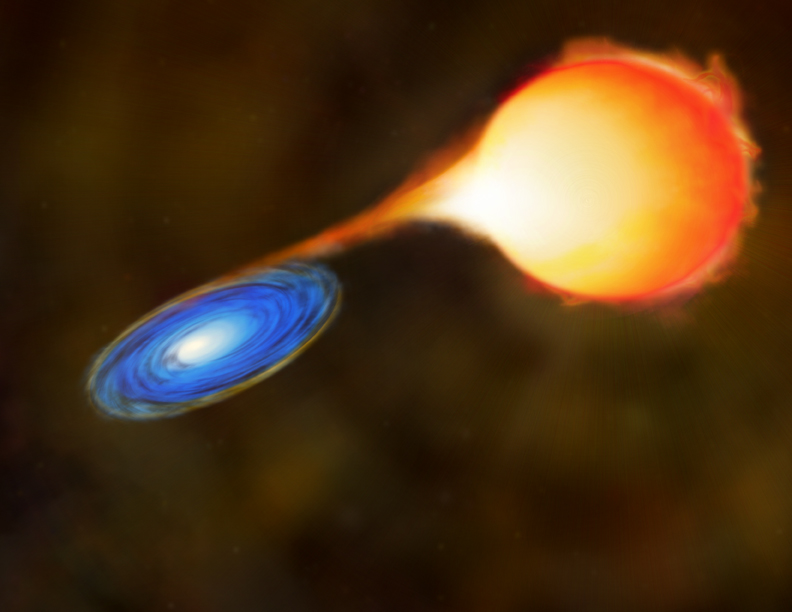
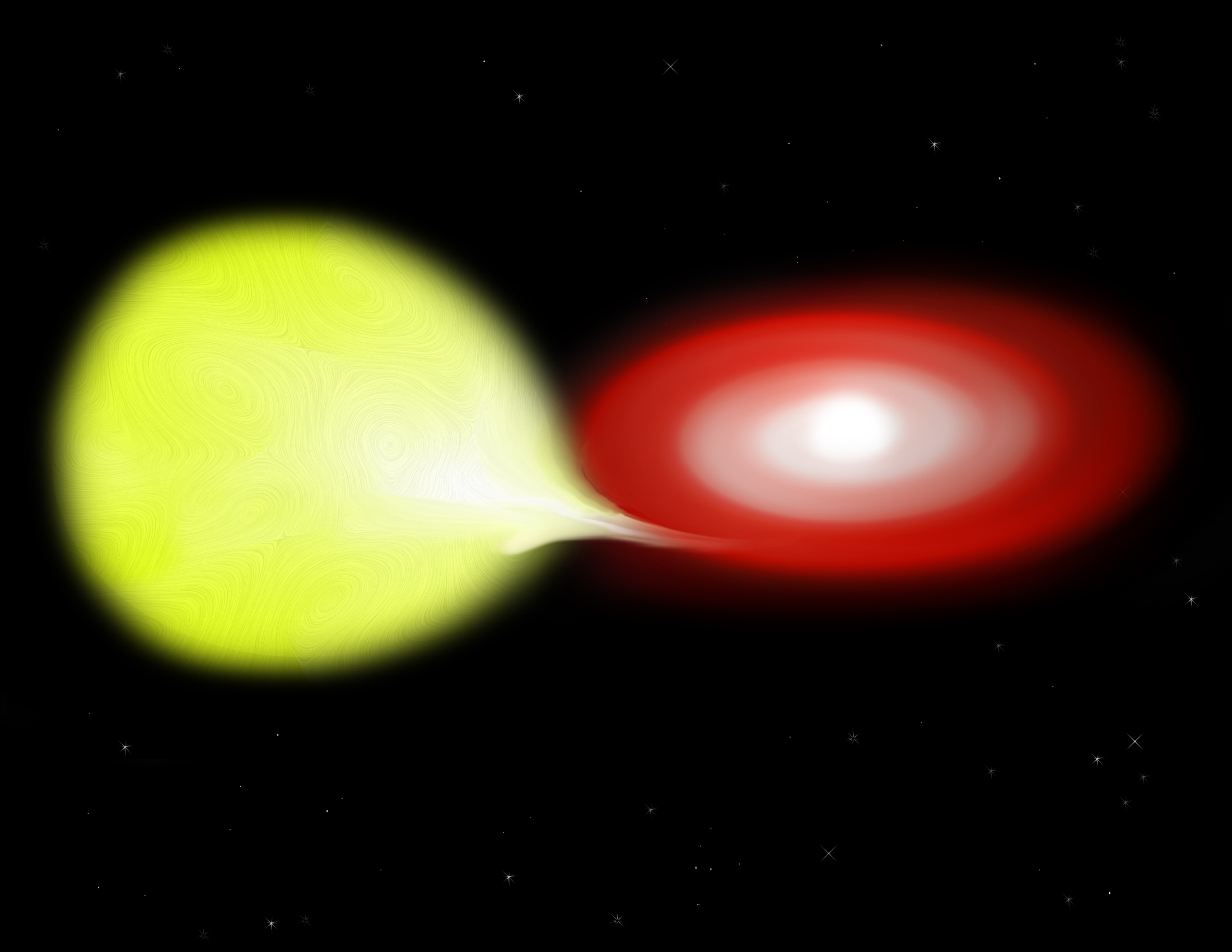
This artist's conception of the Mira star system depicts Mira A (right), a highly evolved red giant star, and Mira B (left), a white dwarf. Mira A is losing gas rapidly from its upper atmosphere via a stellar wind. Mira B exerts a gravitational tug that creates a gaseous bridge between the two stars. Gas from the wind and bridge accumulates in an accretion disk around Mira B and collisions between rapidly moving particles in the disk produce X-rays. (Credit: NASA/CXC/M.Weiss)
Related Photo Album
This artist's conception of the Mira star system depicts Mira A (right), a highly evolved red giant star, and Mira B (left), a white dwarf. Mira A is losing gas rapidly from its upper atmosphere via a stellar wind. Mira B exerts a gravitational tug that creates a gaseous bridge between the two stars. Gas from the wind and bridge accumulates in an accretion disk around Mira B and collisions between rapidly moving particles in the disk produce X-rays. (Credit: NASA/CXC/M.Weiss)
Related Photo Album
Download:
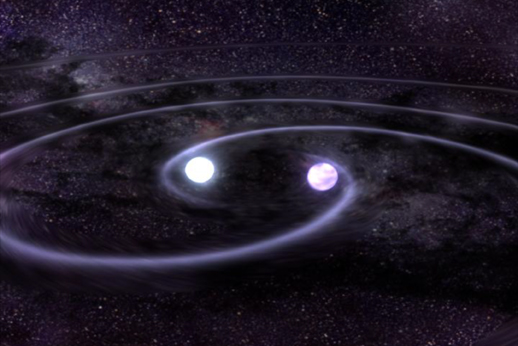
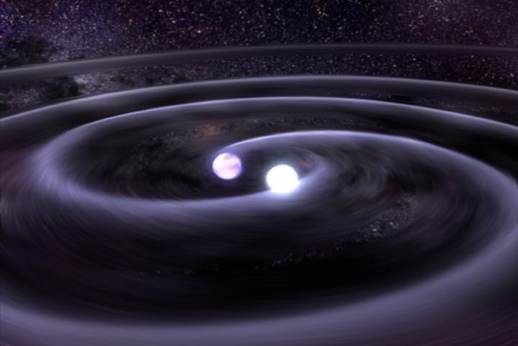
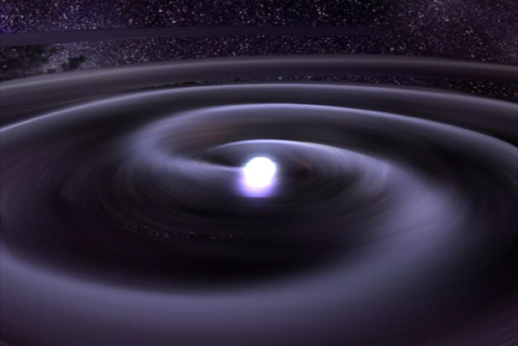
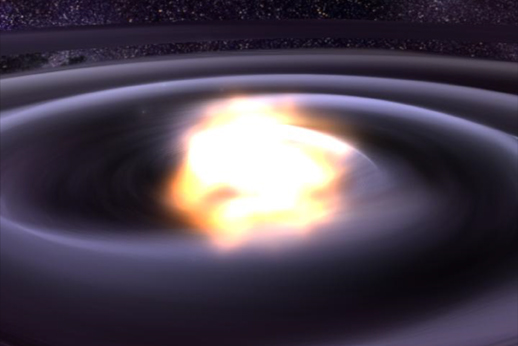
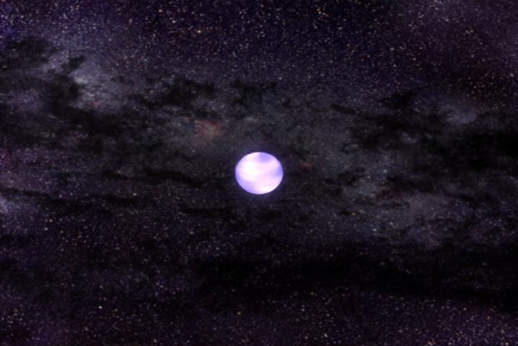
6. Still Illustrations of White Dwarf Gravitational Wave Merger
Two white dwarf stars, orbiting each other in a death grip and destined to merge, may be flooding space right now with gravitational waves. These waves are ripples in space-time predicted by Einstein but never detected directly. Einstein predicted that accelerating, massive objects emit gravitational waves, which propagate through space at light speed. A passing wave will cause the Earth, Moon and all matter to bob, like a buoy on the ocean, subtly altering the distance between them. (Credit: GSFC/D.Berry)
Related Photo Album
Two white dwarf stars, orbiting each other in a death grip and destined to merge, may be flooding space right now with gravitational waves. These waves are ripples in space-time predicted by Einstein but never detected directly. Einstein predicted that accelerating, massive objects emit gravitational waves, which propagate through space at light speed. A passing wave will cause the Earth, Moon and all matter to bob, like a buoy on the ocean, subtly altering the distance between them. (Credit: GSFC/D.Berry)
Related Photo Album
Download:




Revised: January 16, 2018