

CXC Home | Search | Help | Image Use Policy | Latest Images | Privacy | Accessibility | Glossary | Q&A
Page 1

1. The Butterfly Hunter
QuicktimeMPEG Audio Only
Astronomers using NASA's Chandra X-ray Observatory have set out on a hunt, to look at as many planetary nebulae as they can! Planetary nebulae are simply glowing clouds of gas and dust. They actually have nothing to do with planets at all. Now astronomers are using Chandra to track all of these clouds within our part of the galaxy. This picture shows four butterfly-shaped planetary nebulae that they've captured already!
These clouds show us a phase of life that all medium-sized stars, like our Sun, eventually go through. When a star has burned all its fuel it expands, into an enormous Red Giant. The star can swell to hundreds of times bigger! At this size the star has trouble keeping hold of its outer layers of material. A large amount of material from the star's outer shell blows off into space.
The hot core of the star is left behind. It soon begins to collapse in on itself. All the material in the core ends up squashed tightly down into a tiny, heavy star. This is called a White Dwarf. A white dwarf with the same amount of material as our sun would only be the size of Earth!
Gas and dust shed by the star forms a planetary nebula, which surrounds the white dwarf in a colourful cocoon. These gassy envelopes come in many shapes and sizes. In these pictures you can see the material has formed two symmetrical clouds which spread out on either side of the star. They look just like the wings of a butterfly!
[Runtime: 02:11]
(NASA/CXC/April Jubett)
Related Chandra Images:
QuicktimeMPEG Audio Only
- Audio (1.6 MB)
Astronomers using NASA's Chandra X-ray Observatory have set out on a hunt, to look at as many planetary nebulae as they can! Planetary nebulae are simply glowing clouds of gas and dust. They actually have nothing to do with planets at all. Now astronomers are using Chandra to track all of these clouds within our part of the galaxy. This picture shows four butterfly-shaped planetary nebulae that they've captured already!
These clouds show us a phase of life that all medium-sized stars, like our Sun, eventually go through. When a star has burned all its fuel it expands, into an enormous Red Giant. The star can swell to hundreds of times bigger! At this size the star has trouble keeping hold of its outer layers of material. A large amount of material from the star's outer shell blows off into space.
The hot core of the star is left behind. It soon begins to collapse in on itself. All the material in the core ends up squashed tightly down into a tiny, heavy star. This is called a White Dwarf. A white dwarf with the same amount of material as our sun would only be the size of Earth!
Gas and dust shed by the star forms a planetary nebula, which surrounds the white dwarf in a colourful cocoon. These gassy envelopes come in many shapes and sizes. In these pictures you can see the material has formed two symmetrical clouds which spread out on either side of the star. They look just like the wings of a butterfly!
[Runtime: 02:11]
(NASA/CXC/April Jubett)
Related Chandra Images:
- Photo Album: NGC 6543
2. Illustrations of an AM CVn system
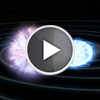
QuicktimeMPEG This series of artist's illustrations depicts what these systems are like now and what may happen to them in the future. The first still shows the current state of the binary that contains one white dwarf (on the right) with about one-fifth the mass of the Sun and another much heavier and more compact white dwarf about five or more times as massive (unlike sun-like stars, heavier white dwarfs are smaller). As the two white dwarfs orbit around each other, gravitational waves will be given off causing the orbit to become tighter. Eventually the smaller, heavier white dwarf will start pulling matter from the larger, lighter one, as shown in the second still, forming an AM CVn system. This process continues until so much matter accumulates on the more massive white dwarf that a thermonuclear explosion may occur in about 100 million years (final still).
[Runtime: 00:12]
(NASA/CXC/A. Hobart, Illustration: NASA/CXC/M.Weiss)
Related Chandra Images:
QuicktimeMPEG This series of artist's illustrations depicts what these systems are like now and what may happen to them in the future. The first still shows the current state of the binary that contains one white dwarf (on the right) with about one-fifth the mass of the Sun and another much heavier and more compact white dwarf about five or more times as massive (unlike sun-like stars, heavier white dwarfs are smaller). As the two white dwarfs orbit around each other, gravitational waves will be given off causing the orbit to become tighter. Eventually the smaller, heavier white dwarf will start pulling matter from the larger, lighter one, as shown in the second still, forming an AM CVn system. This process continues until so much matter accumulates on the more massive white dwarf that a thermonuclear explosion may occur in about 100 million years (final still).
[Runtime: 00:12]
(NASA/CXC/A. Hobart, Illustration: NASA/CXC/M.Weiss)
Related Chandra Images:
- Photo Album: J075141

3. Planetary Nebula Survey
QuicktimeMPEG Audio Only
A planetary nebula is a phase of stellar evolution that the sun should experience several billion years from now, when it expands to become a red giant. It will then shed most of its outer layers, leaving behind a hot core that contracts to form a dense white dwarf star. A wind from the hot core will ram into the ejected atmosphere, creating beautiful, shell-like structures seen with optical telescopes. This gallery shows four planetary nebulas from the first systematic survey of such objects in the solar neighborhood made with NASA's Chandra X-ray Observatory. X-ray emission from Chandra is colored purple and optical emission from the Hubble Space Telescope is colored red, green and blue. The diffuse X-ray emission is caused by shock waves as the wind collides with the ejected atmosphere.
[Runtime: 1.00]
(NASA/CXC/A. Hobart)
Related Chandra Images:
QuicktimeMPEG Audio Only
- Audio (921.3 kb)
A planetary nebula is a phase of stellar evolution that the sun should experience several billion years from now, when it expands to become a red giant. It will then shed most of its outer layers, leaving behind a hot core that contracts to form a dense white dwarf star. A wind from the hot core will ram into the ejected atmosphere, creating beautiful, shell-like structures seen with optical telescopes. This gallery shows four planetary nebulas from the first systematic survey of such objects in the solar neighborhood made with NASA's Chandra X-ray Observatory. X-ray emission from Chandra is colored purple and optical emission from the Hubble Space Telescope is colored red, green and blue. The diffuse X-ray emission is caused by shock waves as the wind collides with the ejected atmosphere.
[Runtime: 1.00]
(NASA/CXC/A. Hobart)
Related Chandra Images:
- Photo Album: NGC 6543
4. Chandra and Spitzer Images of Cepheus B
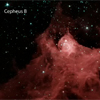
QuicktimeMPEG Astronomers observed an object known as Cepheus B, which is a cloud of molecular hydrogen about 2,400 light years from Earth. X-ray data from Chandra allowed the researchers to pick out the young stars within around Cepheus B. Infrared emission detected by Spitzer revealed whether the young stars had disks around them in which stars may form. By combining the two sets of data, astronomers found that stars in this object are being triggered to form by some external force, such as radiation from a massive star or a shock from a nearby supernova.
[Runtime: 0:08]
(X-ray (NASA/CXC/PSU/K. Getman et al.); IR (NASA/JPL-Caltech/CfA/J. Wang et al.))
Related Chandra Images:
QuicktimeMPEG Astronomers observed an object known as Cepheus B, which is a cloud of molecular hydrogen about 2,400 light years from Earth. X-ray data from Chandra allowed the researchers to pick out the young stars within around Cepheus B. Infrared emission detected by Spitzer revealed whether the young stars had disks around them in which stars may form. By combining the two sets of data, astronomers found that stars in this object are being triggered to form by some external force, such as radiation from a massive star or a shock from a nearby supernova.
[Runtime: 0:08]
(X-ray (NASA/CXC/PSU/K. Getman et al.); IR (NASA/JPL-Caltech/CfA/J. Wang et al.))
Related Chandra Images:
- Photo Album: Cepheus B
5. Animation of Interacting Stars
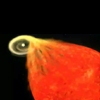
QuicktimeMPEG This animation shows the interaction between a "normal" star and a collapsed object such as a neutron star or a black hole. The star has reached its so-called red giant phase, where it swells to hundreds of times its original size. Those outer layers are then captured by the gravitational pull of the denser companion.
[Runtime: ]
(NASA/STScI)
Related Chandra Images:
QuicktimeMPEG This animation shows the interaction between a "normal" star and a collapsed object such as a neutron star or a black hole. The star has reached its so-called red giant phase, where it swells to hundreds of times its original size. Those outer layers are then captured by the gravitational pull of the denser companion.
[Runtime: ]
(NASA/STScI)
Related Chandra Images:
- Photo Album: Mira
6. Animation of White Dwarf Gravitational Wave Merger
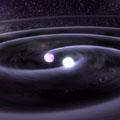
QuicktimeMPEG This artist concept depicts two white dwarfs called RX J0806.3+1527 or J0806, swirling closer together, traveling in excess of a million miles per hour. As their orbit gets smaller and smaller, leading up to a merger, the system should release more and more energy in gravitational waves. This particular pair might have the smallest orbit of any known binary system. They complete an orbit in 321.5 seconds - barely more than five minutes.
[Runtime: 0:40]
View Stills
(NASA/GSFC/D.Berry)
Related Chandra Images:
QuicktimeMPEG This artist concept depicts two white dwarfs called RX J0806.3+1527 or J0806, swirling closer together, traveling in excess of a million miles per hour. As their orbit gets smaller and smaller, leading up to a merger, the system should release more and more energy in gravitational waves. This particular pair might have the smallest orbit of any known binary system. They complete an orbit in 321.5 seconds - barely more than five minutes.
[Runtime: 0:40]
View Stills
(NASA/GSFC/D.Berry)
Related Chandra Images:
- Photo Album: RX J0806.3+1527
7. Sequence of Planetary Nebula Images
QuicktimeMPEG Planetary nebulas - so called because some of them resemble a planet when viewed through a small telescope - are produced in the late stages of a sun-like star's life. In this sequence, composite images of four different planetary nebulas are shown. In these images of Mz 3, BD+30-3639, Hen 3-1475, and NGC 7027, Chandra's X-ray data are seen in blue, while green and red are optical and infrared data from Hubble.
[Runtime: 0:35]
(X-ray: NASA/CXC/RIT/J.Kastner et al. Optical, BD +30 & Hen 3: NASA/STScI/Univ. MD/J.P.Harrington; Optical, NGC 7027: NASA/STScI/Caltech/J.Westphal & W.Latter; Optical, Mz 3: NASA/STScI/Univ. Washington/B.Balick)
Related Chandra Images:
QuicktimeMPEG Planetary nebulas - so called because some of them resemble a planet when viewed through a small telescope - are produced in the late stages of a sun-like star's life. In this sequence, composite images of four different planetary nebulas are shown. In these images of Mz 3, BD+30-3639, Hen 3-1475, and NGC 7027, Chandra's X-ray data are seen in blue, while green and red are optical and infrared data from Hubble.
[Runtime: 0:35]
(X-ray: NASA/CXC/RIT/J.Kastner et al. Optical, BD +30 & Hen 3: NASA/STScI/Univ. MD/J.P.Harrington; Optical, NGC 7027: NASA/STScI/Caltech/J.Westphal & W.Latter; Optical, Mz 3: NASA/STScI/Univ. Washington/B.Balick)
Related Chandra Images:
- Photo Album: Mz 3
Page 1



Revised: May 26, 2023