

CXC Home | Search | Help | Image Use Policy | Latest Images | Privacy | Accessibility | Glossary | Q&A

1. Beyond the Horizon
QuicktimeMPEG Audio Only
[Runtime: 02:03]
(NASA/CXC/April Jubett)
Related Chandra Images:
QuicktimeMPEG Audio Only
- Audio (1.5 MB)
For a long time people believed that the Earth was flat and that if you sailed too far you'd fall over the edge! It seems funny they could have thought that, because now we're lucky enough to have pictures of our entire planet and we can see its shape (take a look at image 2). But it took some pretty impressive technology to get these pictures, which wasn't available to our ancient ancestors. Did you know you have to travel about 20,000 kilometres from Earth to be able to see the entire planet?
Now imagine how far into space you'd have to travel to fit all the 300 billion stars of the Milky Way (our Galaxy) into one shot! This is way beyond our abilities at the moment, but we can photograph small sections of the Galaxy. This picture from the Chandra X-ray Observatory shows the very centre of the Milky Way. This is the most chaotic and dangerous part of the Galaxy, and home to a supermassive black hole.
Anything that gets too close to a black hole is pulled into it with such a strong force that it has no chance of escape. The boundary that marks the point of no return is called the event horizon. Past this not even light will return: this monster will pull it in forever. The blue haze in this picture includes piping-hot gas floating perilously close to the event horizon of our Galaxy's supermassive black hole. But astronomers have found that just a tiny amount of this gas will be gobbled up by the black hole, and the rest will be "spat out" before it gets too close.
[Runtime: 02:03]
(NASA/CXC/April Jubett)
Related Chandra Images:
- Photo Album: Sagittarius A*
2. Learn About the Milky Way
QuicktimeMPEG Audio Only
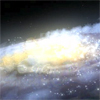
The word galaxy comes from the Greek word meaning "milky circle" or the more familiar Milky Way.
The white band of light across the night sky that we call the Milky Way was poetically described long before Galileo, but with his small telescope, what he discovered was a multitude of individual stars, so numerous as almost to surpass belief.
Today we know that the Milky Way is our home galaxy, a vast rotating spiral of gas, dust and hundreds of billions of stars.
The sun and its planetary system formed in the outer reaches of the Milky Way about 4.5 billion years ago.
See the Milky Way through Chandra's eyes.
[Runtime: 1.31]
(NASA/CXC/A. Hobart)
QuicktimeMPEG Audio Only
- Audio (600.2 kb)
The word galaxy comes from the Greek word meaning "milky circle" or the more familiar Milky Way.
The white band of light across the night sky that we call the Milky Way was poetically described long before Galileo, but with his small telescope, what he discovered was a multitude of individual stars, so numerous as almost to surpass belief.
Today we know that the Milky Way is our home galaxy, a vast rotating spiral of gas, dust and hundreds of billions of stars.
The sun and its planetary system formed in the outer reaches of the Milky Way about 4.5 billion years ago.
See the Milky Way through Chandra's eyes.
[Runtime: 1.31]
(NASA/CXC/A. Hobart)
3. Animation of a Black Hole's Outburst
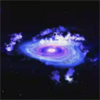
QuicktimeMPEG This animation shows how high-energy particles and X-ray flares are produced when matter falls onto the accretion disk around a supermassive black hole. Astronomers believe such an event occurred to produce the light echo seen in the latest Chandra results.
[Runtime: 0.10]
(NASA/CXC/D.Berry)
Related Chandra Images:
QuicktimeMPEG This animation shows how high-energy particles and X-ray flares are produced when matter falls onto the accretion disk around a supermassive black hole. Astronomers believe such an event occurred to produce the light echo seen in the latest Chandra results.
[Runtime: 0.10]
(NASA/CXC/D.Berry)
Related Chandra Images:
- Photo Album: Light Echo at Galactic Center
4. Illustrations of Light Echo
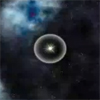
QuicktimeMPEG This sequence of illustrations shows how an outburst from Sgr A* -- produced when material falls into the black hole -- generates a light echo. The faint, star-like object in the center represents the typical, quiet behavior, when the black hole does not have much material to consume. When the black hole's feeding rate increases dramatically, the material around Sgr A* brightens. Although the black hole outburst stops, the light from the outburst continues to travel outwards and then reflects, or echoes, off three clouds of gas in its path.
[Runtime: 0.13]
(NASA/CXC/M.Weiss)
Related Chandra Images:
QuicktimeMPEG This sequence of illustrations shows how an outburst from Sgr A* -- produced when material falls into the black hole -- generates a light echo. The faint, star-like object in the center represents the typical, quiet behavior, when the black hole does not have much material to consume. When the black hole's feeding rate increases dramatically, the material around Sgr A* brightens. Although the black hole outburst stops, the light from the outburst continues to travel outwards and then reflects, or echoes, off three clouds of gas in its path.
[Runtime: 0.13]
(NASA/CXC/M.Weiss)
Related Chandra Images:
- Photo Album: Light Echo at Galactic Center
5. Into the Milky Way: Quintuplet Cluster
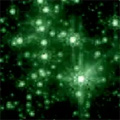
QuicktimeMPEG This sequence begins with Chandra's X-ray view of a 900 by 400 light year swath of the center of the Milky Way. It then zooms into a smaller region where large filamentary structures are seen in radio waves. The view moves in even closer to show the Quintuplet star cluster. Named for its five brightest stars at infrared wavelengths, the Quintuplet is known to be home to hundreds of stars. Several of these are very massive stars that are rapidly losing gas from their surfaces in high-speed stellar winds. Collisions from these winds are what astronomers believe to be the source for the point-like concentrations seen in the Chandra image.
[Runtime: 0:24]
(X-ray: NASA/CXC/NWU/C.Law & F.Zadeh; IR: NASA/ESO/STScI/D.Figer et al.; Radio: NRAO/AUI/NSF/F.Zadeh et al.)
Related Chandra Images:
QuicktimeMPEG This sequence begins with Chandra's X-ray view of a 900 by 400 light year swath of the center of the Milky Way. It then zooms into a smaller region where large filamentary structures are seen in radio waves. The view moves in even closer to show the Quintuplet star cluster. Named for its five brightest stars at infrared wavelengths, the Quintuplet is known to be home to hundreds of stars. Several of these are very massive stars that are rapidly losing gas from their surfaces in high-speed stellar winds. Collisions from these winds are what astronomers believe to be the source for the point-like concentrations seen in the Chandra image.
[Runtime: 0:24]
(X-ray: NASA/CXC/NWU/C.Law & F.Zadeh; IR: NASA/ESO/STScI/D.Figer et al.; Radio: NRAO/AUI/NSF/F.Zadeh et al.)
Related Chandra Images:
- Photo Album: Quintuplet Cluster
6. Towards the Milky Way: DB00-6
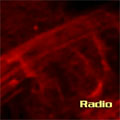
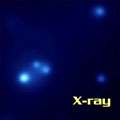
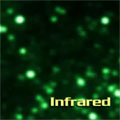
QuicktimeMPEG his series of images shows the DB00-58 star cluster in context with Chandra's 900- by 400-light year mosaic of the Galactic Center. The view then transitions to radio emission from a smaller region that includes DB00-6, before showing infrared data, and ending with Chandra's X-ray close-up. . Despite DB00-6's similar appearance to DB01-42 (#1, above), the X-ray and infrared information show that DB00-6 is, in fact, a foreground object, and is significantly closer to us than 25,000 light years.
[Runtime: 0:24]
(X-ray: NASA/CXC/Northwestern U./C.Law & F.Yusef-Zadeh; Infrared: 2MASS/UMass/IPAC-Caltech/NASA/NSF; Radio: NRAO/AUI/NSF/F.Zadeh et al.)
Related Chandra Images:
QuicktimeMPEG his series of images shows the DB00-58 star cluster in context with Chandra's 900- by 400-light year mosaic of the Galactic Center. The view then transitions to radio emission from a smaller region that includes DB00-6, before showing infrared data, and ending with Chandra's X-ray close-up. . Despite DB00-6's similar appearance to DB01-42 (#1, above), the X-ray and infrared information show that DB00-6 is, in fact, a foreground object, and is significantly closer to us than 25,000 light years.
[Runtime: 0:24]
(X-ray: NASA/CXC/Northwestern U./C.Law & F.Yusef-Zadeh; Infrared: 2MASS/UMass/IPAC-Caltech/NASA/NSF; Radio: NRAO/AUI/NSF/F.Zadeh et al.)
Related Chandra Images:
- Photo Album: DB00-6
7. Towards the Milky Way: DB00-58
QuicktimeMPEG This series of images shows the DB00-58 star cluster in context with Chandra's 900- by 400-light year mosaic of the Galactic Center. The view then transitions to infrared emission from a smaller region that includes DB00-58, before showing Chandra's X-ray close-up. Despite DB00-58's similar appearance to DB01-42 (#1, above), the X-ray and infrared information show that DB00-58 is, in fact, a foreground object, and is significantly closer to us than 26,000 light years.
[Runtime: 0:20]
(X-ray: NASA/CXC/Northwestern U./C.Law & F.Yusef-Zadeh; Infrared: 2MASS/UMass/IPAC-Caltech/NASA/NSF)
Related Chandra Images:
QuicktimeMPEG This series of images shows the DB00-58 star cluster in context with Chandra's 900- by 400-light year mosaic of the Galactic Center. The view then transitions to infrared emission from a smaller region that includes DB00-58, before showing Chandra's X-ray close-up. Despite DB00-58's similar appearance to DB01-42 (#1, above), the X-ray and infrared information show that DB00-58 is, in fact, a foreground object, and is significantly closer to us than 26,000 light years.
[Runtime: 0:20]
(X-ray: NASA/CXC/Northwestern U./C.Law & F.Yusef-Zadeh; Infrared: 2MASS/UMass/IPAC-Caltech/NASA/NSF)
Related Chandra Images:
- Photo Album: DB00-6
8. DB01-42 in context of the Milky Way Center
QuicktimeMPEG This series of images puts the cluster known as DB01-42 in context with Chandra's 900- by 400-light year mosaic of the Galactic Center. The view then transitions to radio emission from a smaller region that includes DB01-42, before showing infrared data of the same area, and ending with Chandra's X-ray close-up. Chandra's X-ray data have helped astronomers identify DB01-42 as a member of the Galactic Center. It is about 26,000 light years away from Earth.
[Runtime: 0:10]
(X-ray: NASA/CXC/Northwestern U./C.Law & F.Yusef-Zadeh; Infrared: 2MASS/UMass/IPAC-Caltech/NASA/NSF; Radio: NRAO/AUI/NSF/F.Zadeh et al.)
Related Chandra Images:
QuicktimeMPEG This series of images puts the cluster known as DB01-42 in context with Chandra's 900- by 400-light year mosaic of the Galactic Center. The view then transitions to radio emission from a smaller region that includes DB01-42, before showing infrared data of the same area, and ending with Chandra's X-ray close-up. Chandra's X-ray data have helped astronomers identify DB01-42 as a member of the Galactic Center. It is about 26,000 light years away from Earth.
[Runtime: 0:10]
(X-ray: NASA/CXC/Northwestern U./C.Law & F.Yusef-Zadeh; Infrared: 2MASS/UMass/IPAC-Caltech/NASA/NSF; Radio: NRAO/AUI/NSF/F.Zadeh et al.)
Related Chandra Images:
- Photo Album: DB00-6
9. Virtual Voyage through the Milky Way: Whole Journey
QuicktimeMPEG Broadcast:
Zoom out past Earth, Venus, Mercury & the Sun. Go beyond the solar system, and out of the Milky Way to our Local Group. Then, zoom back in from the Local Group to the Galactic Center & view the Chandra mosaic of the central region of our Galaxy.
[Runtime: 1:12]
View Stills
(NASA/CXC/A.Hobart)
QuicktimeMPEG Broadcast:
- QuickTime movie (uncompressed)
- D1 (0.9 pixel aspect ratio)
- 720x486
- 29.97 fps
- file size = (747.6 MB)
Zoom out past Earth, Venus, Mercury & the Sun. Go beyond the solar system, and out of the Milky Way to our Local Group. Then, zoom back in from the Local Group to the Galactic Center & view the Chandra mosaic of the central region of our Galaxy.
[Runtime: 1:12]
View Stills
(NASA/CXC/A.Hobart)
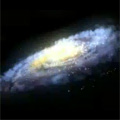
10. Virtual Voyage through the Milky Way: Local Group to Galactic Center
QuicktimeMPEG Zoom in from the Local Group to the Galactic Center & view the Chandra mosaic of the central region of our Galaxy.
[Runtime: 0:16]
View Stills
(NASA/CXC/A.Hobart)
QuicktimeMPEG Zoom in from the Local Group to the Galactic Center & view the Chandra mosaic of the central region of our Galaxy.
[Runtime: 0:16]
View Stills
(NASA/CXC/A.Hobart)


Revised: March 24, 2023