

CXC Home | Search | Help | Image Use Policy | Latest Images | Privacy | Accessibility | Glossary | Q&A
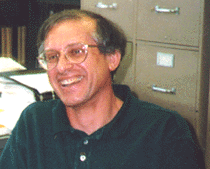
Dr. Harvey Tananbaum, Director Chandra X-Ray Center
August 26, 1997
Q: A lot has happened in the last twelve months.
HT: It has been the busiest year so far for the ASC. The AXAF team successfully completed the calibration of the telescope, the two objective grating assemblies, and the two focal plane science instruments. TRW*, the prime contractor for AXAF, was responsible for the overall test and Marshall (NASA's Marshall Space Flight Center in Huntsville, AL) was responsible for building the testing facility. The SAO Mission Support Team, under separate contract to MSFC, built special detectors used to test the telescope. The ASC was set up as the hub for planning of the calibration. The ASC and the MSFC Project Scientist team, with the help of the Science Instrument teams, listed the tests to be made, scheduled them, and then evaluated the test results in near real-time. The testing itself was an intense effort. We literally had thousands of tests to make and a limited time in which to do them. We kept the XRCF (the X-ray Calibration Facility at Marshall Space Flight Center) running 24 hours a day, 7 days a week.
Q: What were some of the high points of the calibration?
HT: One of the high points, probably the high point, was first light. Around the th ird week of December, we pumped the air out of the vacuum chamber and waited a few hours until we were sure all the contaminants had been cleared out of the chamber. By this time it was well after midnight. We woke up a few of the team members who had been with the project a long time so they could share the experience with us. Then we opened the covers to the mirrors and exposed them to X-rays for the first time. We adjusted the focus and there it was, a nice sharp image, just like we had predicted. It was a very exciting time.
Q: Did the tests reveal things you didn't expect?
HT: Nothing major, and that is very good news. Because of the testing we know we have the best X-ray mirrors ever made, and the most sensitive X-ray detectors. Of course there were many things we learned about the performance of the telescope that we couldn't have learned any other way. For example, the upper and lower parts of the mirror are not centered exactly alike, so the efficiency of the upper part is about ten percent greater than the lower part. Because of calibration, we now understand that effect and can correct for it. Otherwise, every image we made would have been off by a few percent and we wouldn't have known it.
Q: Were there any major crises?
HT: The most significant crisis was of a personal nature after the testing had been completed, when Martin Weisskopf (the AXAF Project Scientist at Marshall Space Flight Center) had a heart attack. This followed a very intense and stressful five-month test period. Fortunately, Martin is now fully recovered and even back to his daily basketball game.
Q: The testing must have been exhausting for everyone, given the round-the-clock schedule and the complexity of the job.
HT: In one way it was. In my case for example, I would often work here (at the Harvard-Smithsonian Center for Astrophysics) Monday through Thursday, catch the plane to Huntsville in time for the three-to-midnight shift, work that shift through Sunday night and fly back to Cambridge. In another way though, it was an exhilarating and energizing process, seeing it all come together and actually work, so you didn't realize how hard you were working. All in all it was a very satisfying experience, seeing how all the different groups learned to work together --- TRW, Marshall Project Science, the science instrument teams and the ASC. It built up a camaraderie that will stand us in good stead in the year ahead as we integrate the telescope and science instruments with the spacecraft and get ready for launch, which is about a year away.
[ Press Index ] [ Interviews ]*In December 2002, TRW was aquired by Northrop Grumman and is now a part of Northrop Grumman Science Technology.


Revised: April 15, 2008