

CXC Home | Search | Help | Image Use Policy | Latest Images | Privacy | Accessibility | Glossary | Q&A
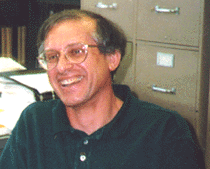
Dr. Harvey Tananbaum, Director Chandra X-Ray Center
August 26, 1996
Background:
The Advanced X-ray Astrophysics Facility (AXAF) is scheduled for
launch aboard the Space Shuttle in August 1998. We present here the
second of a series of interviews with Dr. Harvey Tananbaum, Director
of the AXAF Science Center, on the status of the project.
A major accomplishment during the period from August 95 to August 96 was the coating of the mirrors at Optical Coating Laboratories, Inc. in Santa Rosa, California. The mirrors were painstakingly cleaned and then precisely coated with layers of chromium and iridium, less than a millionth of an inch thick. The successful grinding, polishing and coating of the AXAF mirrors were historic technical accomplishments. They are the smoothest and cleanest mirrors ever made. After the coating process was completed, the mirrors were transported by air-ride van to Eastman Kodak Company in Rochester, New York, where they are being assembled into a support structure called the high resolution mirror assembly and aligned with one another.
Other important tasks underway during this time were the development of the scientific instruments which will record the direction of arrival and the distribution with energy of the X-rays focused by the mirrors, as well as the spacecraft module that will house the instruments and electronics that enable the data to be transmitted back to Earth.
Q: When we talked to you about a year ago, the X-ray mirrors were scheduled to be coated. We understand that it went well.
HT:The coating was very successful. All the mirrors met the requirements, and the job was completed essentially on schedule. X-ray measurements on witness samples in our labs at SAO (Smithsonian Astrophysical Observatory) by Dr. Suzanne Romaine and her team confirmed the excellent quality of the coatings. Everyone was very pleased with OCLI (Optical Coating Laboratories, Inc., in Santa Rosa, CA.). We will use them again if the opportunity arises.
Q: How are other aspects of the program going?
HT: This has been a challenging year in four areas: the construction of the mirror assembly, development of the CCD detectors, building the science instrument module; and keeping the weight on the observatory down. Ball (Ball Aerospace and Technology Corporation) had to deal with a number of issues involving the structural integrity and thermal design of the science instrument module. The weight of the ACIS (AXAF CCD Imaging Spectrometer) went up by approximately 50 pounds, further complicating the situation.
Q: Is this increase in weight a problem?
HT: It has been a challenge to the team because the overall increase has put us close to the limit allowed for the focal plane end of the observatory. The limit involves both the maximum weight that can be carried and the vibration loads to be experienced in the Shuttle. We had to update the predicted vibration loads taking into account the increased weight and other updates to the Observatory design. All of this resulted in a schedule impact as well.
Q: Will the delays on the science instrument module impact the testing schedule?
HT: No. We were able to rearrange the sequence of events and Ball built a special carrier to support and move the science instruments at the X-ray Calibration Facility at Marshall Space Flight Center. After calibration at MSFC, the science instruments will be shipped to Ball around July 1997 for integration into the science instrument module, so the overall program schedule or the August 1998 launch date will not be impacted.
Q: How about ACIS?
HT: They (the Penn State/MIT Consortium) fell behind schedule for several reasons. They had difficulty in getting good CCD (charged-coupled devices, electronic semiconductors used in digital imaging devices on telescopes and in digital cameras and camcorders) chips, then they encountered a series of technical and personnel issues--the launch of the Rossi XTE (X-ray Timing Explorer) satellite was delayed; that prevented a few key people from joining the ACIS team at the anticipated time--and finally, the flexprints, or connectors that link the CCDs to the data processors, failed during testing. They seem to have all that straightened out and to be coming along for a delivery of one unit in early March and the full set of flight CCDs in early April.
Q: How did the mirror assembly at Kodak go?
HT: The assembly of the mirrors was one of the most technically demanding tasks of the entire program. At least as challenging as the grinding and polishing of the mirrors. That's why we practiced with the VETA (Verification Engineering Test Article). Four pairs of heavy, fragile mirrors had to be aligned to an accuracy of a tenth of an arc second. That is equivalent to aligning them to an accuracy of about a fiftieth of the width of a human hair. Yet they had to be secure enough to survive launch--an incredibly difficult engineering feat.
Q: What sort of difficulties did they encounter?
HT: One example will give you an idea of what they were up against. To minimize the distortion due to gravity, they assembled and aligned the mirrors in a vertical orientation in a 60-foot tall tower. They used lasers and mirrors to test the alignment. They found that the body heat of the technicians changed the air temperature by a fraction of a degree and threw off the measurements. Opening and closing the door to the tower would set up air currents that would cause errors. Or turning the light in the tower on and off. So, they left a bank of eight fluorescent bulbs on all the time. The problem was that these light, which were ten feet away, caused temperature differences of a few hundredths of a degree, enough to change the local density of the air, its index of refraction, or ability to bend light, and produced a mirage effect which changed the focus of the test beam ever so slightly. So they had to set up a procedure wherein they kept the lights on only for three or four minutes at a time. That's the kind of problem they had to deal with, day in and day out.
Q: But they met the challenge.
HT: It appears that they have. But we won't know for sure until we finish the testing at the X-ray calibration facility at Marshall. As I said in the beginning, it has been a challenging year, but I like to think that the team is meeting the challenges. A program like this doesn't run without difficulties. We have overcome these difficulties. I hope that we are as effective in dealing with whatever crops up over the next year.
[ Press Index ] [ Interviews ]

Revised: April 15, 2008