

CXC Home | Search | Help | Image Use Policy | Latest Images | Privacy | Accessibility | Glossary | Q&A
The Inertial Upper Stage: Space Workhorse To Boost Chandra X-ray Observatory
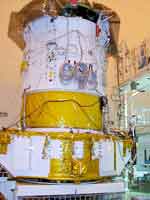
The Inertial Upper Stage is a two-stage, solid rocket used to place spacecraft into a high-Earth orbit or boost them away from the Earth on interplanetary missions. The Inertial Upper Stage is launched from Earth aboard either the NASA Space Shuttle or with a one-use launch vehicle, such as the Air Force's Titan rocket. Once in space, the Inertial Upper Stage is deployed from the Shuttle or Titan and ignites to propel its attached spacecraft to the proper point in space.
In 1999, the Inertial Upper Stage will help propel the newest of NASA's Great Observatories - the Chandra X-ray Observatory - from low Earth orbit into an elliptical orbit reaching one-third of the way to the Moon. The upper stage and the attached Chandra X-ray Observatory will be deployed from the Space Shuttle Columbia on its sixth or seventh orbit after launch. The Inertial Upper Stage then will fire its first stage solid rocket motor for about two minutes, then coast through space for about two minutes more. The first stage will then separate, and the second stage will fire for another minute-and-a-half.
About one hour later, the Chandra observatory's solar panels will be deployed. Then, having done its job, the remains of the Inertial Upper Stage will separate from the Chandra observatory and use small thruster motors to maneuver away from Chandra. This will clear the way for Chandra's own propulsion system to boost it the rest of the way to its working orbit.
Background
Since its first use by NASA in 1983, the Inertial Upper Stage has supported a variety of important missions. The Inertial Upper Stage has boosted all of NASA's Tracking and Data Relay Satellites from low-Earth orbit to geosynchronous orbit. The Inertial Upper Stage also has helped send the Galileo spacecraft on a journey to explore Jupiter, the Magellan spacecraft to study and map Venus, and the Ulysses spacecraft toward a polar orbit of the Sun. Marshall Space Flight Center in Huntsville, Ala., manages the NASA Inertial Upper Stage Program.
The Inertial Upper Stage, originally called the Interim Upper Stage, was designed as a temporary reusable space tug. The word "Inertial" - signifying the guidance technology - replaced "Interim" when it was determined that the Interim Upper Stage would be needed through the 1990s.
The Inertial Upper Stage was developed and built by the Boeing Aerospace Co., at Seattle, Wash., under contract to the Air Force Materiel Command's Space and Missile Systems Center. The Space and Missile Systems Center is the executive agent for all Department of Defense activities pertaining to the Space Shuttle system and, for all NASA missions prior to Chandra, provided the Inertial Upper Stage for Space Shuttle use. The Inertial Upper Stage for the Chandra mission has been procured and provided by the Marshall Space Flight Center. Marshall is working cooperatively with the United States Air Force 3rd Space Launch Squadron for prelaunch integration and launch support for the Chandra mission and with the United States Air Force 5th Space Operations Squadron for orbital operations support for the Chandra mission.
NASA's most recent use of the Inertial Upper Stage was on the STS-70 mission of the Space Shuttle in July 1995. The Inertial Upper Stage successfully transported Tracking Data Relay Satellite "G" to geosynchronous orbit, 22,300 miles from Earth.
Specifications
The Inertial Upper Stage is a two stage, inertially guided, three axis stabilized, solid rocket vehicle. It is approximately 17 feet long and 9.25 feet in diameter, with an overall weight of approximately 32,500 pounds. The Inertial Upper Stage first stage is comprised of a solid rocket motor and an interstage. The first stage solid rocket motor normally contains a maximum 21,580 pounds of propellant and generates an average of 44,000 pounds of thrust. The large first stage motor when first flown, with the capability to burn as long as 150 seconds, was the longest burning solid rocket motor ever developed for space application. For the Chandra mission, the first stage solid rocket motor propellant weight will be only 19,621 pounds due to weight constraints for the Shuttle, but by adjusting the exhaust nozzle on the motor the average thrust will be increased to 46,198 pounds and the burn time will be 125 seconds.
The second stage consists of an equipment support section and a solid rocket motor. The second stage solid rocket motor has a normal maximum load of 6,000 pounds of propellant generating an average thrust of about 18,200 pounds. The Chandra mission will carry an additional 16 pounds of propellant at a reduced average thrust of 16,350 pounds.
The equipment support section houses the avionics systems of the Inertial Upper Stage. These systems provide guidance, navigation, control, telemetry, command and data management, reaction control and electrical power. All vital components of the avionics system, along with thrust vector actuators, reaction control thrusters, motor igniter and pyrotechnic stage separation equipment have backup systems to provide reliability of better than 98 percent. Once deployed from the Shuttle, the Inertial Upper Stage's computers will send commands to the Chandra X-ray Observatory. Until spacecraft separation, these commands will assist Chandra in controlling power, safety systems, recorders, propulsion and heaters.
The Inertial Upper Stage uses airborne support equipment installed in the Shuttle to operate and deploy into space. The Airborne Support Equipment consists of the mechanical, avionics and structural equipment located in the orbiter. The structural and mechanical equipment attaches the Inertial Upper Stage and the payload to the orbiter payload bay and provides the mechanisms to elevate the Inertial Upper Stage and the payload and deploy it from the Shuttle. The Airborne Support Equipment avionics provides command and information transfer between the Upper Stage and the Shuttle during payload checkout.
FS-1999-02-08-MSFCFebruary 1999
For More Info on the Chandra X-ray Observatory:
http://chandra.nasa.gov
http://chandra.harvard.edu
[ Press Index ] [ Fact Sheets ]



Revised: November 13, 2008