

CXC Home | Search | Help | Image Use Policy | Latest Images | Privacy | Accessibility | Glossary | Q&A
Assistant Director of the National Science Foundation for Mathematical and Physical Sciences
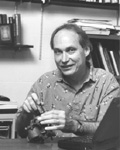
Michael S. Turner is the Assistant Director of the National Science Foundation for Mathematical and Physical Sciences and the Rauner Distinguished Service Professor and Chair of the Department of Astronomy & Astrophysics at The University of Chicago. He received his B.S. in Physics from the California Institute of Technology (1971) and his Ph.D. in Physics from Stanford University (1978).
Turner is a Fellow of the American Physical Society and of the American Academy of Arts and Sciences and is a member of the National Academy of Sciences. Turner has been honored with the Helen B. Warner Prize of the American Astronomical Society, the Julius Edgar Lilienfeld Prize of the American Physical Society, the Halley Lectureship at Oxford University, the Klopsteg Lecture Award of the American Association of Physics Teachers, and the Quantrell Award for Excellence in Undergraduate Teaching at The University of Chicago.
Turner helped to pioneer the interdisciplinary field that has brought together cosmologists and elementary particle physicists to unravel the origin and evolution of the Universe and to understand the unification of the fundamental forces and particles of Nature. His research focuses on the earliest moments of creation, and he has made seminal contributions to inflationary cosmology, particle dark matter and structure formation, the theory of big bang nucleosynthesis, and the nature of dark energy that is causing the expansion of the Universe to speed up. His current research deals with the mystery of cosmic acceleration, which he believes is the most profound mystery in all of science.
Turner has served on and chaired numerous committees for the Department of Energy, NASA, NSF, the American Physical Society, the American Association for the Advancement of Science, the American Academy of Arts and Sciences, and the National Academy of Sciences. The National Academy study, Connecting Quarks with the Cosmos, which he chaired identified opportunities at the intersection of Astronomy and Physics and has shaped the science investment in the US and elsewhere.
[ Press Index ]

Revised: March 12, 2025