

CXC Home | Search | Help | Image Use Policy | Latest Images | Privacy | Accessibility | Glossary | Q&A
For Release: January 10, 2008, 2:00pm CST
CXC Release
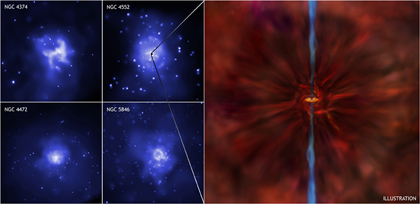
A new study using results from NASA's Chandra X-ray Observatory provides one of the best pieces of evidence yet that many supermassive black holes are spinning extremely rapidly. The whirling of these giant black holes drives powerful jets that pump huge amounts of energy into their environment and affects galaxy growth.
A team of scientists compared leading theories of jets produced by rotating supermassive black holes with Chandra data. A sampling of nine giant galaxies that exhibit large disturbances in their gaseous atmospheres showed that the central black holes in these galaxies must be spinning at near their maximum rates.
"We think these monster black holes are spinning close to the limit set by Einstein's theory of relativity, which means that they can drag material around them at close to the speed of light," said Rodrigo Nemmen, a visiting graduate student at Penn State University, and lead author of a paper on the new results presented at American Astronomical Society in Austin, Texas.
The research reinforces other, less direct methods previously used which have indicated that some stellar and supermassive black holes are spinning rapidly. According to Einstein's theory, a rapidly spinning black hole makes space itself rotate. This effect, coupled with gas spiraling toward the black hole, can produce a rotating, tightly wound vertical tower of magnetic field that flings a large fraction of the inflowing gas away from the vicinity of the black hole in an energetic, high-speed jet.
Computer simulations by other authors have suggested that black holes may acquire their rapid spins when galaxies merge, and through the accretion of gas from their surroundings.
"Extremely fast spin might be very common for large black holes," said co-investigator Richard Bower of Durham University. "This might help us explain the source of these incredible jets that we see stretching for enormous distances across space."
One significant connection consequence of powerful, black-hole jets in galaxies in the centers of galaxy clusters is that they can pump enormous amounts of energy into their environments, and heat the gas around them. This heating prevents the gas from cooling, and affects the rate at which new stars form, thereby limiting the size of the central galaxy. Understanding the details of this fundamental feedback loop between supermassive black holes and the formation of the most massive galaxies remains an important goal in astrophysics.
NASA's Marshall Space Flight Center, Huntsville, Ala., manages the Chandra program for the agency's Science Mission Directorate. The Smithsonian Astrophysical Observatory controls science and flight operations from the Chandra X-ray Center in Cambridge, Mass.
Additional information and images are available at:
http://chandra.harvard.edu
and
http://chandra.nasa.gov
http://chandra.harvard.edu
and
http://chandra.nasa.gov
MEDIA CONTACTS
Jennifer Morcone
Marshall Space Flight Center, Huntsville, Ala.
256-544-7199
jennifer.j.morcone@nasa.gov
Megan Watzke
Chandra X-ray Center, Cambridge, Mass.
617-496-7998
mwatzke@cfa.harvard.edu


Revised: June 08, 2022