



CXC Home | Search | Help | Image Use Policy | Latest Images | Privacy | Accessibility | Glossary | Q&A
For Release: June 21, 2006
NASA RELEASE 06-245
Black holes are lighting up the Universe, and now astronomers may finally know how. New data from NASA's Chandra X-ray Observatory show for the first time that powerful magnetic fields are the key to these brilliant and startling light shows.
It is estimated that up to a quarter of the total radiation in the Universe emitted since the Big Bang comes from material falling towards supermassive black holes, including those powering quasars, the brightest known objects. For decades, scientists have struggled to understand how black holes, the darkest objects in the Universe, can be responsible for such prodigious amounts of radiation.
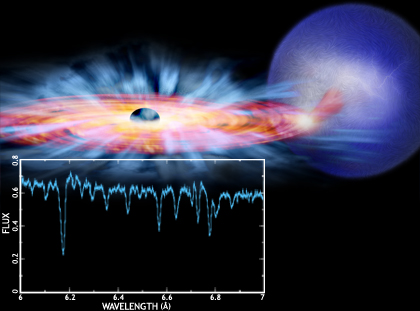
New X-ray data from Chandra give the first clear explanation for what drives this process: magnetic fields. Chandra observed a black hole system in our galaxy, known as GRO J1655-40 (J1655, for short), where a black hole was pulling material from a companion star into a disk.
"By intergalactic standards J1655 is in our backyard, so we can use it as a scale model to understand how all black holes work, including the monsters found in quasars," said Jon M. Miller of the University of Michigan, Ann Arbor, whose paper on these results appears in this week's issue of Nature.
Gravity alone is not enough to cause gas in a disk around a black hole to lose energy and fall onto the black hole at the rates required by observations. The gas must lose some of its orbital angular momentum, either through friction or a wind, before it can spiral inward. Without such effects, matter could remain in orbit around a black hole for a very long time.
Scientists have long thought that magnetic turbulence could generate friction in a gaseous disk and drive a wind from the disk that carries angular momentum outward allowing the gas to fall inward.
Using Chandra, Miller and his team provided crucial evidence for the role of magnetic forces in the black hole accretion process. The X-ray spectrum, the number of X-rays at different energies, showed that the speed and density of the wind from J1655's disk corresponded to computer simulation predictions for magnetically-driven winds. The spectral fingerprint also ruled out the two other major competing theories to winds driven by magnetic fields.
"In 1973, theorists came up with the idea that magnetic fields could drive the generation of light by gas falling onto black holes," said co-author John Raymond of the Harvard-Smithsonian Center for Astrophysics in Cambridge, Mass. "Now, over 30 years later, we finally may have convincing evidence."
This deeper understanding of how black holes accrete matter also teaches astronomers about other properties of black holes, including how they grow.
"Just as a doctor wants to understand the causes of an illness and not merely the symptoms, astronomers try to understand what causes phenomena they see in the Universe," said co-author Danny Steeghs also of the Harvard-Smithsonian Center for Astrophysics. "By understanding what makes material release energy as it falls onto black holes, we may also learn how matter falls onto other important objects."
In addition to accretion disks around black holes, magnetic fields may play an important role in disks detected around young sun-like stars where planets are forming, as well as ultra-dense objects called neutron stars.
NASA's Marshall Space Flight Center, Huntsville, Ala., manages the Chandra program for the agency's Science Mission Directorate. The Smithsonian Astrophysical Observatory controls science and flight operations from the Chandra X-ray Center, Cambridge, Mass.
Additional information and images can be found at:
MEDIA CONTACTS
Erica Hupp/Grey Hautolauma
Headquarters, Washington
(Phone: 202/358-1237/0688)
Megan Watzke
Chandra X-ray Center, Cambridge, Mass.
(Phone: 617/496-7998)


Revised: March 25, 2008