



CXC Home | Search | Help | Image Use Policy | Latest Images | Privacy | Accessibility | Glossary | Q&A
February 03, 2006
CXC release: 06-01
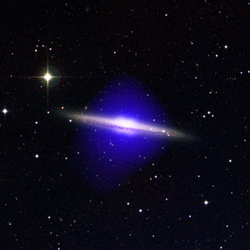
Scientists using NASA's Chandra X-ray Observatory have detected an extensive halo of hot gas around a quiescent spiral galaxy. This discovery is evidence that galaxies like our Milky Way are still accumulating matter from the gradual inflow of intergalactic gas.
"What we are likely witnessing here is the ongoing galaxy formation process," said Kristian Pedersen of the University of Copenhagen, Denmark, and lead author of a report on the discovery.
Chandra observations show that the hot halo extends more than 60,000 light years on either side of the disk of the galaxy known as NGC 5746. The detection of such a large halo alleviates a long-standing problem for the theory of galaxy formation. Spiral galaxies are thought to form from enormous clouds of intergalactic gas that collapse to form giant, spinning disks of stars and gas.
One prediction of this theory is that large spiral galaxies should be immersed in halos of hot gas left over from the galaxy formation process. Hot gas has been detected around spiral galaxies in which vigorous star formation is ejecting matter from the galaxy, but until now hot halos due to infall of intergalactic matter have not been detected.
"Our observations solve the mystery of the missing hot halos around spiral galaxies," said Pedersen. "The halos exist, but are so faint that an extremely sensitive telescope such as Chandra is needed to detect them."
NGC 5746 is a massive spiral galaxy about a 100 million light years from Earth. Its disk of stars and gas is viewed almost edge-on. The galaxy shows no signs of unusual star formation, or energetic activity from its nuclear region, making it unlikely that the hot halo is produced by gas flowing out of the galaxy.
"We targeted NGC 5746 because we thought its distance and orientation would give us the best chance to detect a hot halo caused by the infall of intergalactic gas," said Jesper Rasmussen of the University of Birmingham, United Kingdom and a coauthor of the report. "What we found is in good agreement with computer simulations in which galaxies are built up gradually from the merger of smaller clouds of hot gas and dark matter."
The computer simulations were done by Jesper Sommer-Larsen (also a coauthor of the report) and collaborators at the University of Copenhagen. The paper describing these results will be published in the April issue of the journal New Astronomy. Other researchers on this project were Sune Toft, Yale University; Andrew Benson, University of Oxford, United Kingdom; and Richard Bower, University of Durham, United Kingdom.
NASA's Marshall Space Flight Center, Huntsville, Ala., manages the Chandra program for the agency's Science Mission Directorate. The Smithsonian Astrophysical Observatory controls science and flight operations from the Chandra X-ray Center in Cambridge, Mass.
MEDIA CONTACTS
Steve Roy
Marshall Space Flight Center, Huntsville, Ala.
(Phone: 256/544-6535)
Megan Watzke
Chandra X-ray Center, Cambridge, Mass.
(Phone: 617/496-7998)


Revised: March 24, 2008