



CXC Home | Search | Help | Image Use Policy | Latest Images | Privacy | Accessibility | Glossary | Q&A
January 10, 2006
NASA HQ release: 06-006
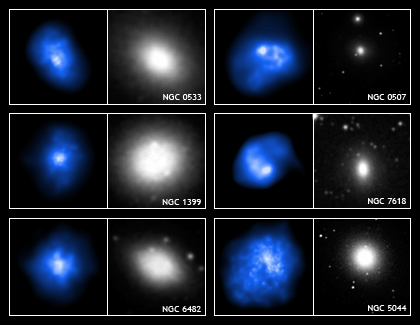
Black holes are creating havoc in unsuspected places, according to a new study of images of elliptical galaxies made by NASA's Chandra X-ray Observatory. The discovery of far-reaching explosive activity, due to giant central black holes in these old galaxies, was a surprise to astronomers.
The Chandra data revealed an unsuspected turmoil in elliptical galaxies that belies their calm appearance in optical light. Astronomers believe massive clouds of hot gas in these galaxies have been stirred up by intermittent explosive activity from centrally located super-massive black holes.
"This is another example of how valuable it is to observe the universe at different wavelengths besides just the traditional optical wavelengths," said NASA's Chandra Program Scientist Wilt Sanders. "Without these X-ray and radio observations, we wouldn't know these apparently static galaxies in reality are still evolving due to the interaction with their central black holes."
These results came from an analysis of 56 elliptical galaxies in the Chandra data archive by associate professor Thomas Statler and doctoral candidate Steven Diehl, both of the Physics and Astronomy department at the Ohio University, Athens, Ohio. Contrary to expectations, they found the distribution of the multimillion-degree gas in these galaxies differed markedly from that of the stars.
"Most elliptical galaxies have traditionally been considered to be quiet places, like placid lakes," Statler said. "Our results show these galaxies are a lot stormier than we thought."
Previous X-ray studies have shown elliptical galaxies contain multimillion degree gas whose mass is a few percent of the stars in it. Except for rare cases, violent activity in elliptical galaxies was thought to have stopped long ago. It was expected the hot gas would have settled into an equilibrium shape similar to, but rounder, than the stars. High angular resolution imaging observations by Chandra indicate otherwise.
"We found the distribution of hot gas has no correlation with the optical shape," Diehl said. "Something is definitely making a mess there, and pumping energy equivalent to a supernova every century into the gas."
Although supernovae are a possible energy source, a more probable cause was identified. The scientists detected a correlation between the shape of the hot gas clouds and the power produced at radio wavelengths by high-energy electrons. This power output can be traced back to the centers of the galaxies, where super-massive black holes are located.
Repetitive explosive activity fueled by the in-fall of gas into central black holes is known to occur in giant elliptical galaxies located in galaxy clusters. Statler and Diehl's analysis indicates the same phenomena are also occurring in isolated elliptical galaxies.
"These results are part of an emerging picture that shows the impact of super-massive black holes on their environment is far more pervasive than previously thought," Statler said.
NASA's Marshall Space Flight Center, Huntsville, Ala., manages the Chandra program for the agency's Science Mission Directorate. The Smithsonian Astrophysical Observatory controls science and flight operations from the Chandra X-ray Center, Cambridge, Mass.
Chandra researchers presented their data today during the 207th meeting of the American Astronomical Society in Washington. For Chandra Images and information on the Web, visit:
For information about NASA and agency programs on the Web, visit:
MEDIA CONTACTS
George Deutsch/Erica Hupp
Headquarters, Washington
(Phone: 202/358-1346/1237)
Steve Roy
Marshall Space Flight Center, Huntsville, Ala.
(Phone: 256/544-6535)
Megan Watzke
Chandra X-ray Center, Cambridge, Mass.
(Phone: 617/496-7998)


Revised: March 25, 2008